

Spoiler Alert: This story contains spoilers from the series premiere of “Stuart Couldn’t Save the Universe,” now streaming on HBO Max.
HBO Max’s “Stuart Couldn’t Save the Universe” begins in post-apocalyptic Pasadena. In this world, zombie hands protrude from the ground, giant moths terrorize, and in reality, random tears act as vacuum portals to uncharted parts of the galaxy, where survivors barter for the last remaining canned goods.
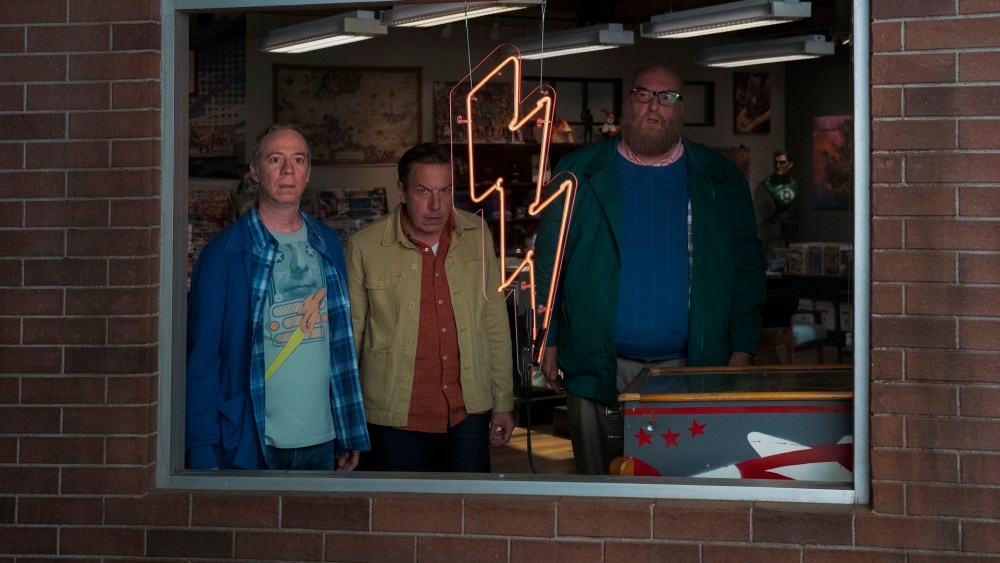
The only comic shop still open is the one run by Stuart Bloom, played by Kevin Sussman. The gang from “The Big Bang Theory” sometimes hung out there. However, even that store is no longer normal, and a fight between regular customers and otakus quickly escalates into a dangerous situation. It’s not a great place, so when another Stuart from another dimension arrives, the protagonist’s quest to save the universe begins.
According to Alt Stuart, it was the characters Leonard, Sheldon, and Howard from “The Big Bang Theory” who built the reality-altering quantum interference device. Regulars Stuart and Bart (Brian Posen) embark on a journey to find the device at Caltech, but along the way, they reunite with Dennis (Lauren Lapkus) and learn that Kripke (John Ross Bowie) has become the leader of an evil gang that controls much of the San Gabriel Valley. They also find Raj (Kunal Nayyar), who has been imprisoned by Kripke for quite some time and tries to help repair the device.
They are all captured, but Bart uses his geological expertise to create a bomb with rocks and water to reach the device. All is saved until Kripke kills Raj, but then the device is activated and Stuart, Bart, and Kripke are taken to another world.
So how much of the show’s pluralistic world can be explained by science? Sussman believes co-creator Bill Prady understands how science works. “There’s a lot of quantum physics involved in the show, and Bill is an expert on quantum physics theory,” Sussman said. “A lot of things get away with it, because at the end of the day, it’s a theory. It’s a general theory, but it’s valid. So I ask him questions like, ‘How can my character be here and there at the same time?’ And then, at some point, I had an epiphany when I realized, oh, wait, this isn’t just a parallel universe, it’s a parallel universe with a little bit of time travel mixed in. ”
Sussman said that while filming the show, there were points that helped him understand the quantum physics theory behind what was happening in certain scenes.
“I’m looking forward to people on Reddit trying to analyze what’s going on, because I know everything is debatable,” he added. “On set, I tried to poke holes in it, and Bill always explained to me, ‘No, look, the reason this makes sense is because A, B, and C.'”
Prady explains that the device built by Leonard, Sheldon and Howard seems to have transported the main characters to a universe with a separate and distinct history, with apocalyptic events taking place after “The Big Bang Theory” and before we meet them.
“This is where Einstein’s problem comes in, that time is a fourth dimension,” he says. “Because when the device malfunctions, it changes reality, but it also creates a new past. So when we meet them in the first episode, the apocalypse is years in the past, and it’s the result of alteration. The past, present, and future have been altered from what they were meant to be.”
So the question is, when characters move between universes, does the universe they left still exist or is it being rebuilt?
“It’s vague, they don’t know, we don’t know,” he says. For example, now that Kripke killed Raj, I don’t think that’s good, right? But in episode 2, he points out that either the universe they just left no longer exists, in which case he didn’t kill Raj because Raj didn’t exist, or they’re dealing with an infinite number of universes, so he just killed one Raj out of an infinite number, which is pretty trivial.
However, “The multiverse bifurcation theory essentially states that every quantum event that can go in one direction can also go in the other direction, at which point there is a bifurcation and both universes exist next to each other. The theory says that because the universes diverge at every decision point, there is an infinite number of rapidly growing universes. This allows some The very annoying realization arises that the infinities of are larger than other infinities, which is mathematically true and conceptually unpleasant. But it would be stating it in terms of large things. “Bang, the number of infinite parallel universes increases with each passing moment of the universe was the kind of science and pseudoscience that explains this. ”
Prady jokingly added: “How useless is that?”
But this is a reminder that “Stuart Couldn’t Save the Universe” may be science fiction, but in some ways it’s grounded.
“When I was teaching at USC and someone had a project that had fantasy elements, I think the most important rule in writing fantasy is that the rules you create for fantasy have to be as realistic as the laws of physics. The rules have to be consistent, they always have to be the same,” he says.
Prady uses the example of “Bewitched,” which has an arbitrary rule that only the witch who cast the spell can break it. “It’s not based on anything, but it keeps each episode of Enchanted from being three minutes long,” he says. “Because if we didn’t have that rule, Endora would give Darin donkey ears, Samantha would take them away, and that would be the end of us. Now, can your universe ever fall apart at the edges? 100%. And that’s ‘Doctor Who.’ There are rules, but sometimes things don’t work out. The doctor will explain. ”
In the case of the multiverse, the parameters of what we think of as a “multiverse” have been cemented in pop culture by Marvel movies, “Rick and Morty,” “Dark Matter,” and more. “I think the reason we end up with multiverses with similar stories is because there’s this notion that multiverses exist mathematically. Things like string theory touch on that. So you can build on things that are pervasive in the public consciousness.”
Prady says that not everything makes sense and is proud of the fact that his characters acknowledge that.
“Some guy online gave us a scientific breakdown of what must be going on in this and explained all the different scientific multiverse theories that we’re obviously drawing from,” Prady says. “That was thick science. It certainly said there was an infinite multiverse. So obviously we should send that article to HBO Max and say, ‘Look, there’s a scientific basis for adding a season!'”
