

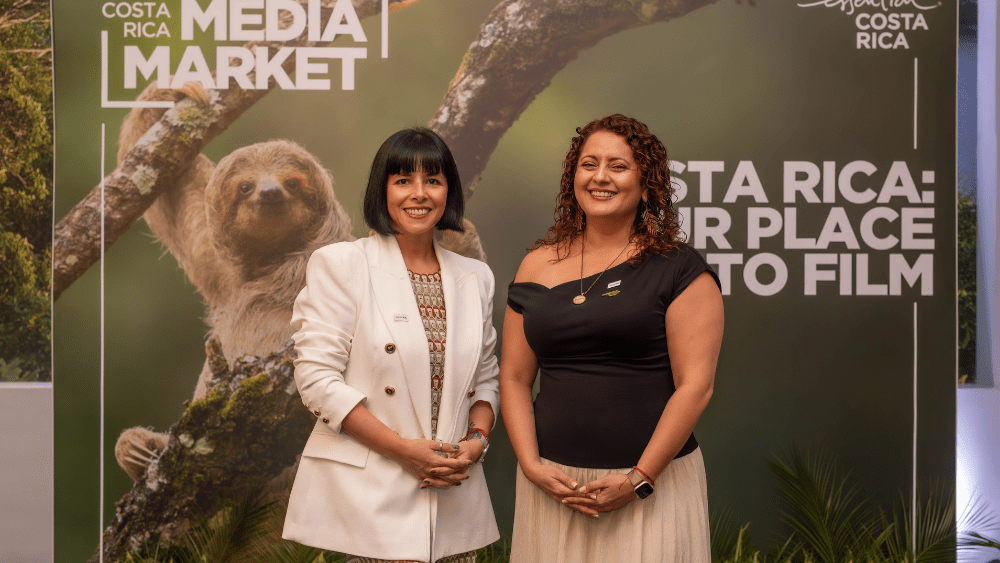
The Ibero-American Film Commissions Network, a non-profit organization that brings together film commissions and film offices from all over Ibero-America, held the Costa Rican Media Market for the first time this year to reaffirm its strategic commitment to the development of the audiovisual ecosystem in Central America and the Caribbean.
IBEROFIC Founder and President Carolina Cordero attended the fast-growing industry event in San Jose on July 14-15, where she held a series of meetings with producers, association representatives, and key players in the region’s industry. Organized by the Film Commission of Costa Rica, the Trade and Investment Promotion Agency (Promocomer) and the Tourism Agency Essential Costa Rica, CRMM aims to strengthen its position as an important platform for regional projects in the international market. The event will be led by Costa Rican Film Commissioner Maricela Zamora.
Other participants in the Costa Rica Media Market included Charlie Sextro, Senior Vice President of Acquisitions and Business Development at Utopia Distribution; Michael Woolston, physical production manager at Walt Disney Studios. Sandino Sarabia, Executive Director of Cimarron Cine. and MrBeast’s Mr. Ari Cheren of Beast Industries.
“One of the most exciting developments this year is the convergence of different perspectives in the industry,” Zamora told Variety ahead of the event’s kickoff. “We welcome a new generation of producers working at Disney, Mr. Beast and Hollywood, as well as top players from countries like Mexico and Colombia, two of the strongest audiovisual industries in the region. Putting them in dialogue with talent from Central America and the Caribbean creates a unique space for new ideas, partnerships and a more connected regional industry.”
During the market, Mr. Cordero met with Mr. Zamora, who is also a member of the IBEROFIC Board of Directors, to develop initiatives aimed at promoting co-production, attracting investment, creating professional jobs, and strengthening regional capacity through training programs, project advisory services, scholarships, and working groups.
The participation in Costa Rica’s media market is part of IBEROFIC’s expansion strategy, which aims to strengthen regional cooperation, foster new co-productions and strengthen the development of film commissions.
Commenting on IBEROFIC’s commitment to developing industry in Central America and the Caribbean, Mr. Cordero said the region has “all the ingredients to become one of the most attractive regions for international audiovisual production: incredible locational diversity, creative talent, an increasingly specialized industry, and a clear willingness to work collaboratively.”
“At IBEROFIC, we believe that audiovisual development depends not only on incentives, but also on cooperation between countries, the strengthening of film commissions and the creation of regional strategies that enable global competitiveness,” Cordero concluded.
With more than 150 members across Ibero-America, IBEROFIC continues to establish itself as the region’s leading facilitator, bringing together regions, producers and institutions, thereby promoting a more integrated, competitive and sustainable audiovisual industry.
Cordero’s visit to Costa Rica will have an impact on the broader picture in Latin America, as more countries introduce tax breaks and incentives. Mexico announced on February 15 that up to 30% of eligible domestic production and post-production expenditures will be exempt from income tax (ISR), joining countries like Costa Rica in ramping up fiscal efforts to attract international productions and strengthen local industry.
In this scenario, co-productions are rapidly increasing in the region, especially between Latin American countries.
Several co-productions between Costa Rica, Panama and Guatemala were shown at this year’s CRMM, and producers expressed their desire to continue cooperation within Central America, as well as strengthen ties with neighboring countries to the south such as Colombia, Brazil and Argentina.
The movement emphasizes the need for well-structured film commissions to support projects that foster new partnerships at national, regional and local levels. With European countries increasing their offers as well, and markets such as Saudi Arabia and Jordan experiencing rapid growth in attracting large-scale productions, Latin American film commissions and audiovisual organizations are working more closely together to make the continent and cultural region more attractive for ever-larger productions.
