

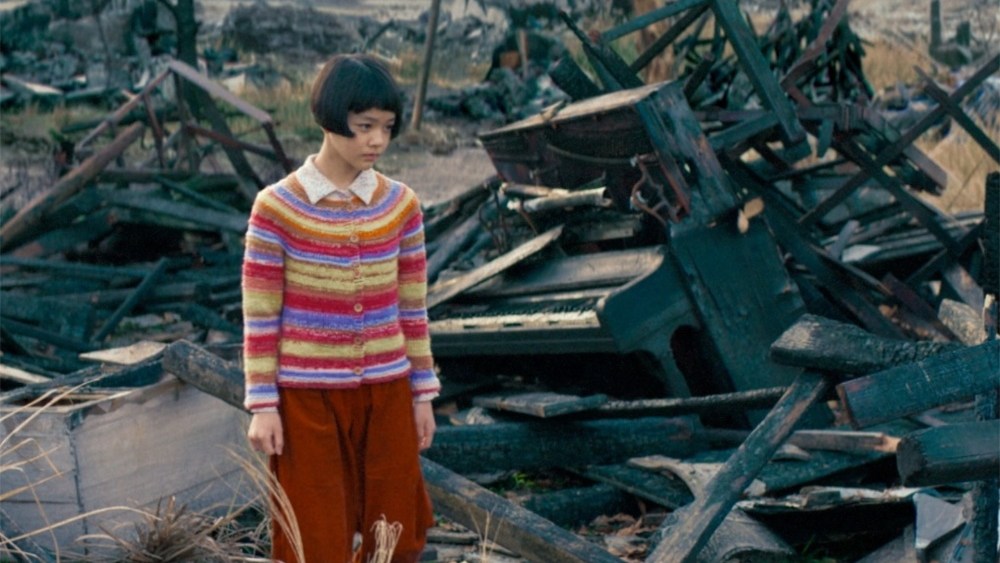
Italian distributor Intra Movies has acquired worldwide rights to the Japanese film Children Untold, a World War II-era historical drama produced by Daiki Koide and written and directed by Miwa Nishikawa, for Japan’s K2 Pictures.
Set in Tokyo at the end of and just after World War II, the film follows a 12-year-old orphaned girl, the daughter of a musician, who disguises herself as a man to survive the underworld, while her former teacher, haunted by guilt and his own need for survival, follows his own path.
The film is in the final stages of post-production and is aiming for a world premiere in late summer or fall of this year. Theatrical release in Japan is scheduled for October 2026, with K2 handling distribution both domestically and in the Asia-Pacific region.
Nishikawa is considered one of Japan’s most acclaimed new generation contemporary novelists and film directors. She began her career as an assistant on Afterlife (1998) under the guidance of director Hirokazu Kore-eda, and made her directorial debut with Wild Berry (2003). Her second feature, Sway (2006), about two brothers with contrasting temperaments, premiered at the 59th Directors’ Fortnight in Cannes. She won the Japan Academy Award for Best Original Screenplay for Dear Doctor (2010), and her films have since been screened at major international film festivals including Toronto, Busan, London, and Rome. His latest work is “Under the Open Sky” (2020).
The music was composed by Marihiko Hara, who won the Japan Academy Prize for the soundtrack of Kokuho (2025), which was recently submitted to the Academy Awards. The music was recorded in Italy with the Rome Film Orchestra. Photographed by Norimichi Kasamatsu, edited by Tomomi Kikuchi. Both previously collaborated with Nishikawa on “Under the Open Sky.”
Jeremiah Biagiotti, Sales, Marketing and Acquisitions Manager at Intramovies, said: “We are honored to begin this collaboration between K2 and director Miwa Nishikawa, whose intimate depiction of the resilience of childhood and the stark human cost of war. Told with a keen eye and classic rigor, this is a universal film rooted in a uniquely Japanese wound. “The Forbidden Game” has echoes of “Oliver Twist” and also resonates with recent works such as “Nobody Knows” and “Capernaum.” The film will connect with arthouse audiences of all ages and will be featured at major international film festivals around the world. ”
Director Nishikawa said, “I was born in Hiroshima, and some of my family members experienced exposure to the atomic bomb.I grew up in an environment that was still deeply affected by the war, and when I was young, I tended to avoid tackling such heavy themes.However, I have been active as a creator for over 20 years, and through this work, I have finally found my own way of dealing with the subject.”
“I first started thinking about this project during the pandemic of 2020. Then came the Russian invasion of Ukraine, followed by the escalation of conflict between Palestine and Israel. More recently, conflicts continue in Sudan and across the Middle East. Civilian homes, schools and hospitals have been bombed, many parents and children have lost their lives, and countless others have lost their livelihoods. (…) The catastrophe that occurred in Japan 80 years ago has since felt almost like a distant myth, but it is still happening all over the world.
Director Koide said, “When I first encountered this script, I was immediately struck by the presence of the main character, Kotoko.After the defeat in the war, when all values are suddenly turned upside down, the girl who lost her parents has to let go of her identity as a woman, the music she loved, and even the name her parents gave her in order to survive.I really want to follow where her journey takes her.”
He added, “This film was made as a silent prayer so that no more children would have to live in this situation, and that this prayer would live on as something that will remain in Kotoko’s eyes forever.”
