

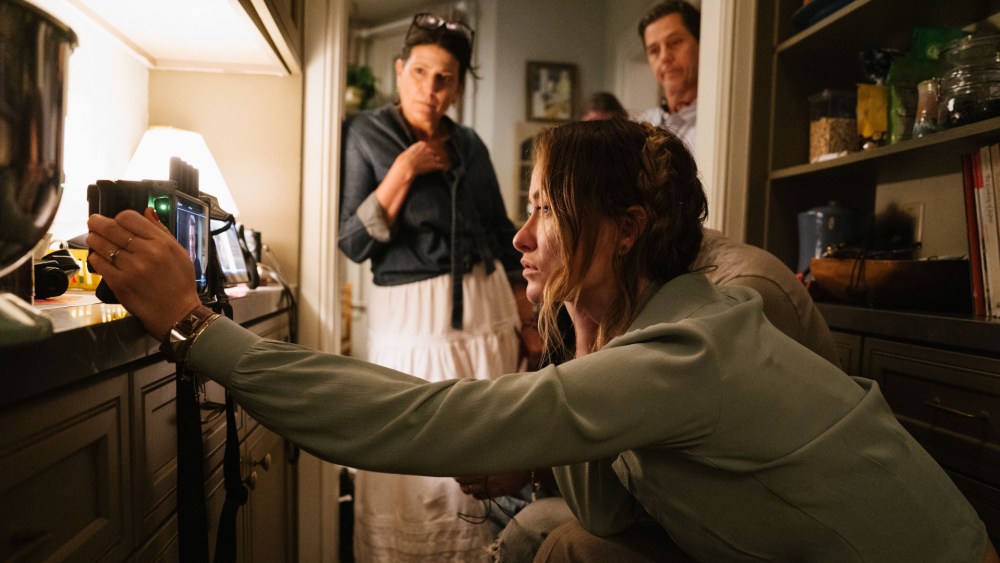
Olivia Wilde did almost everything she wasn’t supposed to do to make “The Invite.”
She shot her third feature as a director, scene by scene, in story order, in a tight 21 days, a luxury that most directors give up by the first morning of pre-production. She was also able to capture it on film. Needless to say, the entire setting of the film is confined to a single apartment in San Francisco, so she could rehearse it like a play, asking her cast to work for free for six weeks to continue the experiment.
The result is a claustrophobic chamber comedy in which two couples are trapped in one house for an intense night they’ll never forget. And when the offer came after its splashy premiere at Sundance, Wilde knew one thing about where the film wasn’t going.
“Every distributor wanted to release this movie in theaters, but I was adamant that I would not go to a distributor,” she told Variety. “Everyone who wasn’t a streamer wanted to show it in theaters, too. That’s a really good sign for everyone.”
It’s a sharp stance from a filmmaker who has watched streaming giants reshape Hollywood’s business, which she sees as part of a larger shift in favor of independent films. Box office revenues, she argues, are rising because of the precise audience power that platforms capture. The generation that wasn’t counted, or Gen Z, is on the rise, embracing authorship and rejecting the idea that young viewers only watch at home.
If Wilde sounds liberated, it’s because she’s already experienced failures that would paralyze most directors. Her 2019 indie comedy “Booksmart” received near-unanimous praise. Her 2022 drama “Don’t Worry Darling” was criticized by critics and the public. She accepts that pendulum swing as the best thing that could have happened to her.
“I believe in early failures,” she says. “Once you get past that, it’s liberating, like Don’t Worry Darling, which got 38% on Rotten Tomatoes.”
That freedom and philosophy seemed to run straight through The Invite, a film she made by focusing on process over results and surrounding herself with collaborators willing to do the impossible on a compressed schedule.
In just one week, production designer Jade Healy conjured up this apartment, a maze of walls, frames within frames, and “rear window” sightlines. Costume designer Arianne Phillips dyed Wilde’s blouse to match the walls, making her character almost disappear into the home she sacrificed her ambitions to protect. And her scene partner Seth Rogen, during what Wilde calls the peak of his career, has given performances that draw comparisons to Albert Brooks and 1980s Richard Dreyfuss, along with Edward Norton and Penelope Cruz.
Beneath its comedy, the A24-distributed film is also a study of how an unhappy couple projects onto those who should have stayed married, a structural sleight of hand that Wilde is happy to unravel for those who see it.
On Zoom with Variety, she talked about the gamble of filming back-to-back, the apartment where she became the fifth character, her battle with a streamer who refused to give up, and the moment she knew Rogen was doing her best work.
Spoiler Alert: This Q&A contains spoilers for “The Invite,” now playing in select theaters.

“Invitation”
Provided by Sundance Film Festival
“Booksmart” came out of the gates topping raves, and “Don’t Worry Darling” was a smash. With this work, do you feel like you’ve finally let go of your nervousness as a director?
I was very happy that you felt that way. I don’t know if anyone feels that there is no tension at all. Still, I think I’ve reached a level of self-awareness that can only come from realizing that the only way to accomplish anything worthwhile is to throw yourself fully into it. Risk is what matters. That’s the reward.
I believe in early failure. The first pilot I produced was canceled after three episodes. There were a lot of challenges early on, but I think they taught me to have calm expectations about Hollywood. “Booksmart” has been a blessing, but it also sets certain expectations for yourself when it comes to connecting with your audience, and you forget how subjective it is. So my next movie got a 38 on Rotten Tomatoes. And I’m pondering how healthy it is to be reminded of how fickle everything is. You have already experienced something that strikes fear into the hearts of directors. What if they don’t like it? Once you get over it, you’ll be free.
This movie was shot in 21 days. Is it true that you took the pictures in succession?
It’s not a rumor, it’s the truth. It took 21 days on stage, followed by two days on location for the footage seen in the opening title sequence.
How and why?
For a long time I was looking for a material that would allow me to have this experience of photographing something in sequence. That’s not all. As anyone who has ever made a film knows, rehearsal time is the first thing we give ourselves. It’s amazing how most of what we see in movies is the first pancake. People strive for that, and I really respect those who have done it. But I always wondered what would happen if I gave this time to marinate.
That’s what the managers I respect have always done. Mike Nichols’ “Who’s Afraid of Virginia Woolf” was my North Star. I wanted to approach it like a play. We rehearsed it, we only had one set, so we shot it in sequence, and we shot it on film, which was my third dream. But we needed the actors’ cooperation because they needed to be fully involved in the process. The film earned $0 for six weeks. When working with busy actors, it’s easy to find yourself concentrating here and there for days on end, which ultimately prevents you from filming or building a Rubik’s Cube. I wanted everyone to be involved in every step of the process, from rehearsal to the end of filming, and this cast was incredibly generous with their time and energy.
Since I have a hypothesis, let’s talk about the ending. The way it was cut, the way it stopped and started suddenly, it read like the other couple weren’t actually there. am I right?
(Raises hands in celebration) That’s my interpretation and that was the intention. You know which scene is against the rules? There’s a moment where Hawk goes into the bathroom and is alone in the medicine cabinet. Otherwise, you can’t experience those characters without Joe and Angela.
I’m glad you felt that, because for me it goes both ways. The couple reached a burn point in an early argument, eventually saying the words “miserable” that triggered them to project their emotions onto the other two. There’s something game-changing about acknowledging your unhappiness. We can endure long periods of time with our dissatisfaction expressed only through passive-aggressiveness or verbal abuse, but when someone looks you in the face and says, “I’m miserable in this relationship,” that’s often the point where you either fix it or fail.
We project people who teach us lessons. They are, in many ways, the ideal partners we can imagine. But imagining the ideal other is part of understanding what you actually want and deserve. Looking back, there aren’t many clues. Should people who are not reflected in the mirror be reflected in the mirror? Do you have wine glasses? Small things. It works even if you don’t buy it at all.
This may be Seth Rogen’s finest moment as an actor. Thankfully, someone saw what I could do.
It means a lot to me because I respect Seth. Not only is he smart in the way he writes and creates, like any great actor, but he also has a connection to the audience experience that I’ve never witnessed before. He knows in his bones when an audience is being underserved or overserved. He reduces everything to its simplest form. He never overcomplicates things. He’s allergic to overblown approaches to everything.
This movie allows us to see a side of him that comes from reaching a place like Albert Brooks or Richard Dreyfuss in the 1980s. He has qualities that are rare in this era. And he makes everyone in the scene better. He’s just an extraordinary person.
The production design surprised me. The house is the fifth character. Please tell us about Jade Healy.
Jade is exceptionally talented and quickly understands what a place is really like. She understood that even though it was one apartment, there were several small spaces and it could feel like a maze. She designed the entire set over one weekend. I spoke with her on Thursday and had a complete design by Monday.
She said she intends to create frames within frames, using architecture as emotional blocks, barriers, and boundaries between people. mirrors, glass, windows. She thinks the tight air shaft design can provide an additional vantage point, and the characters witness something in a very intentional “Rear Window” style, voyeuristic way of breaking into other apartments through windows.
In the original script, the house had an open floor plan. The idea was that there was no place to hide. we changed that. We created hiding places, hallways, offices, nooks, and bedrooms so that the four of us could split into two and do two small rendezvous at the same time, called house tours. Jade created a space where she felt the danger of being so close to her partner, but still had the privacy to have secret conversations. Once you know the space you are trying to exist in, you can tell a unique story about what is allowed in that space.
This house inspired me as a character to represent the house that Joe grew up in. The house Joe grew up in was far beyond today’s economic means, with the bones of an expensive home and the skin of people living right on the edge.
I would like to give a shout out to the cinematographer, Adam Newport-Bera. Because he’s really working hard right now. He and his crew are extraordinary. That’s the most exciting DP right now, and you can see that in “The Invite.”
And then there’s Steve Morrow, the sound mixer. The second time we worked together, I told him I wanted everyone to talk like they were in a Robert Altman movie. I wanted us to improvise and didn’t want anyone to be told to hold up to someone else’s lines. He mixes everything live, and it’s great when viewers say they like the natural feel of everyone talking, even when the dialogue overlaps. That’s pretty much what I think works.
Your character Angela almost disappears into the wall.
That was intentional. Thank you to costume designer Arianne Phillips who dyed my blouse to match the wall perfectly. It creates the almost unconscious effect that Angela has little or no identity outside of this house. She gave up her dream of becoming an artist to support her family and become a housewife, and instead of delving deeper, much of her life was spent on cushions and lamps.
After the festival, the distributor called. What was the line in the sand?
Every distributor wanted to release this movie in theaters, but I was adamant about not going to a streamer. All the non-streamers really wanted it in theaters. I think that’s a really good sign for everyone.
With AI and everything going on in the world, there’s good reason why people are worried about this industry. But there are also really positive things happening. We’re seeing that at the box office. The streaming giant has seen a 30% increase in generations counted. They said that Gen Z doesn’t want to watch movies in theaters, but we’re now completely rejecting that and embracing authorship. What we’re seeing is independent films, independent studios, independent companies winning by saying, “We’re going to take a different approach.” There is an appetite for feature films and comedies. Audiences are very willing to support independent filmmakers, and that’s good for all of us.
