

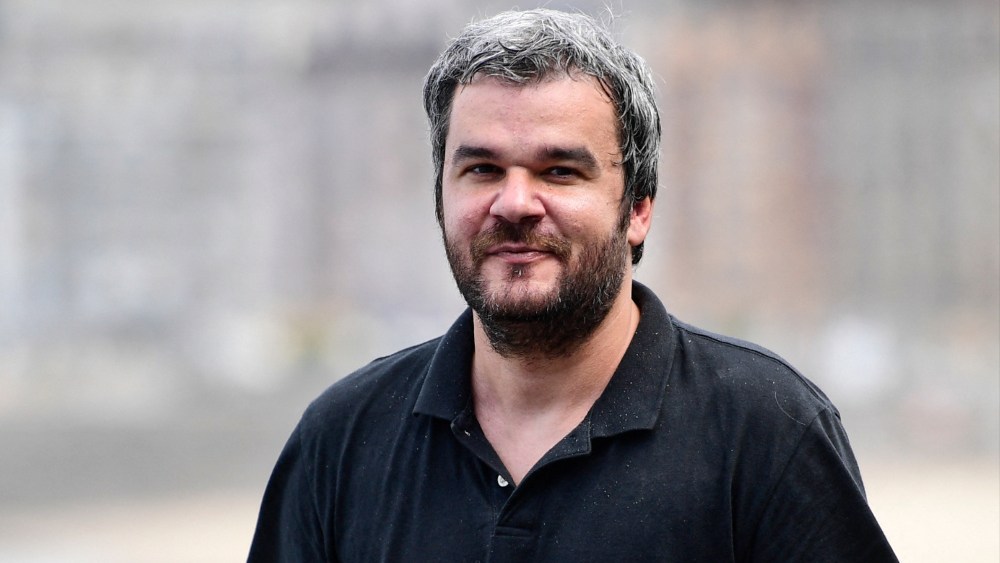
At this week’s Karlovy Vary Film Festival, Greek director Christos Nikou was added as a mentor to 10 participants in Future Frames, a program for young European directors. Variety magazine sat in on their discussion.
Nikou, who directed “Apples” and “Fingernails,” began by emphasizing the importance of “finding your own voice” for filmmakers. He said, “The best compliment I’ve ever heard about the things I do is that they have a very unique tone and identity. It’s not what I set out to do, but somehow it comes from my heart, my soul.”
“How do you find your voice?” he asked, adding, “I feel like a lot of filmmakers are trying to follow what the Film Fund needs and what the film festivals need.”
He continued, “I never call myself a director. I call myself a cinephile. And the reason I do this is because I love watching movies.”
Nikou, who likes to watch three movies a day, said that even if you don’t know who a movie’s director is before you watch it, you can tell within the first five to 10 minutes, and he loves discovering “really unique voices and unique identities.” He added, “That’s our goal: to create a unique voice.”
He said “Apples” was rejected by foundations and festival workshops in several countries because they did not understand the atmosphere of the film. “This is a subtle film. They were able to get the idea, but it’s very difficult to explain it in tone, script, so sometimes you have to make a short film first,” he said.
Young filmmakers often said that the likes of Martin Scorsese and Quentin Tarantino were their favorite directors, but he said what they pitched was more like “poverty porn,” which he found “very, very boring.” “So we can tell more interesting stories. We can tell stories not only about what we see, but also about what we love. So for me, it’s very important that filmmakers make films that are very close to their hearts and what exactly they like to see in movies.”
Nikou did not attend film school and is self-taught. Three of his favorite filmmakers were also self-taught. “So I said, if they can do it, I can do it too. My school was about the movies I watched.” His tastes in movies range from “The Chinese Bookie Killer” to “Lovers on the Bridge,” but he says it was “The Truman Show” that made him want to become a director. It’s a movie that I felt had the perfect balance of drama, and how you can make something that’s conceptual yet grounded, and it’s also an amazing prophecy about our lives. So it still works perfectly, and it’s a movie that I really love.”
Nikou added that for the past 15 to 20 years, films have suffered from a lack of originality. “The reason is that all these stupid executives think they know what they’re doing, but they really don’t at all, and they’re just playing it safe. And the point is, we don’t have to listen to them. We have to protect what we have in our hearts. That’s the hardest thing.”
He continued, “They always put you in a box. When I did ‘Apples,’ I signed with an American manager and then I signed with an agent. And the first script I got was about memory. And I thought, ‘What the heck? I’ve already done a movie about memory and I don’t want to do another movie.'”
Nikou emphasized the primacy of the audience. “I’m not a big fan of filmmakers who are doing things that benefit themselves and their friends. They’re very self-centered. I feel like you need to think about your audience and put yourself in the audience’s shoes. You have to have yourself as a filmmaker and yourself as an audience, and combine the two.”
“There are filmmakers who just want to challenge the audience and want to feel very provocative, but to be honest, what I’m missing in films is gentle films, and films that come from the heart. That’s the easiest thing in the world to provoke. The important thing is to figure out how you can make something authentic and gentle and avoid all this pretentiousness that happens so often in film.”
Nikou was in charge of the final cut for “Fingernails,” which was featured on Apple TV. He encouraged young filmmakers to fight for it, but acknowledged that recognition is rare, especially for projects shot for American studios and streamers.
For “Apples,” Nikou worked on a budget of just $250,000, while for “Fingernails” he spent between $10 million and $12 million. He commented that the additional costs associated with complying with union rules in North America would mean that money would be spent further in Europe. “Europe makes movies in a much more efficient way,” he said.
“For example, in ‘Fingernails,’ there was a scene where we had three make-up artists and three hair stylists in a two-person house and they were just sitting there. There were 120 people on the film crew, 10 grip people, 10 electric and lighting people, and I was like, ‘Oh my God, why are all these people here?'” he said.
“It’s the union rules that you have to follow there. So the problem is (in the US) there’s not a lot of money going to the screens. That’s a good thing in Europe.”
For Nikou, the shift in focus from Greece to North America was facilitated by signing a deal with manager Jerome Duboz, CAA as agent, and Cate Blanchett as executive producer before Apples premiered.
“When you have an agent and a manager and something like this is going on, they always arrange a meeting with an American producer and ask you what you want to do next. But at the same time, I’m trying to figure out how to stay true to my vision, how do I want to tell the story, and who can somehow create a family and continue working with them. ”
Nikou confessed that although he was never a fan of film awards, the money he received for “Apples” allowed him to continue as a director. “I don’t think there’s anything more stupid than awards. We all love movies, so in a way there’s no point in competing. When I first started getting awards, in a way I was very uncomfortable and not happy. I was like, is my ego happy? Why are you giving me awards now? I’ve been a judge many times, and most of the time the judges don’t know what they’re doing, they go to parties late, they watch movies early in the morning, and half of them are asleep during the screening.
“It’s very difficult to be honest because a lot of times they come with an agenda of where they want the award to go. Some people make it wholeheartedly, but some people don’t, so don’t be sad if you miss out on an award. It doesn’t mean anything. Just enjoy the journey. We’re the luckiest motherfuckers in this world.”
