

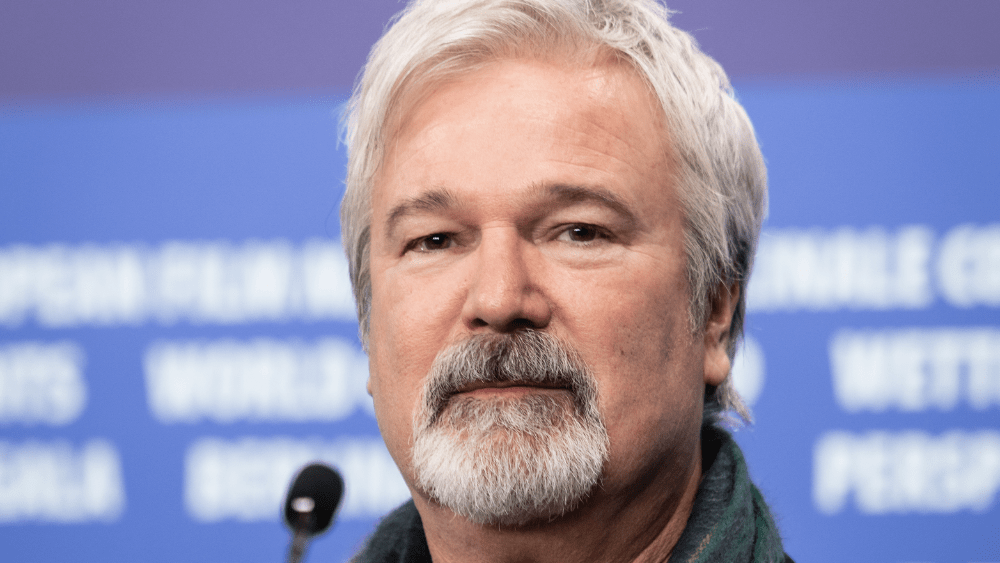
American director Gore Verbinski, who is participating in the Taormina Film Festival in competition with “Good Luck, Enjoy, Don’t Die,” spoke about the challenges of labeling the use of AI in film as technology continues to grow by leaps and bounds.
Verbinski’s latest film is a genre-bending sci-fi that stars Sam Rockwell as a time-traveling madman who enlists the help of humanity to save humanity from the threat of artificial intelligence, leading the director to delve deeper into new tools. Asked about the impact of AI on filmmaking, the veteran cautioned: “You’re supposed to check this box to say there’s no AI in a movie. It’s going to get very complicated very quickly.”
“You have to go back 20 years,” he pointed out. “Technically speaking, artificial intelligence has been used in film grading and sharpening tools…These tools have been around for 20 years. You almost need a rating system. If you use AI to write a script, you’ll get an F grade. What people are most afraid of is the lack of transparency. People are afraid of what’s real and what’s fake.”
Sadly, Verbinski is not a purist and doesn’t see the issue of using AI as purely black and white. According to the director, that’s “okay” even if independent filmmakers “couldn’t afford” to create certain parts in their films that were “central aspects” of emotional tropes. “I think you have to be absolutely transparent about what it’s used for. I would never try to use it to advance a story.”
Verbinski’s other big concern is how artificial intelligence is eliminating entry-level jobs, given that new technologies are primarily taking over menial tasks traditionally performed by interns, apprentices, and assistants. “The loss of apprentices is a huge concern,” he said. “We’re seeing this happen in law firms and everywhere. We’re going to start seeing the same thing happen in film production.”
“The path for young filmmakers will change forever,” he added, noting how the film industry used to hire directors who had worked on music videos and commercials. Currently, the path of entry is even more opaque. “The more we do it, the more we learn. I think we’re going to see a lot more people creating content for YouTube and short videos. We’re also going to see a lot of AI-generated stories. It’s going to be very interesting as the industry reaches out to these storytellers. Will they catch someone who’s been cheating?”

“Do your best, have fun, and don’t die” (Courtesy of Briarcliff Entertainment)
Verbinski, who directed three films in the Pirates of the Caribbean series from 2003 to 2007, looked back on his time working on major films. The director reflected on his memories on set, stressing how “truly precious” his relationship with series star Johnny Depp was to him. “We hit it off,” he said.
“I also felt there was something about the crew,” he continued. “We knew this was going to be the last movie where you get on a boat and go out to sea with a camera. We knew they would never let us do that. And this was going to be blue and green screens and processes and gimbals. Crazy, right? Crazy to actually go out to sea with a camera.”
The director reiterated, “When you make a movie on stage, or when you make a fully synthetic movie, you’re shaking the cart before the horse and chasing something that is inherently unrealistic. I think there was a real spirit that we were coming to the end of an era.”
As for what’s next, Verbinski said he welcomes the opportunity to go in the opposite direction of new technology and strip filmmaking down to its basics. “I want to tell the film in a purely analogue way, without any visual effects or animation, because I think that’s the basis of storytelling.”
The director of “The Ring” said there is “quite a lot of work to do” but that it is a “stingy time” and “tough” time for original IP. The filmmaker, who ranks as one of the 30 highest-grossing directors of all time and has garnered blockbuster hits and critical attention, still struggled to get financing for “Good Luck, Enjoy, Don’t Die,” and ultimately bypassed the studio system and independently financed this ambitious cautionary tale. Briarcliff Entertainment ultimately selected the film for US distribution, releasing it in theaters in February after the Berlinale closed.
But he has some hope for the future of moviegoing and audiences’ curiosity about original stories. Commenting on recent horror box office phenomenons such as “Obsession” and “Backrooms,” Verbinski said: “These are fascinating times. People still seem to go to the movies for the communal experience of fear. It’s hard to get people to go to the cinema (…) Anything that starts going is a win.”
