

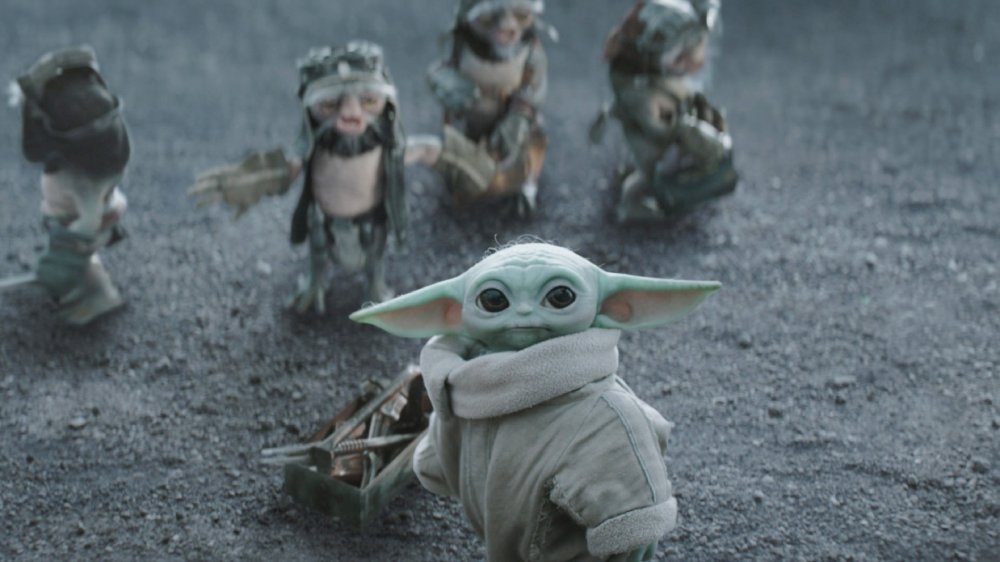
In 2019, Baby Yoda was seen everywhere. The adorable green sidekick of Pedro Pascal’s masked bounty hunter made his debut in the Disney+ series The Mandalorian and became a pop culture sensation, spawning enough memes and merchandise to fill the galaxy.
After seven years and one pandemic, will its powers be strong enough to turn the creature officially known as Grogu into a big screen star? His box office potential will be tested this summer in “Star Wars: The Mandalorian and Grogu,” a sequel to the hit TV show. As the first Star Wars movie in what feels like years (the last being 2019’s The Rise of Skywalker), the pressure is on to prove that the space opera series is still viable as a movie.
“The Mandalorian & Grogu” is estimated to gross between $80 million and $100 million domestically over the four-day Memorial Day weekend. If this wasn’t a Star Wars movie, ticket sales would have been modest. To be sure, the box office hasn’t returned to full steam since COVID-19, and major franchises (Marvel included) haven’t been immune to shifts in audience tastes.
But “Star Wars” is one of Hollywood’s preeminent film properties. It’s a popular series with few that can match it, so some box office success is expected. Case in point: Disney-owned Lucasfilm went into crisis mode after its 2018 spinoff Solo: A Star Wars Story premiered in the same holiday slot with $103 million (not adjusted for inflation). Lackluster reviews and distracting behind-the-scenes chaos made Solo the first Star Wars movie to lose money in theaters. Despite a huge budget of nearly $300 million, it grossed $392 million worldwide. That said, The Mandalorian and Grogu’s price tag is a modest $165 million, not including extensive marketing costs.
“There’s clearly a lot of interest in this brand,” said Eric Handler, senior media analyst at Roth Capital Partners. “But the revenue for each movie has been declining over time. ‘Star Wars’ doesn’t resonate as much with younger moviegoers as it did with (older) generations.”
Jon Favreau, who directed The Mandalorian and Grogu, is the man who directed blockbusters such as Elf, Iron Man, and the remake of The Lion King before making The Mandalorian. Favreau co-wrote the script with Dave Filoni, who was promoted to president of Lucasfilm following Kathleen Kennedy’s resignation in January. Favreau and Filoni face major obstacles in their first theatrical effort since Kennedy leaves office. It’s about convincing fans that The Mandalorian and Grogu is worth getting off the couch to watch, while ensuring newcomers can watch the movie even if they haven’t watched the series. Needless to say, ratings and reviews for “The Mandalorian” were declining by season three. Set after the events of the show, The Mandalorian and Grogu revolves around Pascal’s Din Djarin (aka Mando) and Grogu (formerly known as The Child, formerly known as Baby Yoda) as they navigate a galaxy recovering from the fall of the evil Empire.
“The biggest challenge is whether streaming audiences will convert into theatrical audiences,” says Shawn Robbins, director of film analysis at Fandango and founder of Box Office Theory. “If word of mouth is good, that’s a big X factor.”
Even Disney’s Marvel Cinematic Universe, the most commercially successful film franchise of all time, has struggled with streaming and theatrical crossovers. Last year’s “Captain America: Brave New World” and “Thunderbolts” were both released as Disney+ streaming series, but they did poorly at the box office. But the MCU has been more prolific than Star Wars, with 37 movies and more than 15 TV shows produced since 2010. Meanwhile, The Mandalorian and Grogu could benefit from shortages and pent-up demand.
It’s not for lack of trying that this franchise has been out of the multiplex for years. Lucasfilm has failed to launch new movies after projects from Patty Jenkins, Marvel producer Kevin Feige, and Game of Thrones creators David Benioff and D.B. Weiss failed to materialize. Meanwhile, the company drew attention to the small screen with its series of “Mando” poems, including “The Book of Boba Fett” and “Ahsoka,” as well as “Andor” and “Skeleton Crew.”
There is a more pressing reality. Star Wars box office revenue has declined since Disney acquired Lucasfilm in 2012 for $4 billion and revived the property with 2015’s The Force Awakens. A huge critical and commercial hit, the film grossed more than $2 billion worldwide and remains the highest-grossing film of all time domestically with $936 million. Sequels like 2017’s The Last Jedi and The Rise of Skywalker were billion-dollar hits, but still only earned half as much as their predecessors. “Rogue One” was the company’s only successful spinoff, earning $1.05 billion in 2016.
Analysts say the 50-year-old brand is about more than just movies. It’s part of a lucrative ecosystem that spans theme park attractions in California and Florida, not to mention the action figures and stuffed animals that fly off store shelves long after summer ends.
“The box office is very important, but this is a broader pop culture marvel,” Robbins says. “Grog is going to be a merchandising monster.”
Studio officials and box office watchers believe that next summer’s high-profile movie “Star Wars: Starfighter” is likely to reinvigorate the franchise. Directed by Shawn Levy (Deadpool & Wolverine) and starring Ryan Gosling, the ocean adventure could serve as a fresh start without the baggage of continuing the TV show. It also helps that Gosling scored in another recent space adventure, “Project Hail Mary.”
“Disney needs something new and exciting to bring energy to the franchise,” Handler says. “Ryan Gosling is super hot right now. ‘Starfighter’ might be the perfect fit.”
