

Nearly 30 years have passed since Steven Spielberg’s The Lost World: Jurassic Park was filmed in Costa Rica, and much has changed in the country’s film industry. From a virtually non-existent market in the late 1990s to a fast-growing powerhouse whose exports sweep the awards at major film festivals like Cannes and Berlin, Costa Rica has invested heavily not only in increasing its domestic film output, but also in attracting major international productions to shoot in the country.
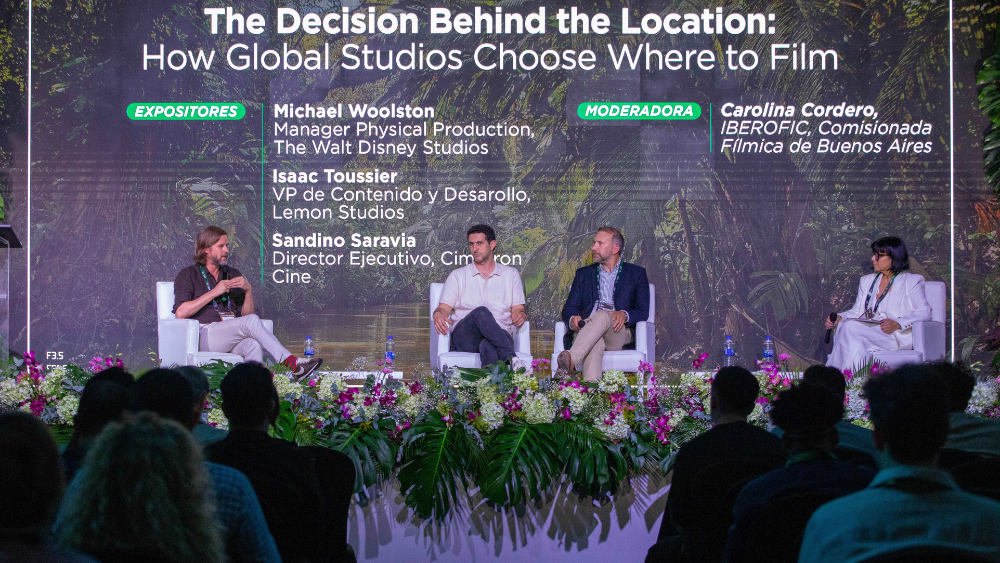
At this year’s Costa Rica Media Market, Costa Rica’s leading industry event, global production experts gathered to discuss how major companies choose locations for blockbuster shoots in a panel titled “The Decisions Behind Locations: How Global Studios Choose Locations.”
Michael Woolston, physical production manager at Walt Disney Studios and an experienced producer who has worked on films such as “Avatar: Fire and Ash” and “The Little Mermaid,” said the decision to take production overseas depends on the availability of two key assets: staff and talent.
Regarding his process, Woolston said variables can be the difference between winning and losing when comparing countries with similar budget ranges. “If you look at all the other variables, staff and talent is probably one of the biggest things. We’ll probably bring in a director, a producer, maybe a production designer, of course, but we want to hire all the local talent we can.”
“The goal is to have talent here that we can draw from,” he added. “Including costume designers, construction staff and craftsmen. That’s big for us. We love creating beautiful visuals and we’re all about the craftsmanship. If you can provide those people, that becomes really important to us.”
Another talent-related issue that can have a big impact on location selection is that “actors want to be close to their families,” said Sandino Sarabia, executive director of Cimarron Cine, which has headquarters in Uruguay, Argentina, Brazil and Mexico.
“They travel a lot,” he continued. “Especially for veteran talent, leaving home for six months in another country isn’t always an option. So the project has to be worthwhile or there’s a financial discussion around that. So sometimes you end up deciding where a project will be filmed, not necessarily because of economic efficiency, but because you need talent and you want talent.”
When it comes to efficiency, having a production services company, a seasoned producer, and a readily available film commission that understands how to make local laws and policies understandable and manageable for foreign productions is a huge asset for a country looking to attract blockbusters. Woolston said that for large studios to come to a country like Costa Rica and shoot a project, “they need boots on the ground to handle everything.”
“The Walt Disney Company is under a microscope, so if something goes wrong, it makes the news,” he said. “We rely heavily on production service companies and local producers to ensure compliance with laws and required policies.”
Disney executives then categorically stated, “Mitigate your risks. We already have a lot of other risks. If you compare multiple countries, the risks are minimal.”
Isaac Toussier, vice president of content and development at Lemon Studios in Mexico, echoes Woolston’s comments about the importance of efficiency. “If the cameras take eight days to arrive instead of two, that could already disrupt production.”
That said, Touchier believes Costa Rica is “very well positioned” as a country with a young market because it has a chance to make the industry work under best practices. “In addition to biodiversity and people, Costa is able to build industries that incorporate best practices that may be difficult elsewhere. It is much harder to change industries than to create new ones.”
“It’s much more viable for a company to go back to a place where they have good experience and have people who can solve problems under pressure,” he continued. “You can’t just ask ChatGPT to find you five horses first thing in the morning. You need people to solve problems. The real competition is no longer the tax incentives that are the norm in any country, but rather how well a country adapts to accepting these works.”
Another important topic of conversation was how film is a “relationship industry.” Often, a place grows into a popular destination thanks to good feedback from producers who have ventured into unexplored countries.
“Hollywood is small in some ways in that it talks closely with all the other studios and executives,” Woolston said. “I think that’s really great. Even Mark Johnson is a close friend of ours and to have his experience in this country is a thumbs up for us to feel comfortable coming back and saying, ‘Okay, we can do this too.’
“We’re talking to all the executives at Netflix and Warner Bros.,” he continued. “They’re our competitors, but they’re also our friends. If you find out someone had a great experience and recently filmed here, it’s easy to give them a call. But the opposite can also happen. If someone has a bad experience, it makes it really hard for them to come back.”
Touchier agreed, saying that “the personalities of the people and the synergy created between the creative and production teams” are very important when choosing a place to work. According to the producer, focusing on personal compatibility is a big advantage for Latin America. “Latin America is very interesting in that it shares certain idiosyncrasies with other regions of the world.”
“Spain doesn’t share much with Italy in terms of culture, but we Latin Americans share a lot,” he said. “These dynamics allow us to skip many cultural steps when moving between Colombia, Costa Rica, Argentina, and Uruguay compared to recording outside of Latin America. That’s a big advantage of being here.”
