

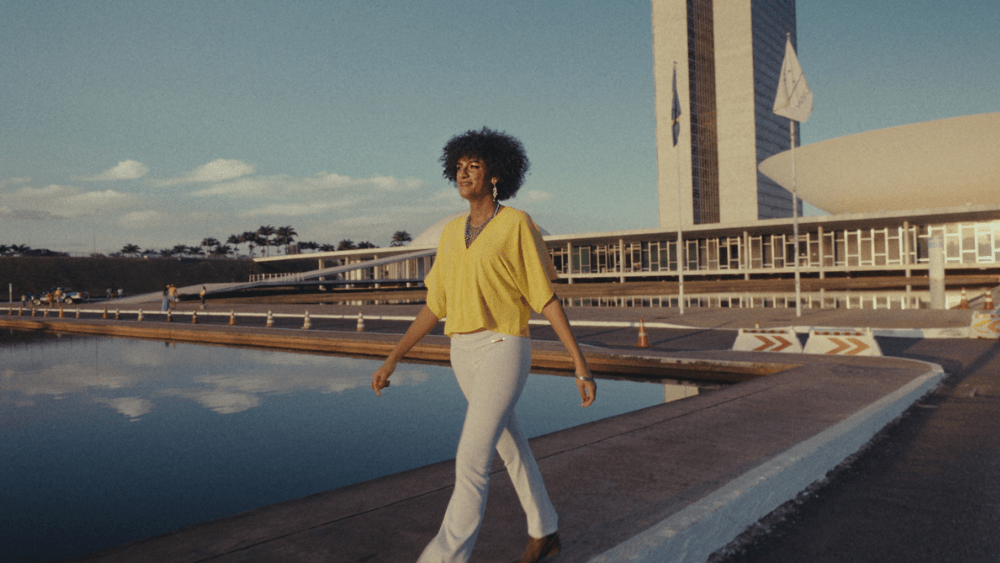
More than a decade ago, Brazilian photographer and filmmaker Vivian Davila traveled to India to develop a photographic project based on Indian culture and spirituality. There she met members of India’s Hijra community, a legally recognized third gender that includes transgenders, intersexes and eunuchs. This encounter completely changed Dávila’s project and became the original seed for Let Us Be, which had its world premiere at the Raindance Film Festival.
“Let Us Be” follows intersex people (people born with anatomical structures that are typically neither male nor female) in India, Brazil, and the United States. The director chronicles their journey of self-discovery to expose the ongoing human rights struggle against non-consensual surgeries performed on intersex children, highlighting the rigid dichotomies that shape society’s understanding of sex and gender.
In an interview with Variety ahead of the premiere of Raindance, Davila reflected on his first trip to India and his first encounter with Hijras, saying, “I was struck by the contrast between the fact that they are sacred in certain cultural contexts, yet face severe discrimination and often live on the margins of society.”
The director then contacted Gopi Shankar, an “intersex activist who opposes non-consensual surgery on intersex children and supports LGBTQIA+ people in situations of abuse and marginalization.” The two spent three months traveling across India to learn more about the community and Shankar’s work, resulting in Davila’s short film Gopi, which awakened in her a “deeper sense of urgency to understand and depict intersex life across different regions and countries.”
Once the filmmakers decided to embark on a feature-length project, they enlisted other subjects, including Ananda Rajappan, an intersex Dalit living in India, Hida Viloria, a writer and activist who pioneered the intersex movement in the United States, and Carolina Iara, the first intersex person elected to public office in Latin America.

Provided by Vivian Davila
“Finding willing participants who were open, trusted me, and felt comfortable around me was critical to the success of the project,” says Davila. “It was important to us to bring together different generations and perspectives, and to show how the intersex movement can exist through many voices, experiences, and forms of expression.” The director also wanted the film to be global, as he wanted to emphasize that the human rights issues surrounding intersex people are “not just about geography, territory, or even specific laws,” but “about how society responds to people who are different from what they consider ‘normal.'”
Asked about the importance of speaking deeply about the intersex experience and the relative lack of documentaries on the subject, Davila said that within the community, “many people are not ready to come out publicly as intersex.” “There’s also a lot of confusion because being intersex and being transgender are very different experiences. I think this lack of public understanding has led to fewer stories being told.”
The director said it was “very important” that the film be released in the United States, “especially given the current political challenges impacting LGBTQIA+ rights.” “Currently, the LGBTQIA+ community is being threatened and their rights stripped away in the United States. There is a very urgent need to shine a light on this issue in this country, to push back against what is happening, and to work to bring more awareness to educators, politicians, doctors, and society in general.”
“Let Us Be” is a U.S.-Brazilian co-production from Dona Rosa and Social Construct Films, a decision made early in the financing process when the producers decided to apply for the International Co-Production Fund. Such partnerships are becoming increasingly common in Brazil, which is currently attracting international attention thanks to the back-to-back productions of Walter Salles’ I’m Still Here and Kleber Mendonça Filho’s The Secret Agent.
“This kind of international production (model) is very interesting, especially for independent films,” the director added. “In Brazil, we still struggle with financing and the potential for project development and production can be limited. So by working across countries and with different partners, we can really widen our possibilities creatively, financially and in terms of reach. It allows our films to travel further, enter new conversations and At the same time, I think it’s very important not to lose the identity of where the film comes from. Even if the project becomes international, it needs to convey its culture, perspective and characteristics. That balance is essential for a director to open up a film to the world without losing its roots.”
