

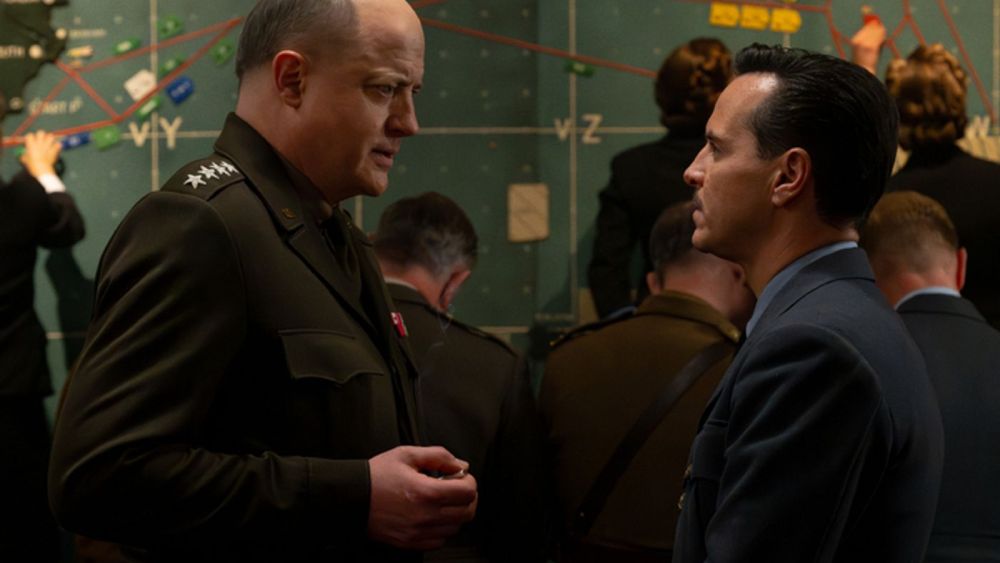
Britain’s obsession with the weather goes from an easily ridiculed national quirk to a world-class pride in the handsome and competent World War II drama “Pressure.” I can’t go so far as to say that the weather forecasters won the war, but I wouldn’t mind it one bit if they went home believing that. In fact, the “weather forecaster” was Captain James Stagg, Scotland’s leading meteorologist, who was appointed Chief Weather Officer for Operation Overlord and reported to General Dwight D. Eisenhower in deciding what day D-Day would be. If that sounds like a less than engaging drama, you’re underestimating both the eternally unpredictable vagaries of the English summer and the terrifying magnetism of Andrew Scott as Stagg, who argues with Brendan Fraser’s Eisenhower about the rain as if the lives of thousands of people depend on it – because this time it’s raining.
Although the marketing for “Pressure,” which opens nationwide this Friday but, somewhat surprisingly, in the U.S. a few months before its mainland UK release, emphasizes the epic scale of the much-abbreviated dramatization of D-Day, director Anthony Maras’s film is primarily a chamber drama, set primarily in an Allied command center where operations are meticulously planned, and much of the drama is contained in tense altercations over desks, maps, and bulletin boards. If you’re watching this and think it would work well on stage, that’s because it already does. A play of the same name by actor and playwright David Haig was a West End success in 2014, but it was probably too truncated, too British, or too niche to transfer to Broadway.
But the film also works well on screen. One reason for this is that Australian director Maras (Hotel Mumbai) and Haig, who co-wrote the adaptation, let the film unfold without much effort. Instead, they honor the original’s ironic scope and stakes, in which the fate of the free world depends on environmental details beyond human control, and illustrate how various parties react to that powerlessness. (Like the men on screen, they keep a close eye on the clock; this is a rare period war drama that starts at a businesslike 100 minutes.)
When Mr. Stagg’s calculations lead him to the conclusion that, after a long period of calm, an almighty storm may arise on June 5, 1944 (the day originally scheduled for the Normandy landings) and ruin the entire vast plan, his simple but urgent advice is to wait a day. All of the military’s top brass, including an excited Eisenhower and his erratic counterpart British General Bernard Montgomery (Damian Lewis), act as if rational, necessarily single-minded scientists have betrayed their mission.
There’s an element of dry comedy to seeing these powerful men not only thwarted by a simple weather forecast, but also angered by it. Everything about Pressure, from the earnest ensemble work to Jamie D. Ramsay’s subtly varnished lensing to Volker Bertelmann’s alternately urgent score (“All Quiet on the Western Front”), seems to ennoble the events unfolding on screen, but the movie is. Lifted by a series of contrasting absurdities.
It doesn’t help matters that Mr. Stagg’s American colleague, the less qualified meteorologist Irving Crick (a perfectly funny and slippery Chris Messina), tries to selectively manipulate the charts to tell his boss exactly what he wants to hear: facts and statistics. Although it’s more than 80 years old, “Pressure” is very much in tune with the post-truth political climate of the Trump era. Expertise is not trusted by default, and leadership means unquestioned authority.
To be fair, Eisenhower is not portrayed as such a tyrant here. Frazier’s funny, wide-ranging, gritty performance gives us a glimpse of the future president’s humility and uncertainty, even his brick shoulders crumpling under the pressure of the moment. Kerry Condon is a warm and cool presence in the somewhat thankless role of Kay Summersby, a personal assistant tasked with competing with masculinity and wrangling an enormous amount of ego.
Still, the film is always reliable Scott’s, and to his credit, he doesn’t take the easy path of sympathy for the anxious, uptight Stagg, playing him with a brooding coldness befitting his harsh predictions, but also a stern, stoic honesty that makes him trust life. It would not be nice to see it rain on this special parade. Scott, and by extension “Pressure,” offers an unfashionable but timely position for planning, listening, and choosing wise options.
