

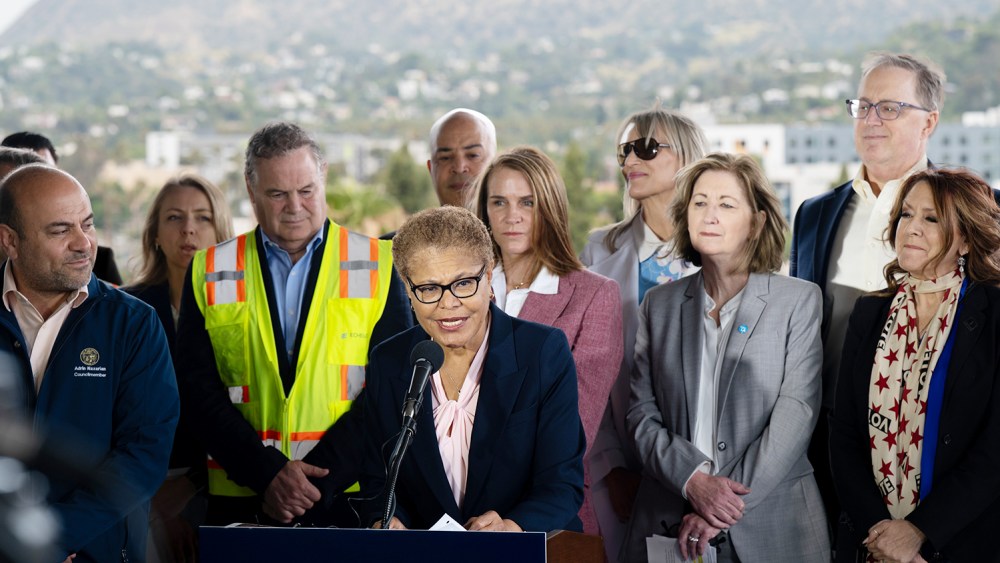
Los Angeles Mayor Karen Bass declared Tuesday that Hollywood is “turning the corner” as production rose slightly in the first quarter of 2026 on the back of increased state aid.
Mr Bass, who is running a tight race for re-election, welcomed the increase as a sign that local efforts to cut through bureaucracy are bearing fruit.
“We have a long way to go, but after years of decline, Hollywood is finally turning the corner and bringing in more production and more jobs,” Bass said in a statement. “City Hall will continue to work with industry to support good-paying union jobs and expand economic opportunity across LA.”
Television, film and commercial production in the Los Angeles area increased 16% sequentially, but remains well below historical levels. Production has not increased for two consecutive quarters since the peak TV era of 2021.
Led by feature film production, the number of shooting days has recovered to its highest level in the past two years. Television dramas and comedies also showed a slight increase, but this was offset by a sharp decline in reality television, which does not receive state incentives.
Reality TV production was down 52% compared to the same quarter in 2025 and 71% below the five-year average. This is the lowest level since the pandemic and the second lowest since 2010.
The percentage of Los Angeles film projects receiving California tax credits rose to 21.8%, the highest since FilmLA, the region’s permitting agency, began tracking that statistic two years ago. Television production, which receives subsidies, also hit a record high of 17.1%.
A sharp contraction in film and TV production from 2022 onwards is a global phenomenon, as major studios put the brakes on the streaming craze of the past decade. Several states, including California, New York and Texas, have responded by increasing tax incentives to attract, or at least retain, film activity.
California Gov. Gavin Newsom and the state Legislature more than doubled the state program to $750 million last summer, and the first projects eligible for credits under that expansion began operating in the first quarter.
Incentive increases have not been able to offset the significant decline in overall production. But the data suggests we are beginning to see a “new normal” in which LA production becomes a smaller, more heavily subsidized industry than before.
“While some of the latest numbers are encouraging, we know there is still significant work to do to bring filming and jobs back to the region,” said FilmLA CEO Dennis Gatches.
Bass and FilmLA last week announced a temporary pilot program to provide low-cost permits to small productions. The city also offered a 20 percent discount on parking for productions over the next year, in line with an agreement offered to help promote Baywatch filming in Venice Beach, which resulted in $21 million in state tax credits.
City Councilor Nitya Raman, who is challenging Basu in the June 2 primary, announced her own plan last week to cut production costs and red tape. She also expressed support for eliminating caps on state tax incentives and extending subsidies to all produce in the state.
“While this slight economic uptick is welcome news for the workers who depend on this industry, it does not erase years of devastating decline under our current mayor,” Raman said in a statement Tuesday. “As Mayor, I will push for the changes needed to revive Hollywood, including faster and more predictable permitting, lower fees, uncapped state tax credits, and appointing film executives with industry experience to make our city a trusted partner for productions of all sizes.”
Tax incentives are also an issue in the gubernatorial race, with San Jose Mayor Matt Mahan and former Los Angeles Mayor Antonio Villaraigosa also calling for lifting caps on incentives. Neither company has provided cost estimates for their proposals.
