

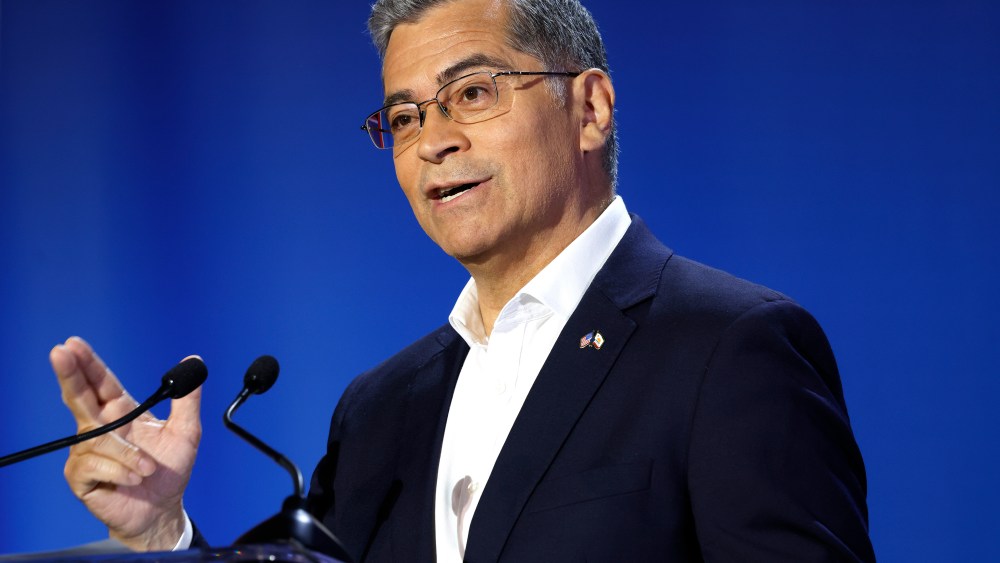
California Democratic presidential hopeful Xavier Becerra on Friday called for a summit of studio, labor and technology leaders to address Hollywood’s sharp decline in jobs.
Becerra is the latest candidate to offer proposals to revive the entertainment industry, which has lost 51,000 production jobs over the past three years. He promised to expand state incentives for film and television production, but unlike some other candidates, he did not promise to eliminate the $750 million cap.
“We intend to expand the size, capacity and access of our programs when the demand is real, when jobs continue and when a return to California is warranted,” Becerra said.
Becerra said in a subsequent interview that he plans to convene industry officials soon after taking office.
“When you come out of the huddle, everyone needs to know what their play is,” he said. “The first job is to organize our actions and know what our strategy is.”
He said he wants to focus the tax credit expansion on areas that need it most.
“If we continue to move in this direction towards expanding tax credits, I want to make sure that we see results, that we see real results,” he said. “Don’t do this shotgun. If you can be strategic, you should be. Make sure the patient is really suffering and address the real problems. An early summit will help uncover where the real wounds are.”
Becerra’s Democratic rival, billionaire Tom Steyer, first called for expanding the state’s tax incentives in March. San Jose Mayor Matt Mahan and former Los Angeles Mayor Antonio Villaraigosa upped the ante in April, saying they intended to make the program unlimited.
Leading Republican candidate Steve Hilton similarly called for eliminating the cap on programming and expanding eligible expenses to include the salaries of actors and producers. Since then, all three leading candidates for Los Angeles mayor have similarly called for the cap to be lifted.
Gov. Gavin Newsom signed an expansion bill that more than doubles state incentives in 2025, which have been set at $330 million annually for more than a decade. “We’ve been working this way since before Gavin Newsom even thought about this,” Becerra said, touting his record as a lawmaker in the 2000s.
“We went into knife fights without weapons, and now people are bringing guns,” he said. “We have to prepare for what’s coming.”
Some leaders say it won’t be easy to get Northern California lawmakers to agree to the $750 million increase, suggesting they wait to see how the recent expansion plays out before committing to additional increases.
“There’s still a perception in other parts of the state that this primarily benefits Los Angeles,” said Rep. Rick Chavez Zubru, an author of the expansion bill. “I support lifting the credit cap. I think it will take several years to build support for it in Congress.”
Mr. Becerra’s policy statement calls for the creation of a California Entertainment Summit that would include producers, studios, labor and technology leaders to develop a “public action plan” for Hollywood. Becerra also emphasizes the need for federal tax incentives for production jobs to compete with subsidies from countries like Canada and the United Kingdom.
The proposal states: “Our workers should not fight the Treasury Department of a foreign government alone.” “Government must act on behalf of workers at all levels, so California will be at the forefront of seeking federal assistance.”
Becerra’s proposal included several Hollywood worker-friendly elements, including a promise to provide compensation for AI training, a key unmet demand from industry unions, and a national mandate for disclosure of streaming viewing data, a key theme of the 2023 Actors and Writers Strike.
IATSE, the largest union representing Hollywood workers, joined other labor groups in backing Steyer in a more aggressive anti-corporate campaign. Mr. Steyer has been particularly outspoken in his opposition to the Paramount-Warner Bros. merger, warning that it would result in the loss of thousands of jobs.
Becerra, a former California attorney general, did not oppose the merger but said it needed to be considered.
“We will certainly scrutinize any such transaction,” he said. “The industry is undergoing significant change. That doesn’t necessarily mean consolidation is good.”
Becerra’s campaign adviser Michael Bustamante said in April that Becerra would likely support increasing state production incentives, but was wary of making the program unlimited, which could easily reach billions of dollars.
“The problem is we have a budget issue overall,” Bustamante said at the time. “We need to be smart about it.”
