

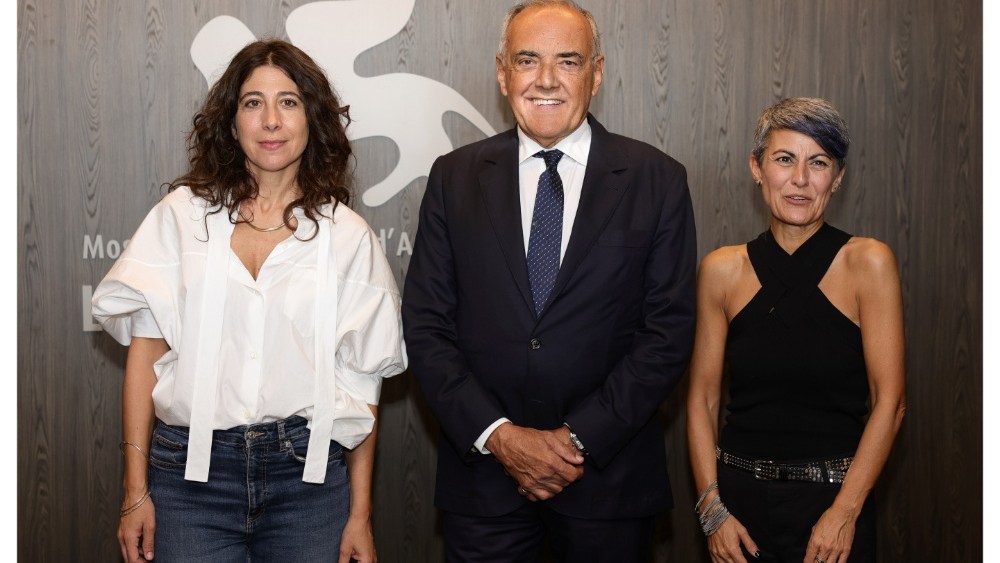
Alberto Barbera, the artistic director of the Venice Film Festival, has drawn criticism from several Italian film associations, including Women in Film Television and Media Italia, for the dramatic decline in the number of female directors this year, with only one film by a woman in the 20-title competition.
Regarding Italy’s selection, they pointed out that “seven male directors represent Italian cinema in competition and out of competition at the Venice Film Festival and on the festival’s main stage. This is a one-sided selection. All are men.”
More broadly, “quality is not a timeless, sacred, neutral and objective category,” the group said in an impassioned appeal published Monday in Italian newspaper La Repubblica and posted on social media. “We know full well that it is a moving, evolving concept, that art is a battlefield made of flesh, tears, blood, and power. It is not a pure celestial sphere where quality angels flutter asexually.”
The statement continued: “Each choice is the result of gaze, culture, and imagination: tastes, sensibilities, limitations, mistakes, and precise editorial policy. To think that quality can be separated from all of this is to ignore how cultural norms are constructed and where art originates.”
“For this very reason, the very standards by which we judge quality must continually be questioned,” the appeal continues. “We can’t simply conclude that there aren’t enough female directors when the results are so disproportionate year after year. We have to ask whether the tools we use to watch film are still relevant to our times.”
Signatories of the appeal also include the Italian film directors’ association ANAC and 100autori, which are behind the event’s sidebar “Giornate Degli Autori (Venice Days)”. Italian director’s union Air3. European Women’s Audiovisual Network. Italian documentary director group Doc/it.
Aside from the obvious fact that only one film in the Venice competition is in contention for the Golden Lion directed by a woman (the aptly titled drama Woman Unknown, by Danish-Egyptian director May el-Touky), this is a significant drop from last year’s competition, where the proportion of films directed by women was around 29% (six out of 21).
The Venice Horizons section, dedicated to new voices and cutting-edge work, features 8 out of 19 films directed by women, making up about 42% of the section.
“Since 2000, Venice has given more top prizes to female directors than Cannes or Berlin or any other festival, so I don’t think they can be accused of bias against female directors,” Barbera told Variety in an interview last week after this year’s lineup was announced.
In fact, in the past five years, three female filmmakers have won the Golden Lion. They are Chloe Zhao from the 2020 film Nomadland, Audrey Dewan from The Happening, and Laura Poitras from the 2022 documentary All the Beauty and the Bloodshed.
In 2024, Italian director Maura Delperro won the Silver Lion for Vermiglio.
Barbera also told Variety magazine that “three of this year’s main judges are women,” starting with Maggie Gyllenhaal, who serves as the competition’s head judge, and noted that “three of the main judges this year are women,” including French directors, actors, and screenwriters. He pointed out that Valerie Donzelli will be the president of the jury for Horizons, and that Italian screenwriter and director Carolina Cavalli will be the president of the jury for the Luigi De Laurentiis Venice Prize debut film.
“We had hoped to find more films directed by women in the competition, but there were fewer entries,” Barbera said, noting that “fiction films directed by women accounted for 24% of entries, compared to 30% last year.”
Barbera added: “Unfortunately, we were unable to enter any more films into the competition as we also found that the quality of the films was poor. This is very unfortunate, but there should be no suspicion of bias on our part. The only strict criteria we follow is the quality of the films.”
She continued, “We absolutely oppose choosing films based on gender, because we don’t think it’s beneficial. It’s humiliating for women to think that they were chosen because they’re women, not because they made good films. Even if it was a mistake not to choose films directed by women, people will be able to judge when they see the films.”
The independently run Venice Days sidebar, curated by Gaia Frères, boasts a predominantly female-directed lineup, with 14 of the 25 titles in the main selection directed by women. The lineup opens with Hungarian filmmaker Lili Horváth’s English-language debut My Notes on Mars, starring Mackenzie Davis and Rupert Friend.
The Critics’ Week section is dedicated to first films from around the world and is comprised of two female directors from among the seven feature films selected in competition.
Get ready for Barbera’s male-dominated competition selection to be a hot topic in Venice, which runs from September 2nd to 12th.
Pictured above (from left to right): Gaia Fuller, artistic director of Venice Days, Alberto Barbera, director of the Venice Film Festival, and Beatriz Fiorentino, executive director of Venice Critics’ Week.
