

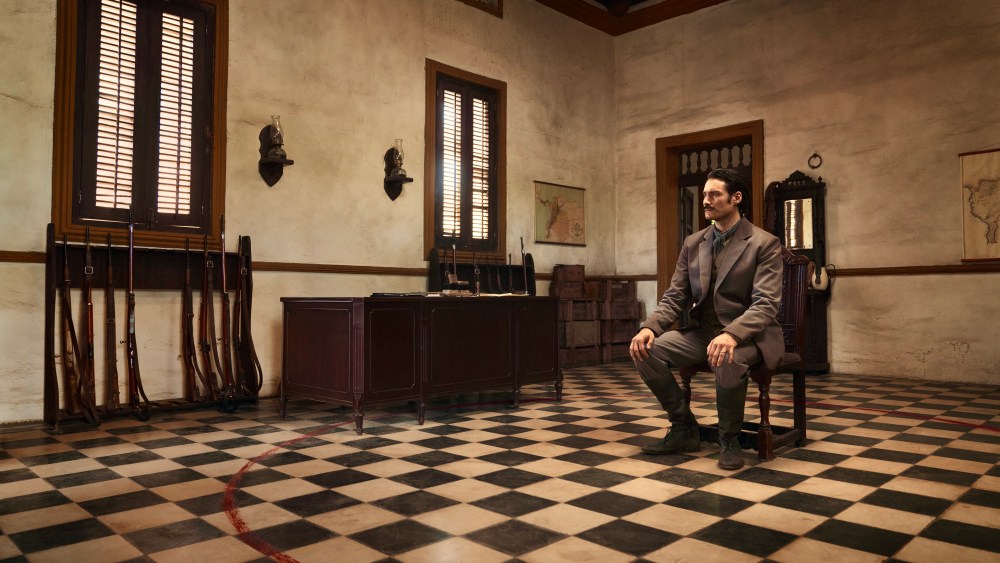
One Hundred Years of Solitude, by far Netflix’s most ambitious series in Latin America, will drop its second and final season this August. Season 2 picks up right where season 1 left off, covering the last 50 years of this century as covered in Nobel Prize winner Gabriel García Márquez’s masterpiece.
In a rather unusual move, the first seven episodes of Family Story will be released on August 5th, with the nearly two-hour cinematic grand finale premiering on August 26th.
Finale theatrical events (special solo screenings similar to premieres rather than releases) are planned in select cities across Colombia in partnership with Colombian promotional organization Proimagenes.
The first half of One Hundred Years of Solitude introduces us to young Macondo, the utopian town of Colonel Aureliano Buendía, whose innocence has been diminished by the exhaustion of war. The second half depicts the next generation of Buendías, as the town is reshaped by progress and modernization, Macondo is on an irreversible path to decline, and a long-heralded curse is fulfilled.
“We always intended to release it in two parts, so we approached it as a bookend project. Having that ending in sight gives us some perspective,” said Francisco Ramos, vice president of Latin American content at Netflix.
“We also noticed something else: Macondo itself, as a town or village, has become an increasingly important character in the novel. It really emerges as a character in its own right,” he said, adding, “In the first part, Macondo is about the founding of the nation and the creation of a utopia. In this case, that utopia has already been built and, as with all utopias, the inevitable path to destruction has begun.”
“I think what García Márquez accomplished with this novel was to capture what ultimately happens to all utopias over the course of a hundred years,” he mused.
“We wanted to further enhance this work narratively and aesthetically and see how it evolved into something deeper, more complex, more cinematic,” said showrunner Laura Mora (“Kings of the World”). Showrunner Laura Mora (The Kings of the World) directed five episodes, including the final episode of Part 2, while Carlos Moreno (Dog Eat Dog) directed the other three episodes.
The directors divided the seasons according to major changes in the story. Mora directed episodes 1 and 2 to introduce the next generation of Buendías and the transformed Macondo as a bridge to the first season. Moreno then filmed episodes three and four, bringing his flair for humor and personality to the introduction of the main antagonist, Fernanda del Carpio. Maura returned for episodes five and six, which depicted the United Fruit Company and the arrival of Americans in Macondo, and this was an important turning point that she had long wanted to bring to the screen. Moreno directed Episode 7, which focused on Macondo’s legendary years of relentless rain.
“I think one of the things we accomplished this season was to give each episode a cinematic structure, meaning that while all the episodes come together to tell a larger story, each episode also functions as a standalone story, with its own purpose and identity,” Ramos said.
“I think it gives viewers a very rewarding experience. Each episode feels complete on its own, yet still contributes to the whole. We respect the intelligence of our viewers by following their own narrative logic, rather than simply serving as another chapter in a larger story.”
Shot entirely in Colombia and Spanish, this epic film adaptation, with the blessing of García Márquez’s family, involved hundreds of artists and crew members who helped recreate Macondo for the screen.
The town of Macondo was built from the bottom up, a first for the country’s audiovisual industry.
“What was so great about this new season was that we had really great talent not only in front of the camera but also behind the scenes with all the new actors on the show. Not only did we have Carlos as another director, we had two great cinematographers this season: James Brown, an Australian cinematographer who has worked with me before, and Camilo Monsalve (‘The Whistler’).
Maura’s handwritten diary is both a creative tool and a personal record of her filmmaking journey. “These are a testament to my relationship with filmmaking,” she said, noting that her notes for “The Kings of the World” were particularly thick because they were based heavily on her own experiences.
She starts each time by reminding her team the same thing. “If there’s one thing I can’t afford to lose, it’s my books. If I lost my books, it would be like flying with a drunk pilot.” Very analog in an increasingly digital industry, she still relies on paper, handwritten notes, and sketches to shape each project. “While everything is moving so much faster with AI and all these new technologies, my resistance has remained analog,” she said. “Writing by hand is my way of resisting the world.”
“I think “One Hundred Years…” became like school for just about everyone. Some of us had never worked on a project this big and challenging before. Working on a movie set on the backlot was completely foreign to us. I’m sure it was for 90% of us, myself included.”
“One of the things we’ve talked about a lot in recent months is that it’s amazing that just four, five, six years ago, people in the industry in Colombia believed that a project like this was impossible. And now we’ve proven that it is possible,” Ramos reflected. “I think this is extraordinary, not just for the industry, but for Colombia as a whole. It shows that you can aim incredibly high and actually achieve it. That creates strong potential, success, and intellectual ambition. I think this is truly amazing.”

“One Hundred Years of Solitude” Provided by: Netflix
Mauricio González A – @MauroGon, Mauricio González A – @MauroGon, Mauricio González A – @MauroGon
