

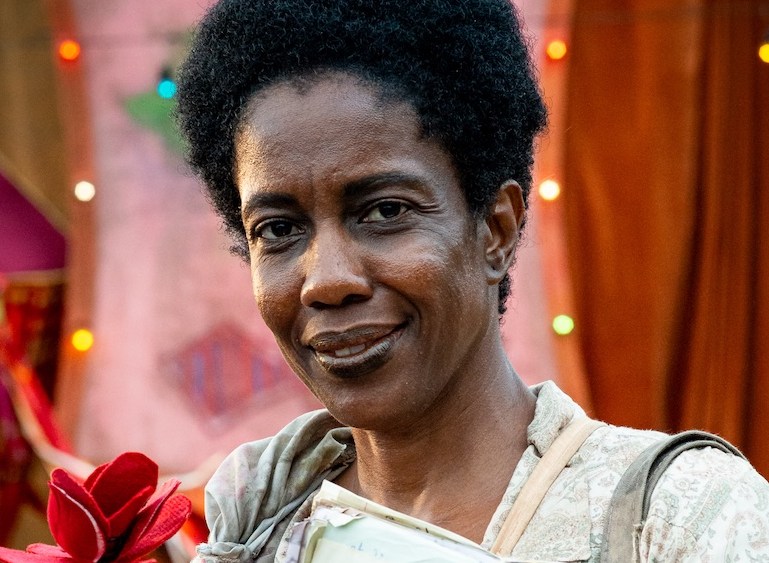
“Carolina María de Jesús,” directed by Brazilian Jefferson De, which won the AH Media Production Award at this year’s Goes to Cannes showcase, aims to capture the “cinematic side” of one of Brazil’s literary greats, says Maria Gal (“Perfect Love”), who produced the film and starred as Carolina.
The film, which is in post-production, is based on the international bestseller “Quarto de Despejo” (“Child of Darkness”), Carolina’s diary published in 1960. De Jesus depicts her life working as a waste collector in the Caninde favela in São Paulo, Brazil, in the 1950s. Through sheer talent and self-determination, she overcomes extreme poverty and racism.
“This is not just a Brazilian story; it is a deeply human story about dignity, motherhood, love, hunger, education, survival, and the pursuit of dreams,” says Gal.

Jefferson De Photo by Renato Nascimento
“Carolina María de Jesús is a fundamental figure in our history and Brazilian literature, and telling her story through film has great artistic, political and historical significance,” director Jefferson de (Broader, M8) told Variety.
The film was produced by Clélia Bessa (Raccord Produções), along with Maria Gal (Move Maria). Co-producers include Globo Filmes, Rosane Svartman (RSMTS), Cris Arenas (Buda Filmes), Sara Silveira (Dezenove Som e Imagens), Mact in France, and distributed in Brazil by Elo Studios. Mayra Oliveira (The Magic of Aruna) wrote the film’s script, and Sundance Award winner Lilith Soares (Mami Wata) serves as the cinematographer.
Goes to Cannes is an ongoing initiative of the Marché du Film that aims to promote film festivals around the world, nurture future talent and provide a comprehensive platform for industry networking. This year there were entries from seven international film festivals.
The other two winners were German director Golb’s At Your Service (Estonia, Germany), which won France’s Ciné+ OCS Award, and Daniel Romero Bueno’s The Daughters (Spain, UK), which won the Sideral Cinema Award from the Spanish studio.
After the film’s emotional win at Cannes, Variety had a chance to speak with Maria Gall. Below are some of her thoughts.
I remember my mother and I reading Child of the Dark when I was a teenager in America. We both loved this book. Why do you think it took so long to adapt Karolina’s life story into a film?
María Gal: I think one of the reasons it took so long for Carolina María de Jesus’ life story to reach the screen is because Brazil, a country where more than 56% of the population identifies as black or mixed-race, still reflects deep structural inequalities. And this is especially paradoxical when we talk about Carolina María de Jesús, one of the most important writers in Latin American history, one of the first black women writers in Latin America to become an international bestseller, and a writer whose work crossed borders decades ago through Cuarto de Despejo (Child of Darkness). There has also been a longstanding belief in some markets that Black stories, Black protagonists, and Black-centered stories only work if they don’t “travel,” “don’t sell,” or are associated with violence, poverty, crime, or stereotypical roles.
Although it has not been made into a movie, there have been plays and songs based on Carolina’s life. Are any of them successful in Brazil?
Gal: Yes, of course. The story of Carolina María de Jesus has inspired plays, musical works, and artistic adaptations in Brazil for decades. Many of these projects were huge critical and cultural successes. This year, she also became the theme of the samba school Unidos da Tijuca during Carnival, one of the country’s most important cultural expressions.
Carolina named her diary “Cuarto de Despejo.” Can you talk about what that means?
Gal: The English title of this book, which is best known internationally, is “Child of the Dark.” However, if we think of the more literal and symbolic translation of the expression “cuarto de despejo”, it would be closer to something like junk room or dumping room. Because in Brazil, “cuarto de despejo” means a space in the house where discarded, forgotten or unnecessary objects are kept. And that’s exactly the powerful metaphor Carolina uses. She said favelas were treated by society as the city’s “dumping ground,” a place where the poor, black, and invisible were forced into.
Carolina Maria de Jesus. Photo credit: Mariana Viana
How did you prepare for the role of Carolina?
Gal: As an actress, it was a very challenging role in every way – emotionally, physically and artistically. In the process of preparation, I lost 18 kilograms, because I understood that Karolina’s body needed to leave on the screen traces of the hunger that it experienced throughout its life. Carolina often survived by feeding her children with bone broth and other improvised methods, so I felt I needed to honestly reflect that reality in both my body and the film’s visual language.
I also cut my hair and went through a very intense physical transformation process. I walked the streets of São Paulo and Rio de Janeiro as a paper collector. We collected paper, recyclables, and trash on the streets in order to minimally understand the everyday life, silence, gaze, and social invisibility experienced by Carolina.
Some people accused Carolina of being a witch because she could read, but that was not the norm at the time. However, she was actually very Catholic, even though the church rejected her on the grounds that her mother had given birth to an illegitimate child.
Gal: This question reveals a lot about Brazil at the time. Carolina was a black woman, poor, and had little formal education, but was highly intelligent, an avid reader, and a writer. To many at the time, it was almost unthinkable that a woman like her could write with such strength and social awareness. So there was a lot of prejudice and a lot of attempts to delegitimize her intelligence.
At the same time, Carolina had a very strong relationship with faith and God. However, her very existence challenged the social and moral standards of the time. She was a black woman, a single mother, a writer, and an independent woman in deeply conservative Brazil.
