

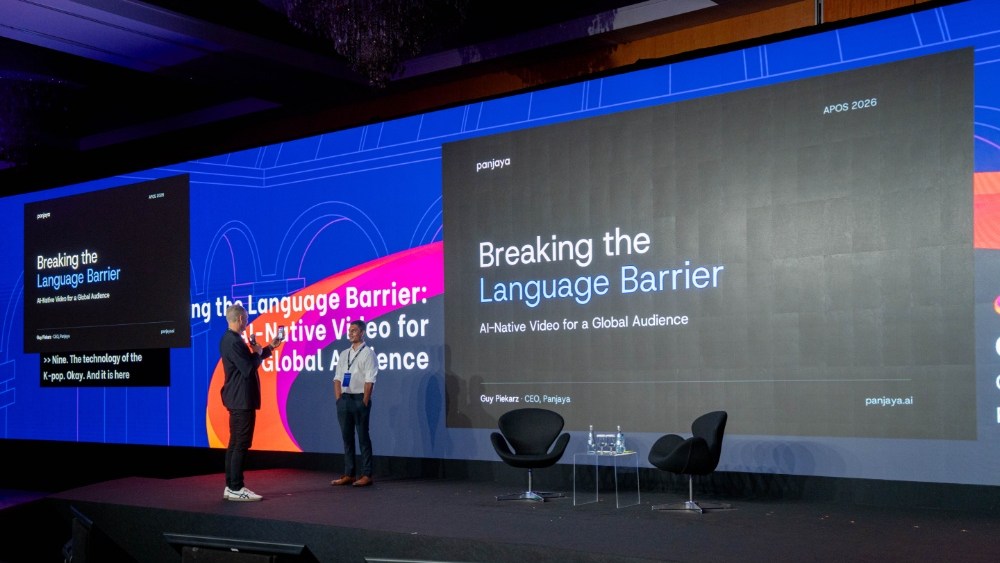
Asia’s entertainment industry is entering a new stage of maturity. Growth remains important, but executives at this week’s APOS conference in Bali were focused on building a sustainable ecosystem, scalable IP, and deeper audience engagement. Here are eight themes that characterized the conversation.
IP has become the new currency
Whether it’s Netflix trying to awaken a dormant fan base with Japanese live-action and Chinese-language content, or MD Entertainment pursuing global co-productions, one theme has emerged repeatedly: ownership of intellectual property is more important than ever. The focus has shifted to creating franchises that can expand across platforms, markets, and formats. “I always think of myself and my team as portfolio managers,” said Minyoung Kim, Netflix’s vice president of content for Asia Pacific (formerly India), pointing to successful investments in South Korea, Japan and India. In the “Indonesia At Scale” session, MD Entertainment founder and CEO Manoj Panjabi said that while global streaming services have become an important gateway for bringing Indonesian stories to a global audience, future growth will increasingly depend on cross-border IP development.
AI is moving from experimentation to infrastructure
Vivek Koot, CEO of Media Partners Asia, which organizes the conference, set the tone in his opening remarks by saying that AI has moved from a conference topic to a real-world application. JioHotstar specifically explains this point. Chief Architect Vijay Seshadri said the platform introduces conversational voice detection built with OpenAI, with more than 60% of users choosing voice over text for content detection. ReelShort described AI as a future production workflow that will work alongside traditional live-action. Day two’s dedicated panel on GenAI across the content pipeline, featuring JioStar’s Stephan Bugaj and FBRC.ai’s Todd Terrazas, was followed by sessions on AI-native filmmaking, AI-powered localization, and AI video generation. This was a depth of content that was unimaginable at previous summits.
Fandom is now a business strategy, and sports are the clearest proof of that
Crunchyroll’s expansion into Taiwan and South Korea has highlighted how anime fandom is increasingly seen as an economic driver rather than a marketing product. At APOS, sports emerged as the category where this logic was most evident. Ishan Chatterjee, CEO, JioStar Sports, said the platform currently delivers over 1 billion viewers on a regular basis every IPL cricket tournament season, reaching 1.2 billion in 2026, and set a world record for digital concurrent viewership of 72.5 million for the ICC Men’s T20 World Cup Cricket 2026 final. Chatterjee said live sports is still one of the few formats that can attract viewers at that scale, and cited JioStar’s 10-year investment in Kabaddi (which now draws more than 300 million viewers per season) as evidence that cricket’s top-of-funnel viewers can be redirected to build fandom for other sports from scratch. On commerce, it cited the integration of JioStar and food delivery platform Swiggy as part of a broader push to combine content consumption and transaction experiences. Speaking to Variety ahead of the summit, Coote cited the changing geography of cricket as further evidence of the sport’s expanding reach. The latest ICC cycle saw meaningful demand emerge for the first time in Japan, Indonesia and Thailand. “How do you monetize it?” Kout said. “How do you develop a fan base? And how do you develop new revenue streams, such as merchandising, ticket sales, and working with brands and advertisers, rather than just relying on these rights cycles?”
Vertical entertainment is becoming mainstream – the numbers prove it
From ReelShort’s expansion into Southeast Asia to FlareFlow’s efforts to build a vertical reality franchise, industry leaders are increasingly describing vertical storytelling as a long-term content category rather than a passing trend. This category now has an economic weight commensurate with its beliefs. Media Partners Asia estimates that DramaBox and ReelShort, two of the most profitable players in the micro-drama space, collectively generate nearly $1.5 billion in annual revenue, and ReelShort, which has most of its users based in the US, announced a new partnership with Philippine telecom company Globe at the summit, following a deal with Thailand’s AIS two months ago. In the session “Building a Vertical Stack in Asia”, Mr. Timothy Oh, General Manager and Chief Marketing Officer of COL Group International, said, “Today, we are already witnessing the development of vertical documentaries, vertical IP, and vertical franchises.” Cassandra Yang, CEO and co-founder of RisingJoy, separately announced the launch of RJOY. RJOY is a direct-to-consumer microdrama streaming service launching in the US and Japan via TikTok Mini, with 20 original productions scheduled for the second half of 2026.
Connected TVs are reshaping home screens across Asia
A theme across multiple sessions was that the transition from digital viewing to television is accelerating. YouTube India country managing director Gunjan Soni told APOS that the platform currently holds the highest reach of any media property on connected TV screens in India, according to Comscore data, describing YouTube as “India’s primetime screen”. Creator-driven cricket content alone generated 190 billion views on the platform in 2025, with 66% of time spent on non-live content such as analysis and behind-the-scenes programming. JioHotstar’s Bharath Ram cited India’s roughly 100 million connected TVs as a factor behind the platform’s accelerated CTV push, while Soni said YouTube now reaches more than 75 million Indian adults aged 18 and above on connected TV screens. Collectively, the data points to a market where mobile-first assumptions are rapidly being revised.
Governments appear on courtroom streamers
This year’s summit made visible a new dynamic, with civil servants actively competing for productive investment. Jakarta’s Deputy Governor Rano Karno attended APOS and announced a six-point initiative to position the Indonesian capital as a major production hub. This is centered around a tax rebate program that will allow eligible domestic filmmakers to receive a tax refund of up to 50% of costs incurred in the city, and is scheduled to officially launch on June 26th. He also held separate discussions with senior Netflix executives about expanding the streamer’s production in Jakarta. The moment was notable for suggesting that governments in the region are increasingly recognizing that content production infrastructure is worth attending and promoting at media summits as a priority for economic development.
The creator economy has become a macroeconomic force.
Soni positioned India’s creator ecosystem not as a marketing channel but as a structural economic contributor. “India represents a blueprint for how the digital creator economy can achieve institutional scale,” she said. YouTube reported that 200 million logged-in users searched for shopping-related content on YouTube India in 2025, with shopping watch time increasing 250% year-over-year. The content-to-commerce pipeline (where creators drive purchase behavior directly) emerged across multiple sessions as one of the most commercially tangible developments in Asia’s digital economy.
Asia is no longer just a market, it is becoming an industry growth engine
Netflix, which is celebrating its 10th anniversary in the Asia-Pacific region, released figures at the same time as APOS, showing that APAC content now accounts for more than half of all titles appearing in the world’s top 10 non-English rankings each week, up from about 30% in 2021, and that the amount of time spent watching APAC content on the platform has quadrupled since 2019. Prime Video, Disney and regional players all highlighted the growing international appeal of Asian stories. In his opening remarks, Couto pushed back on the words disruption and reset, preferring to more accurately describe what APOS captures. “It hasn’t really reset,” he said. “In fact, it’s being redefined. The entire industry is being redefined in terms of possibilities, in terms of new revenue streams and, frankly, in terms of the cost structures that we have to adopt.”
