

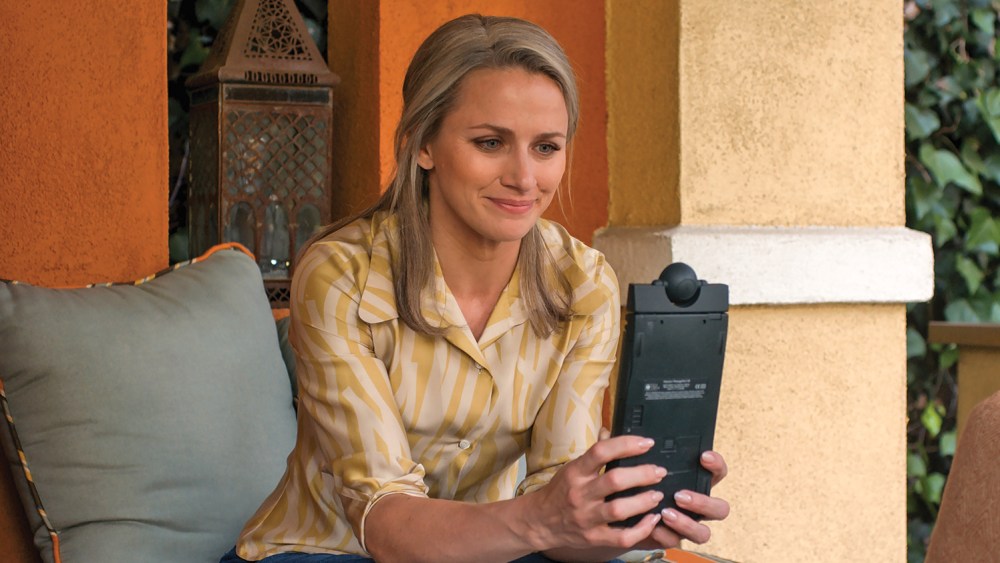
Each season of Apple TV’s For All Mankind begins the same way for props master Jaime Mengual. In a meeting with co-creators and showrunners Ben Nedivy, Matt Wolpert, and producer Ben McGinnis, they discuss one prop: the Apple Newton.
Apple products and their use in movies and television have long been a source of conversation. Who can carry an iPhone on screen? Are the bad guys forced to use nondescript phones and computers to avoid confusion with devices bearing Apple’s famous logo? Now, For All Mankind asks a completely different question. Can its characters use completely forgotten Apple products that were canceled 20 years ago?
For those who didn’t go through the handheld personal assistant phase in the 1990s, the Newton was an early Apple mobile device that used a stylus-controlled touchscreen for digital scheduling and organization. But in the world of PalmPilots and BlackBerry, it lost out to some flashy competition and was discontinued in 1998, despite being credited with paving the way for the iPhone. Still, in the alternate history timeline in which For All Mankind has existed for five seasons, America’s ambitions for space exploration never run out of rocket fuel, and the Newton thrives as the iPhone of its day.
But it doesn’t work exactly the same way as our smartphones. It’s an advanced communication tool that bridges people on Earth, Mars, and everywhere in between, but it’s not very addictive.
“The technology in our world is really dictated by the fact that when the internet started, it wasn’t in the public domain. So the rise of social media doesn’t really happen in the world of ‘For All Mankind,'” Mengual told Variety. “This really changes the personal connection to the device. In our world, communication and characters are used very often to learn things through Newton.”

provided by apple
The first Newton to appear in the series in Season 3 came courtesy of a scourer on eBay, where Mengual found several authentic Newtons in good condition. He watered down the artifacts, backlit them, and baked in the graphics. Soon, mounted cameras were also added, adding video capabilities. This is a feature that didn’t really exist.
“I like digging through the archives to find iPhone prototype images that didn’t exist before and things they tried,” Mengual says. “We follow the iPhone a little bit, and Newton does some things that we wish the iPhone could do, but we’re not quite there yet.”
At least we weren’t in the ’90s, when “For All Mankind” offered features like Newtons FaceTime and capacitive touch technology. Every choice made for the evolving Newton is discussed with the Apple team to approve a design for how apps and sounds will change seasonally. Especially with Mengual, he’s mainly focused on the hardware and whether the buttons are placed and if the buttons are placed.
In Season 4, Newton’s expanded design was heavily influenced by the iPad Mini. In Season 5, we scaled it down to make it look like an iPhone. Mengual tried to build a model from scratch using an AMOLED screen, but that didn’t work, and he retreated to housing a real iPhone in an aluminum Newton case. However, their Newton is neither sophisticated nor sexy. They are situationally practical.
“Just because our technology is advanced doesn’t mean the hardware can’t get a little clunky or retro,” he says. “Part of the design motivation was that the technology needed to be a little more robust in a Mars or lunar environment.”
Mengual also has to consider that there are almost certainly no Genius Bars in the universe. “There may not be an Apple repair shop on Mars as close as you’d like, so things will have to last a little longer,” he says.
