

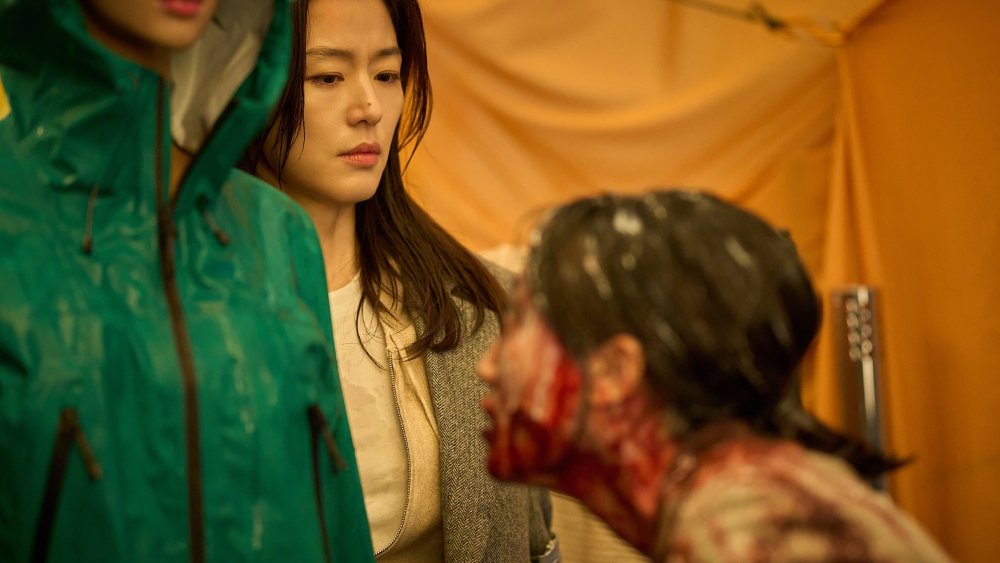
“Train to Busan” proved that humans cannot outpace the number of infected people. “Colony” proves they can’t outsmart them.
Director Yeon Sang-ho returns to the zombie genre with his third live-action thriller Colony, expanding on the “Yoniverse” of cinematic universes he has built through genre-defining horror films. This Korean film marks the long-awaited return of Gianna Jun (also known as Jeon Ji-hyun) to the big screen after 11 years, co-starring Koo Kyo-hwan and Ji Chang-wook.
Colony, which made its North American debut as an opening night film at the 25th New York Asian Film Festival, is scheduled to be released in U.S. theaters on August 28th through Well Go USA and tells the story of Kwon Se-jeong, an unemployed biotechnology professor played by Gianna, who is trapped in a high-rise building due to an outbreak of a rapidly mutating virus. The infected evolve into beings smarter and more dangerous than your average zombie, while the survivors must flee.
Indeed, the zombies in “Colony” are unlike anything audiences have ever seen from Yong. Rather than standard reanimated corpses, the infected are connected by collective intelligence and can learn, adapt, and adjust as one. When one zombie evolves, so does the entire group.

Yeon Sang-ho and Gianna Jun attend the premiere of “Colony” on opening night of the 2026 New York Asian Film Festival at Walter Reade Theater on July 10, 2026 in New York City.
Getty Images
“The most difficult thing was how to visually represent the zombies, who exist in the form of colonies with collective intelligence. In order to convey that intuitively to the audience, the zombies’ movements had to be unique,” Yong told Variety. In “Train to Busan,” break dancers were used to choreograph the movements of infected people. “Colony” took a different approach. “This time, we hired an experienced modern dance team to choreograph the group movements in order to create movements that could better emphasize the group nature.”
According to Yeon, the idea of the collective influenced his approach to film. “I thought it was very interesting that organisms that are based in real aggregations or colonies are constantly producing variants and mutations. The reason for this is that they are a group of people with exactly the same characteristics, so if one weak point is found, the entire colony may perish all at once, so they are constantly producing mutants.”
The film’s antagonist, Seo Young-chul (Koo Kyo-hwan), is driven by the belief that imperfect communication is the root of all tragedy. This belief leads him to orchestrate the film’s bioterrorist attack. However, Yong disagrees with him.
“I think many of my films have explored the question of what it means to be ‘human,'” he insists. “I had the same concerns with this film. What I think is ‘humanism’ in this film is individuality. In other words, humans have no choice but to have individuality, and I think it is precisely because we cannot communicate perfectly that we are more human.”
Young-chul considers individuality to be humanity’s greatest flaw, whereas Se-jeong’s personality represents the strength of individuality. When developing Se-jeong, Yeon envisioned a character who was an outcast, but not someone weakened by isolation. He wanted her to be assertive and confident enough to choose solitude for herself. “Kwon Se-jeong is a complex character. She has to be an outcast and at the same time confident,” he says. “When I thought about who could represent that, I naturally thought of Gianna.”
Yeung’s admiration for Gianna’s ability to play unconventional female characters dates back to the early days of her career. “Even in her debut film, “Mysterious Girlfriend,” her character was something that had never been seen in Korean films before,” he says. “I’ve always thought of her as an actress who changed the paradigm for female characters, and she’s continued to do so many times since through her different roles and performances.”
The ending scene of the movie suggests that the fight against the infected may not be over yet. Yeon admits that he already has plans for what’s next, but it’s not what fans might expect. Rather than teasing another film, director Yong revealed that he is currently in talks with Smile Gate, the film’s co-producer and game developer, about the possibility of continuing the story of “Colony” as a video game.
A scene from “Colony.”
Well Go USA
As for the inspiration behind “Colony,” Yung cited the 1978 sci-fi horror classic “Invasion of the Body Snatchers” as one of the biggest influences behind the film. Other recent works that have inspired him are “28 Years Later” and “The Last of Us.”
As Korean films continue to expand globally, Gianna was asked if she would like to pursue Hollywood projects in the future. The short answer is “no.” “I feel strongly that the most Korean thing is the most global thing,” she says. “I think it’s more meaningful to work with great directors and actors here in Korea than to look for work overseas.”
Director Yeon expressed similar sentiments when asked about the possibility of a Hollywood remake of “Train to Busan.” Although he acknowledged that there had been efforts to remake the film in English, he said he had no intention of directing it himself, saying, “I feel that I was able to fully express everything I wanted to do with the original film Train to Busan.”
Nearly a decade after “Train to Busan” changed the perception of Korean horror around the world, “Colony” suggests that the next evolution of on-screen zombies isn’t just faster or stronger, but smarter.
