

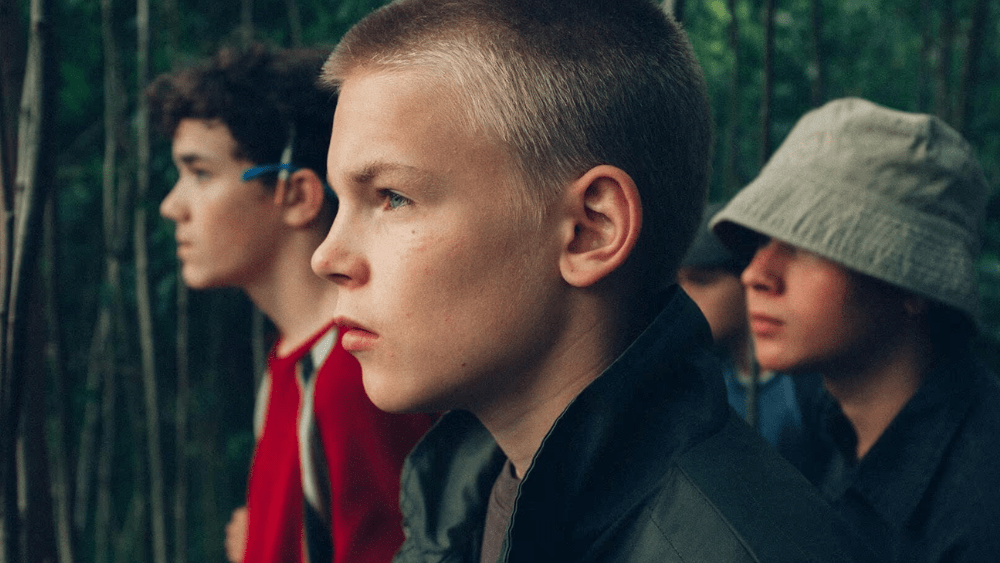
Tony Pill’s directorial debut, Frank, was inspired by a tragic personal incident. When the director was a boy living in a small town in Estonia, an intellectually disabled person fell under a train and tragically died. Rumors quickly spread that it was the work of a group of boys who had bullied the man who had pushed him onto the tracks. “That gruesome detail was the main motivation for wanting to tell his story,” Pill told Variety after screening the film at the Raindance Film Festival.
Frank, a moving coming-of-age story inspired by Rob Reiner’s Stand by Me, Jonah Hill’s Mid-90s, and Ali Abbasi’s Border, follows 13-year-old Paul, who arrives in a strange town after a serious incident of domestic violence. Struggling to fit in and struggle with his rebellious personality, the teenager makes one bad decision after another until his downward trajectory is altered by the titular disabled man played by Oscar Seeman.
Pill entered the industry as an assistant director and received his second feature film credit as director Christopher Nolan’s “Tenet,” which was shot in Estonia. When asked if he could apply what he learned from these major sets to his own, the director said, “Big budget sets usually come with a huge financial burden, which often results in very aggressive and unfriendly sets.”
“Working on these large sets, I mainly learned that you should always be kind, regardless of your hierarchy on set,” he added. After all, we work as a team, so no one should feel bad just doing their job. ”
Tenderness and patience were especially important in Frank, given that the director was working with a cast comprised primarily of children and teenagers. Pill went through a two-month casting process and considered more than 500 candidates. “It was a really enlightening process,” he recalls. “There was a six-month gap between the production of the short film and the final funding, and we were very worried that we might lose some children in their adolescence, but the film gods were with us and all the children we had still fit into the final film.”
When asked about tackling disability on screen, the director said he approached it with two things in mind. “First of all, respect for the real person that the character is based on, and secondly, we tried to de-emphasize the fact that we have an outcast character with a disability. Rather, we want this very empathetic, joyful, and hopefully inspirational person to come into the world and hopefully inspire someone.”

“Fränk” (Courtesy of Raindance Film Festival)
As part of this process, we worked closely with Seaman to develop the characters. “We had a thorough discussion, and then we started figuring out the physical and vocal aspects by putting him in costume, walking around the city, and letting him stay in character. It was actually quite a tense experience because we found out that a large part of our society is actually afraid of people like Frenk, and we encountered some small conflicts where we actually had to defuse the tension.”
“Frank” is also a film about male friendship and boys’ mental health, themes that are currently very popular due to misogynist movements such as the manosphere and the Red Pill movement. “I’m glad that these sensitive topics are receiving more and more attention these days,” says the director. “What I missed as a kid was good male leaders, and this is even more meaningful now. With the recent (Andrew) Tate cult, I think we need to show better, positive examples of men. We need to show positive leaders, and we also need to show misunderstood children and adult men how they can change for the better.”
Regarding the recent growth in his country’s film industry, Pil said that while more and more big productions coming to Estonia is “very helpful” for the industry and its staff, there are still major financial barriers preventing films from flourishing in the Baltics. “There’s actually not that much money to make Estonian films, so there’s a decline of talented directors who are in financial difficulty,” he says. “In this country of 1.3 million people, we can only make four or five fiction films a year on a general budget. A lot of directors are starving until they finally get a chance to make a movie. I really hope things get better soon, because if they don’t, a lot of stories will be lost.”
