

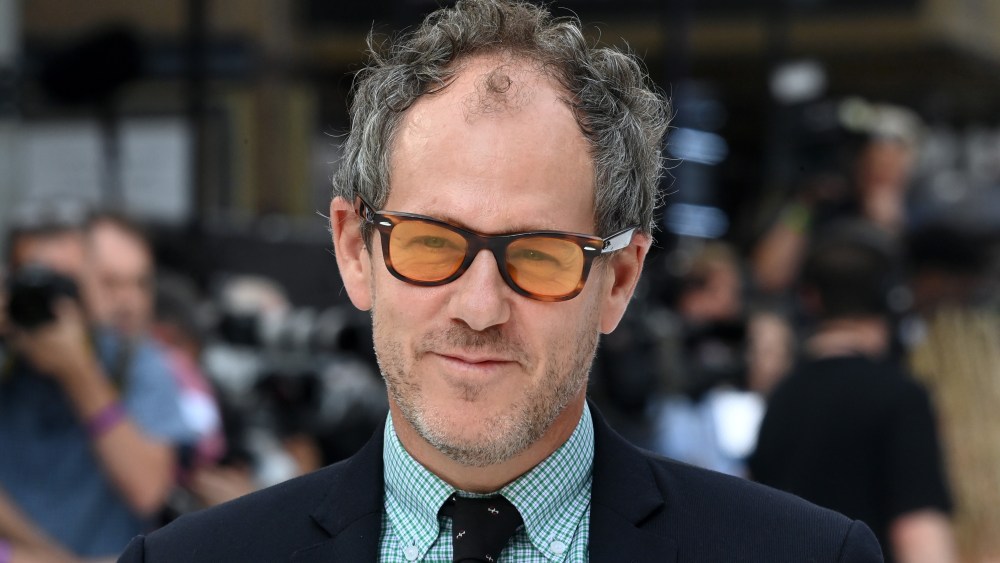
Sanford Panitch arrived at the Cannes Film Market with a theory he wants the Japanese entertainment industry to hear. Theater remains the only window for creating sustainable global IP, and the age of anime has arrived, and Japanese rights holders are leaving opportunities on the table by waiting too long to get involved.
The president of Sony Pictures Entertainment Film Group made the assertion at a session hosted by Japan’s Ministry of Economy, Trade and Industry and the Japan External Trade Organization. This is part of an industry program following Japan’s designation as an honorary country at this year’s Cannes Film Market, an honor that brought an unprecedented number of Japanese titles, talent and industry delegations to the Croisette.
The conversation, moderated by Re-Entertainment’s entertainment sociologist Atsuo Nakayama, covered Sony’s approach to Japanese IP, Crunchyroll’s growth, and the studio’s strategy to expand its presence in Asia’s local content market.
“True global IP has never been created by a streaming service,” Panitch said flatly, pushing aside the assumption that the sheer volume of content flowing through subscription platforms will lead to franchises with true cultural staying power.
His argument was partly based on marketing. Streaming platforms, he said, are structurally unwilling to invest in the kind of theatrical marketing campaigns that studios run, campaigns that, by their very nature, insert movies into the cultural conversation before anyone has seen them. He cited “Napoleon,” which Sony distributed theatrically for Apple, and “F1,” which Warner Bros. released for Apple, as evidence that even movies intended as streaming titles, if properly released theatrically, can garner larger audiences and greater value on their respective services.
Panitch argued that anime is in a particularly advantageous position, given the streaming environment that has shattered the old monoculture. Before the internet, before TikTok, audiences gravitated toward a single, shared cultural reference point, making the mainstream their default ambition. That world is gone. Instead, deep subcultures have formed, of which anime is one of the most globally embedded, he said.
“In fact, being specific is the key to being global,” says Panitch.
Crunchyroll, which Sony acquired in 2021, had about 3 million subscribers at the time. Currently, it has more than 20 million users outside of Japan. The platform is dedicated to anime, and Panitch held it up as a measure of how far the subculture has gone from a niche world to a solid global audience. The worldwide theatrical release of Chainsaw Man, which Sony distributed outside of Japan through its Crunchyroll pipeline, struck him as the clearest recent evidence of its reach.
“There was no fan base for ‘Demon Slayer,'” Panitch said. “Despite having no previous film to fall back on, Chainsaw Man was an unusual success.”
Panitch attributes Hollywood’s widespread focus on Japanese IP over the past few years to a confluence of factors. These include the gold rush mentality that films like Sonic the Hedgehog and the Super Mario Bros. movies inspired, the role of technology (TikTok, translation tools, AI) in lowering the barrier to understanding the original, and the industry-wide recognition that IP is now an essential prerequisite for theatrical survival. He acknowledged that it’s becoming increasingly difficult for original films to generate box office success.
In terms of fanship, Panitch drew a line between Kevin Feige’s comic book fluency at Marvel and the new generation of genuine manga and anime superfans currently in a position to lead animated features. He said the lesson of One Piece on Netflix is that a deep creative partnership with the original author, an understanding of what the fanbase needs to perceive as authentic, is what made the series a success where many previous Japanese anime versions did not. He said it’s now part of Sony’s process for Hollywood screenwriters to meet directly with manga artists.
He spoke candidly about the issues that still plague Hollywood companies operating in Japan. He said the consortium system and the power of publishers make deals unusually complex, and the sequential logic of Japanese intellectual property, which moves from manga to anime to local live-action before Hollywood gets involved, often leaves studios arriving later than ideal. He said he felt empowered by Japanese companies to demand a more creative voice on adaptation and hoped that dialogue could start sooner.
“The sooner Hollywood can have a dialogue with IP, the better,” Panitch said. He cited Neil Druckmann’s role as a producer on Uncharted (he was treated as a true creative partner rather than a licensor) and Sony’s acquisition of the original Japanese novel of Super Express before an English translation existed as models of what early trust-based engagement looks like. The goal, he argued, is a 360-degree IP approach where Japanese companies stop thinking of Hollywood as a downstream destination and start thinking of it as a co-producer.
“We are now making it a priority to have Japanese products part of our lineup across almost every label in the company,” Panitch said. Not just because Sony is a Japanese company, but because the fan base surrounding Japanese IP is too commercially important to treat as secondary.
Sony Pictures International Productions is the largest investor in the live-action Kingdom series and is currently working on a fifth film. Columbia Pictures will release director Zack Creger’s Resident Evil reboot on September 18th, based on Capcom’s Japanese video game series. Rather than adapting established game characters, Creger, whose credits include Weapons and Barbarian, is creating an original story set during the Raccoon City outbreak. Panitch also confirmed that Nintendo creator Shigeru Miyamoto is closely involved in the development of The Legend of Zelda.
“He’s very evolved in everything we do in Zelda,” Panitch said of Miyamoto. “This is truly his film and we are truly grateful to be able to support it.”
Panitch said Japan’s local box office revenue has flipped over his career from about 70% Hollywood to about 70-80% local content, a shift that has been replicated in South Korea, India and across Southeast Asia. For the right partner in Hollywood, he suggested, it’s a sign of market deepening, not market closure. “I sincerely commend Cannes for recognizing the power of Japanese film and Japanese intellectual property this year,” Panitch said.
