

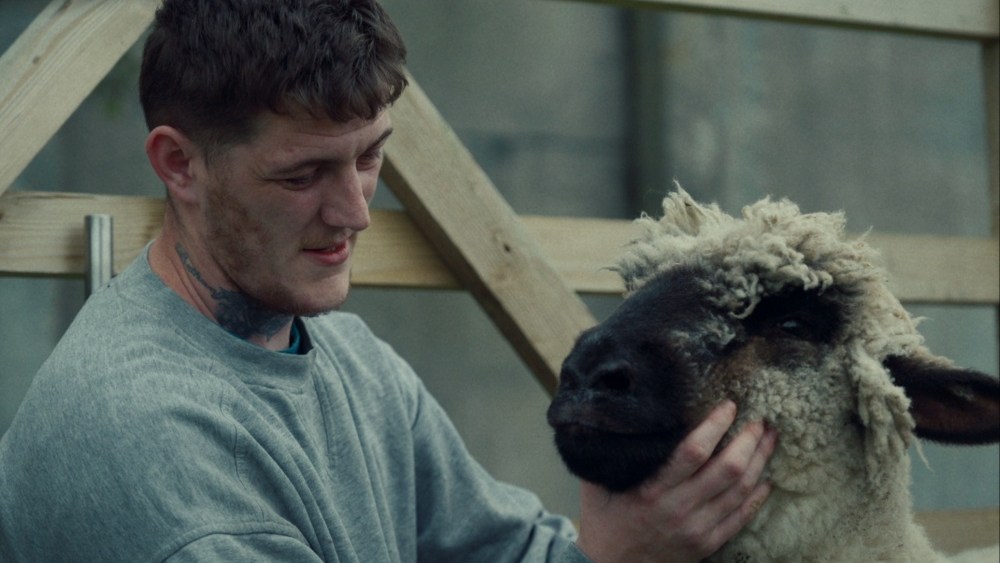
When director Ross McLean first met Ryan Craig while running a workshop at a young offenders prison in 2019, he never imagined he would be filming the young man for the next six years.
The result is the Northern Irish director’s debut feature, Magilligan, which premiered in competition at Switzerland’s premier documentary film festival, Visions du Lille.
Named after the prison where Ryan committed a heinous crime as a teenager and spent the best years of his decade between the ages of 18 and 28, the film is built around the central question of how much of one’s life is shaped by family and environment, and how difficult it is to break free from that.
MacLean first met Ryan, whose family history includes prison and riots, while filming the short film “Hydebank” at the juvenile offender institution of the same name. “Magilligan” begins with an image that stuck with the director. As part of the prison’s breeding program, Ryan tends to sheep against the backdrop of the prison’s high walls.
“There’s a sheep sanctuary and a farm inside the prison. It’s a place where you can see him really relaxing and being himself,” MacLean told Variety.
What unfolds is not a story of reintegration, but of a cycle in which Ryan, who spent most of his adult life indoors, struggles to adapt to life on the outside and returns to prison repeatedly.
Sheep became one of the few essential things in his life. In contrast to the outside world, prison provides a kind of structure in which Ryan finds community and a sense of purpose, albeit a very restrictive one.
That paradox is at the heart of this film. Ryan’s release doesn’t mark a clear break, but it does expose how unprepared he is for life on the outside. “For many people who have been in prison for such a long period of time, even the idea of working is a monumental demand,” says the director.
After serving years in prison, it becomes difficult to meet basic expectations such as housing, employment, and stability.
MacLean reflects that instability through the film’s visual structure, using landscapes that reflect Ryan’s inner life. The open countryside surrounding the prison contrasts with the image of the city, which he describes as an “intimidating and inhospitable place”.
“[The idea was]to talk about where Ryan could find peace,” MacLean explains.
A word from Ryan’s mother brings that tension into focus. “I don’t think he’ll ever find peace,” she says, but the director describes that moment as a turning point. “Where can this man find peace…if it’s not at his mother’s house, if it’s not in the city, if it’s not even by arriving in prison?”
MacLean admitted that at one point he had hoped the story might go in a different direction. “I believed in the fairy tale ending, where Ryan gets free and walks off into the sunset with his flock of sheep. I still might have some hope that there might be something for him in this profession that he’s found and that he’s really passionate about. But I also see the obstacles that this guy has to deal with from the outside.”
This question is reflected in the film’s broader exploration of determinism. The director connects this to his own background. His grandfather was once deeply involved in the Orange Order, a supporter of Northern Ireland, but ultimately distanced himself from the organization and shaped the generations that followed. “My grandfather found a way out of that situation, which led my father and myself to be neutral and open-minded,” says MacLean. “Ryan didn’t have the same contract.”
But the film leaves room for agency, however limited. “The very act of Ryan working with the sheep, even if it’s not entirely sustainable, is a kind of resilience. It’s turning your back on a kind of life and a kind of expectation,” he added.
“Magilligan” was made with a skeleton crew, often just MacLean himself or one other person. This was both a practical necessity in prison and a means of maintaining access. The director also co-wrote, co-produced, and co-edited the film.
He said he hoped the event would go beyond the festival and spark a broader discussion about incarceration. “Prisons and the prisoner experience are all too easily sensationalized and oversimplified,” he says. “I hope this film retains its complexity and is used in places where it can provoke discussion.”
After a recent screening in a Scottish prison, he added: “The footage resonated with young offenders and we were really excited by the discussion that came out of it.”
Mr MacLean is currently developing a feature film set in Belfast’s Shankill area and a short fiction film about Loyalist paramilitary figures, with a continued focus on the social structures that shape life in Northern Ireland.
Produced by Bronte Stahl, MacLean and co-producer Roisin Geraghty, Magilligan is a UK-Ireland-US co-production supported by BFI Doc Society, Northern Ireland Screen, Screen Ireland and SWR/Arte and the LEF Foundation Moving Image Fund.
The film will have its world premiere in international competition on April 19th at Vision du Lille.
