

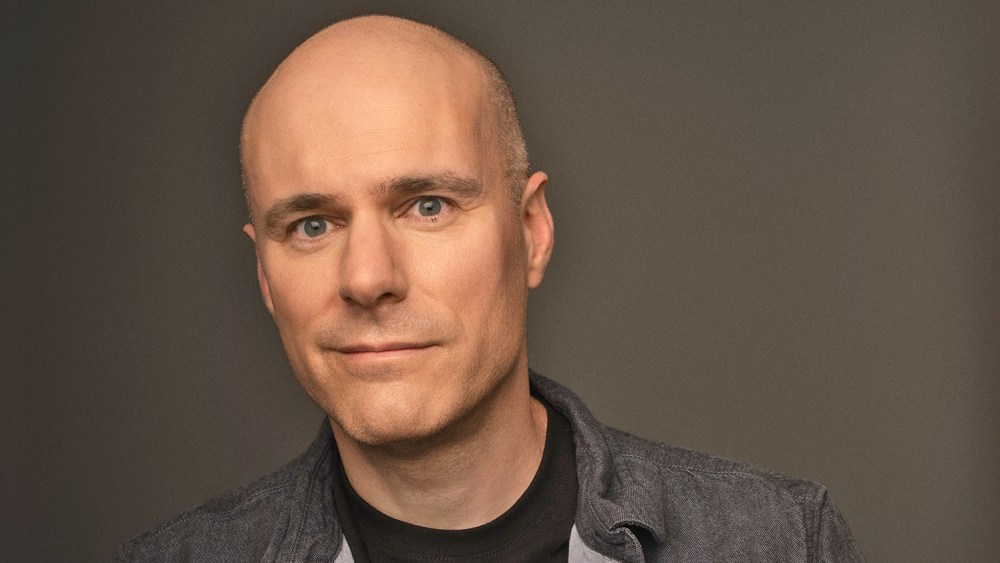
If cartoonist Tom King has a superpower, it’s that everything he writes turns into gold.
Marvel and DC each adapted his comics into films, resulting in 2021’s WandaVision and 2026’s Supergirl. Now, he’s helping build the rebooted DC Universe with his take on Green Lanterns, galactic peacekeepers who can create any item imaginable using a magic ring.
Green Lantern has struggled in Hollywood, lagging far behind Superman, Batman, and Wonder Woman in popularity. Ryan Reynolds brought one of the Emerald heroes to life in the infamous 2011 film Green Lantern. The result is a cheap CGI-filled disaster. For his new HBO series “The Lanterns,” King has reimagined the Lanterns as gritty, down-to-earth detectives, similar to Matthew McConaughey and Woody Harrelson’s “True Detective” characters.
So don’t be fooled by the superhero genre. “The Lantern” carries as much weight as any hit HBO drama. In fact, after the heroic adventures of Superman and Supergirl, the DC Universe is charting a more mature path. On the show, Kyle Chandler plays Hal Jordan, a grumpy Green Lantern who reluctantly trains an upstart apprentice (Aaron Pierre). The argumentative pair are called to investigate a murder in rural Nebraska that has a mysterious connection to dangerous extraterrestrial life.
King has the comic credentials to fill The Lantern with plenty of references for fans, but he also brings a wealth of espionage and detective knowledge from unexpected sources. He worked as a counterterrorism official for the CIA from just after 9/11 until 2009.
It’s raining early in the morning in Brooklyn, but King, who is in town for the world premiere of “Supergirl,” based on the Western comic “The Women of Tomorrow,” is wide awake and doesn’t need coffee. He stayed out late after the premiere and was up early to prepare to fly to France’s Annecy Film Festival to present “Mister Miracle,” another animated version of his comic. His three children also joined him on the trip and got to see their dad frolic at the star-studded event. In just a few hours, King will escort the children to Newark Airport to board their first international flight, but for now, King is calm and ready to talk about his favorite thing in the world: comics. When asked how he manages to balance everything, he says it’s thanks to the CIA’s sleep deprivation training.
“If you’re only getting two or three hours of sleep for months on end, you’re going to go crazy,” he says. “These days, I play Mister Miracle during the day, then spend time with my kids, and after 10 p.m., I’m back on the computer writing until 3 p.m.”
Before his career detoured into counterterrorism, King started out like many other comic book writers. When I was 7 years old, I bought my first issue, “Avengers” #300 (which I still own today). His obsession grew from there, landing him internships at both DC Comics and Marvel while attending Columbia University. As an intern, he worked as a copy boy at DC’s Vertigo imprint, making copies of Garth Ennis’ “Preacher” and serving as an assistant to “X-Men” screenwriter Chris Claremont, who made Marvel’s mutants an international bestseller.

“Lantern” by Aaron Pierre and Kyle Chandler
HBO Max
But the comics bubble burst in the early 2000s, just as King was graduating from college. He learned this when his boss at Marvel called him and said, “Hey, hey, comics are dead. This industry is dying. Marvel has declared bankruptcy. Superheroes are going away.”
Indeed, before films like Spider-Man (2002), Batman Begins (2005) and Iron Man (2008) launched the world of superhero movies, the comic book industry went through a rough patch that redirected King toward a new career path. In 2000, after a phone call with his boss at Marvel, King pivoted to work at the Justice Department in Washington and planned to attend law school. But 9/11 changed his life again.
“Like a million other people, I was thinking, ‘What can I do to help my country?'” King recalled. “I applied to the CIA because I was good at intelligence. I think the comics helped, like knowing all the Avengers and their first appearance. I could be a dot connector. To my surprise, after a year of training, they say, ‘You’re a front-line guy.'” Then I became a case officer for the CIA. That’s how I spent my 20s. ”
Some comic book readers take issue with Dr. King’s past and equate his service with pro-war sentiments. Several of his later books were based on his CIA experience, including DC’s The Sheriff of Babylon, which follows a military consultant who solves murders in Iraq, and Grayson, which reimagines Batman’s former Robin into a gun-toting spy. But Dr. King silenced the rumors.
“I’ve seen rumors that I started the Iraq war. I didn’t start the Iraq war. I was 23 years old,” he says. “I was against al-Qaeda and the Taliban. I was trying to stop them from doing horrible things. I was against the Iraq war. I thought this was the stupidest thing to do. I was watching people lie on TV, but I still had to go. That was my duty. I worked on some cases where people tried to blow up the base, and we stopped them. Should I let those kids die just because I didn’t agree to the war?
After seven “very stressful” years at the CIA, a care package from his mother sent to Baghdad convinced King to quit the agency and return to writing. The package was full of new-age comics from 2000s powerhouse writers Brian Michael Bendis, Mark Millar, and Ed Brubaker. After giving up on the medium, Dr. King discovered the writers who elevated superhero stories to a prestigious art form. “This was the generation that reimagined comics,” he says. “They turned them from books with pictures to movies with words,” he says. “I was shocked.”
After deciding to leave the CIA, King returned to comic book writing for Marvel and DC. His first big hit was 2015’s The Vision, which moved Marvel’s androids to a quaint suburban neighborhood where they retire from crime fighting and live peacefully with a family of robots. If it looks familiar, that’s because it was the inspiration for Marvel’s first Disney+ TV series, WandaVision.
The Vision was the first of King’s comic books to be made into a film, but it wasn’t the last. After that, she signed an exclusive writing contract with DC Comics and wrote issues such as the 85th issue of the masterpiece “Batman” series and the 2021 hit “Supergirl: Women of Tomorrow.” Supergirl caught the attention of filmmaker James Gunn, who decided to bring the series to the big screen when he and Peter Safran rebooted the comic book universe.
“Even before I took over building DC Studios, I thought this was a great comic,” Safran says. “We love the idea of working with comic book authors and taking them out of their comfort zone and into another realm.”
So in 2022, Gunn and Safran recruited King to DC’s brain trust, the Justice League of writers who help plan the future of the nascent universe. The group met at Saffron’s house, where everyone was given a copy of The Women of Tomorrow to read. There, in addition to greenlighting the movie “Supergirl,” Dr. King pitched “The Lantern” as a grounded murder mystery. The writers loved the idea, and “The Lantern” was added to the DCU’s announcement schedule.
“It’s easy to forget that superheroes are human. What they want is the same thing you and I want. That’s basically Tom’s approach,” says Damon Lindelof, who joined “Lanterns” as a co-creator along with “Ozark” showrunner Chris Mundy. “There’s a sophistication to his writing because he’s lived a life. Before I was a writer, I was a writer’s assistant. Tom was in the CIA. He’s experienced a level of intensity that permeates his work.”
“Lantern” has been a hot topic at San Diego Comic-Con, which means King’s sleep deprivation will continue for the foreseeable future. He has since stuck with the DC Universe, turning the acclaimed comic book Mister Miracle into an animated series that follows Scott Free, an immortal escape artist with PTSD. King won two Eisner Awards for this series, comics’ equivalent of the Academy Awards.
“Of all the books I’ve written, this one is the one that can connect with people on a deeper level, because it’s the story of a man who attempts suicide, goes through something, and comes out of it,” he says. “What matters is how you recover from the trauma and live with it.”
After a short trip to France with the kids, we’re off to San Diego Comic-Con for “The Lantern.” He’s no stranger to Comic-Con and its giant Hall H stage, but this year will be different.
“The first year I went to that convention, I was selling my novels, and I was given a table in the far corner of Hall H, and no one was there,” he says. “I sat there for five days and listened to the hole explode every 10 seconds. This year, for the first time, I will be standing in Hall H. The hole goes completely around.”
