

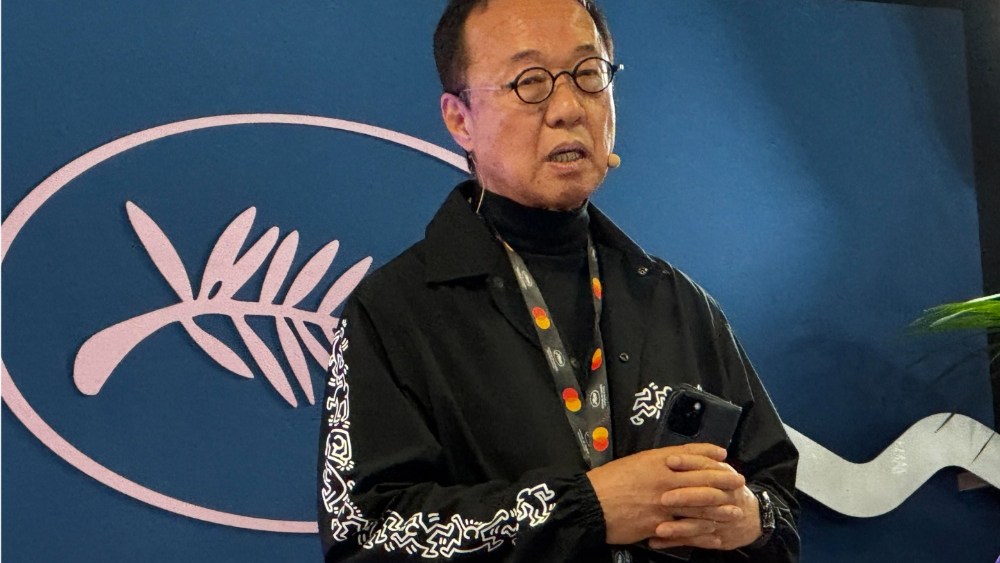
Tetsu Fujimura, CEO of Japanese IP consultant and production company Philosophia, and producer of Netflix’s live-action series One Piece, gave a data-intensive keynote speech at Cannes Film Market, providing a comprehensive explanation of the burgeoning global market for Japanese IP film adaptations and cataloging Hollywood’s development pipeline across all major studios.
The session, part of Japan’s designation as an honorary nation at this year’s event and hosted by the Japan Honorary Nation 2026 Executive Committee, Japan’s Ministry of Economy, Trade and Industry, and the Japan External Trade Organization, was titled “The Future of Japanese Intellectual Property in Global Adaptation.”
Fujimura started by establishing a commercial context. He presented 45 years of box office data showing that IP-based films have grown from about 10% to 20% of the world’s top 30 in the 1970s and 1980s to more than 80% today. All titles in the world’s top 10 for 2024 are IP-based, with Godzilla x Kong: New Empire and Sonic the Hedgehog 3 coming in at No. 8 and No. 10. “Demon Slayer: Kimetsu no Yaiba Infinity Castle” ranked 7th in the world’s top 10 in 2025.
To explain Japan’s position as an IP powerhouse, Fujimura cited data from Titlemax showing that 10 Japanese franchises rank in the top 25 in the world in terms of all-time IP revenue. Pokémon leads the pack in terms of estimated lifetime revenue with $92.1 billion. This was followed by Hello Kitty with $80 billion, Anpanman with $60.3 billion, Super Mario with $36.1 billion, and Shonen Jump with $34.1 billion. In the “Fandom Franchise Top 25” fan voting ranking, “One Piece” was ranked 3rd in the world.
The slides, which quote a Nikkei Shimbun report from June 2025, highlight what Fujimura described as structural changes in the economy. The combined market capitalization of Japan’s top nine entertainment companies – Sony Group, Nintendo, Bandai Namco, Konami Group, Nexon, Capcom, Sanrio, Toho, and Square Enix – temporarily exceeded the market capitalization of Japan’s top nine automakers, reaching approximately 53.8 trillion yen (approximately $359 billion), compared to the auto sector’s 48.1 trillion yen (approximately $359 billion). ($321 billion). Grand View Research predicts that the global anime market will reach $77.3 billion by 2033, up from $26.5 billion in 2021, and the manga market will grow from $7.3 billion in 2021 to $43.9 billion by 2033. The global gaming market is projected to reach $505.2 billion by 2030.
Filosophia’s exclusive research tracked the number of Japanese IP applications around the world every 10 years. In the 1990s, there were 25 cases, in the 2000s, 52 cases, and in the 2010s, 101 cases.In the current decade, there are already 88 cases, and the number is increasing. Asia, led by South Korea, which accounts for 46% of the region’s adaptation activity, is driving the overall volume and bias toward TV, which accounts for 62% of Asia’s adaptation activity. The US and European markets have the opposite trend, with films accounting for 65% of projects. Source formats vary widely by region. In Asia, novels and manga account for 34% and 32% of adaptations, respectively, while games account for 48% of projects in the US and Europe.
The Hollywood section of the presentation was notable for its breadth. Feature films currently in development include Paramount’s Your Name, directed by J.J. Abrams. ”, the legendary film “Mobile Suit Gundam”, the Sony Pictures films “One Punch Man” and “Astro Boy”, the Lionsgate film “Naruto”, the Warner Bros. film “Attack on Titan”, the Netflix film “My Hero Academia”, and the A24 film “Elden Ring”. Adding to the game-to-screen pipeline are “Metal Gear Solid” and “Ghost of Tsushima” at Sony Pictures, the live-action “Death Stranding” at A24, and the anime “Death Stranding: Mosquito” in development at Line Mileage. On the series front, there’s “Claymore” at CBS Studios and Propagate, “Rashomon” on HBO Max via Amblin Television, “Speed Racer” on Apple TV+ where Abrams is executive producing, “Samurai Champloo” at Tomorrow Studios, “Steins;Gate” on Skydance Television, “Pokémon” on Netflix, and “God of War” on Amazon Studios.
Fujimura, who founded Gaga Corporation 40 years ago and Philosophia 20 years later to connect Japanese intellectual property holders with Hollywood producers, drew on his own career to explain this dynamic. He and Marvel Studios founder Avi Arad spent a decade developing Ghost in the Shell, which arrived at Paramount in 2017. Through a partnership with producer Marty Adelstein’s Tomorrow Studios, Fujimura also worked on Netflix’s “One Piece.” The show debuted in 2023 and ranked No. 1 in 86 countries, with 54 million views and 410 million hours watched in its first 25 days. Season 2 received a 100% critics score on Rotten Tomatoes. Season 3 is in production for release in 2027.
Fujimura also pointed out that Japanese IP is expanding beyond the screen to include theater and music. “Spirited Away”, which was performed in Japanese in the West End in 2024, was performed by a Japanese cast in a venue with approximately 2,300 seats, and attracted 300,000 people in London, making it the largest production of a Japanese-language play overseas in history. Their 2026 tour to Shanghai and Seoul attracted a combined audience of over 250,000 people. On the music side, according to Spotify data, anime-related streaming increased by 395% between 2021 and 2024, and YOASOBI’s “Idol,” the opening theme for the anime “Oshinoko,” became the first Japanese song to top the Billboard Global Excluded Chart. US charts for June 2023.
Data points specific to the Chinese market attracted particular attention. The top-grossing film in China in 2024 was “YOLO,” the Chinese remake of the Japanese film “100 Yen Love,” with box office revenue of RMB 3.46 billion (approximately $486 million).
Fujimura acknowledged that the most prominent Japanese IP titles primarily contribute to studios and platforms. “Attention is starting to shift to the next tier of IP,” he said. “These titles may not be well-known yet, but they have incredible potential. And their scope is expanding. We’re seeing momentum in novels, light novels, and even indie games.”
Mr. Fujimura said, “I truly believe that Japan has the richest creative resources in the world, and that intellectual property in Japan has a great future ahead of it.” “With the power of these IPs, we believe we can create entertainment that resonates with audiences everywhere, including live-action, animation, stage productions and music.”
