

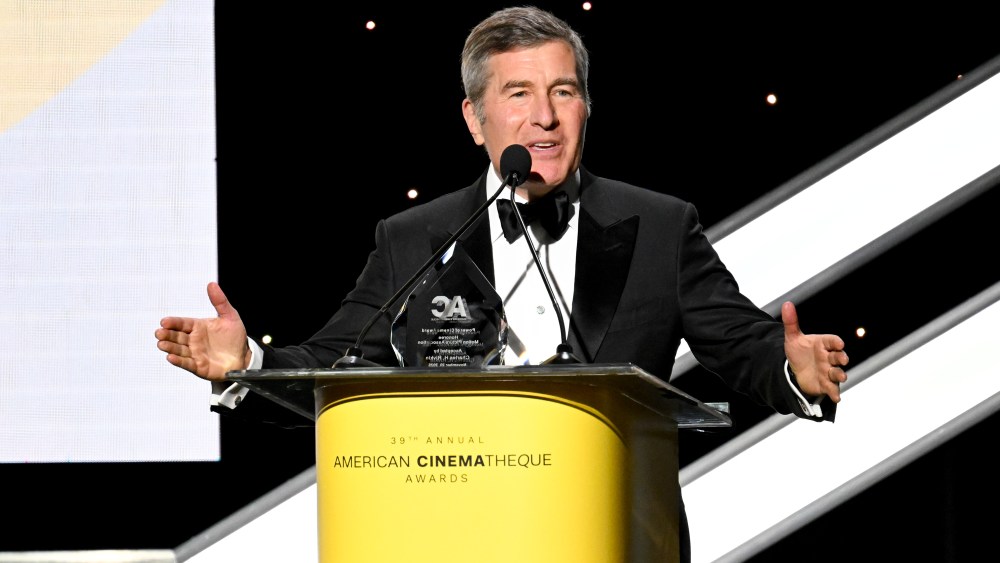
Motion Picture Association President Charles Rivkin took a nuanced stance at CinemaCon Tuesday morning, acknowledging concerns about artificial intelligence but emphasizing its creative and commercial potential.
“We have entered the age of AI,” Rivkin told movie theater operators at an exhibition industry conference in Las Vegas this week. “None of us should ignore its potential dangers, nor should we deny its potential. We should, like humans before us, see AI as a tool that can enhance human creativity, not replace it. We should focus on how to develop and use AI responsibly. AI should be seen as a way to improve the fan experience and allow artists to explore new formats, as many are already doing.”
There is growing concern in Hollywood that AI could lead to job losses as studios look for ways to make films more cheaply. Fears about AI led to the actors and writers strike of 2023, which disrupted the entertainment business. It remains a controversial topic. However, Rivkin argued that film was also once considered a disruptive technology.
“Innovation is also part of our DNA,” Rivkin said. “And every time we’ve seen a new advancement in our industry, and every time we’ve been told our end is near, we’ve persevered. We’ve adapted and thrived. We’ve always embraced what technology can do in the hands of creators to enhance the art of storytelling.”
If Rivkin seems like he’s doing some verbal gymnastics, it’s probably because his members, which include major movie studios like Warner Bros., Paramount, and Disney, and streamers like Netflix and Amazon, can’t agree on how they want to implement AI. This technology can reduce costs, but it also threatens cultural dominance by removing barriers to high-end content creation. Already, member companies such as Disney and Comcast are engaged in legal battles with AI platforms that they believe are infringing on copyright by allowing users to create content using their characters without their consent. Rivkin sounded a similar alarm in a speech Tuesday.
“But no matter what, no matter how AI changes the game, we’re going to continue to be clear about our core principles,” he said. “Protecting copyright as the engine of free expression. Protecting intellectual property as the engine of creative communities. Now, some say we should wipe out copyright in order to keep pace with America’s rivals and gain ground on the geopolitical stage. But that is the wrong choice. What most distinguishes our industry and our country is our fidelity to the rule of law and our openness to change. We can and must do both.”
If Rivkin had to strike a delicate balance Tuesday, Cinema United CEO Michael O’Leary drew a tougher line, reiterating his opposition to the pending merger of two MPA members, Paramount and Warner Bros., arguing that a merger between the companies would lead to theater closures. Mr. O’Leary, the exhibition industry’s top lobbyist, has a different constituency and is concerned that more consolidation will result in fewer films being produced.
“The further concentration of market power in the hands of a small number of distributors who determine terms, duration, schedules, screen placement of films, and access to historic film catalogs will have real and lasting consequences for Main Street and for millions of moviegoers around the world,” O’Leary said.
The Warner Bros.-Paramount merger is expected to be approved by the Trump administration, but Cinema United is pressuring state attorneys general and international law organizations to take a closer look at the merger’s economic impact. They believe they can slow it down and even stop it. In his lawsuit, O’Leary pointed out that Disney’s acquisition of 20th Century Fox in 2019 dramatically reduced the number of movies the studio produced for theaters.
“Unfortunately, history shows that consolidation results in fewer films being made for theaters,” O’Leary said. “We believe the (Warner Bros.) deal is harmful to exhibitions, consumers, and the entire entertainment ecosystem.”
On stage, Rivkin used his remarks to tout the industry group’s recent legal victory in its battle with Meta over the use of PG-13 language on teen Instagram accounts.
“It’s not often that an MPA takes on a $1.6 trillion company, but in this case we knew it was the right thing to do to protect our ratings, our theaters and the trust we have built with our families,” Rivkin said Tuesday. “We’ve made it clear: there’s something very different about what you find in theaters and what you find online.”
The controversy began last October when Meta, which owns Instagram, said the social media platform would limit what users under 18 could see through filters that reflected the MPA’s PG-13 classification. MPA claimed that Mehta’s plan constituted copyright infringement. In March, Meta blinked and agreed to “significantly reduce” references to the PG-13 rating, adding a disclaimer distinguishing its own rating system from MPA’s.
“Instagram and Meta have agreed to the restrictions we requested, which will allow our ratings to remain focused on movies seen on the big screen,” Rivkin said. “There’s no question about it. On my watch, no one confuses the movies shown in your theater with the user-generated content people watch on their phones. We will always fight to protect the integrity of our ratings, no matter the enemy. We will always fight to maintain the trust we have built with our parents. We will always fight to protect our theaters as trusted places of entertainment for everyone.”
Rivkin, who served as ambassador to France under President Barack Obama before becoming a top lobbyist in Hollywood, noted that the MPA’s rating system has an approval rating of 91%.
“Nobody in politics knows those numbers,” Rivkin said. “But our assessment is.”
