

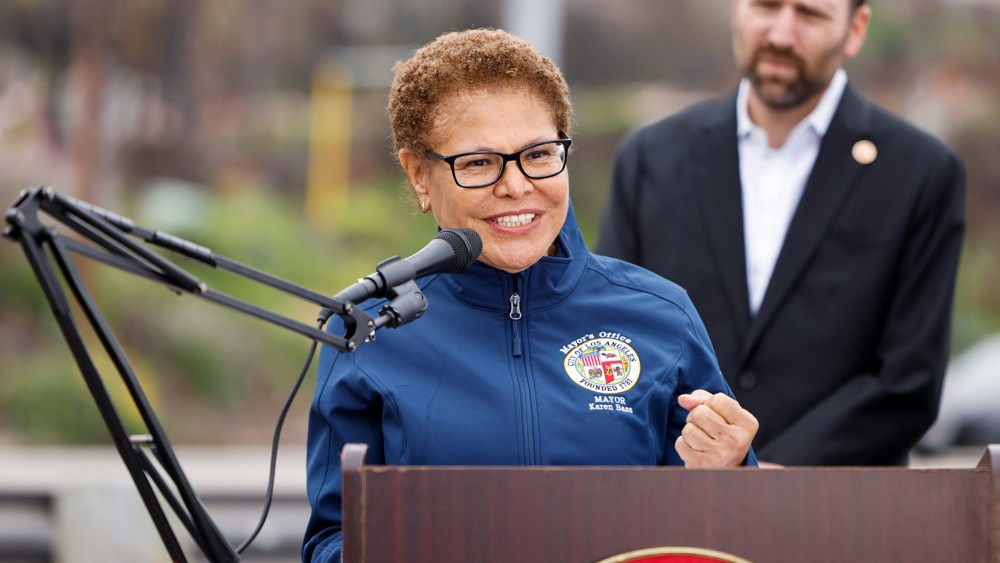
Los Angeles Mayor Karen Bass on Tuesday announced a temporary cut in film production funding following accusations that the city is not doing enough to preserve jobs in Hollywood.
Bass is seeking re-election, with just six weeks left until the June 2 primary election. Her main opponents, City Councilor Nithya Raman and reality star Spencer Pratt, argued last week that the city is failing to facilitate filming.
On Tuesday morning, Bass announced a six-month pilot program to reduce fees for “low-impact” productions. She also announced that all productions will receive a 20 percent discount on parking in city parking lots for one year, in line with a recently proposed deal to help keep “Baywatch” in Venice Beach.
“The bottom line is that we will never let anyone steal our place as the entertainment capital of the world,” Bass said in a statement.
The standard filming permit fee in Los Angeles is $931. Under the pilot program, payments are only $350 for certain productions shot for up to three days and in up to three locations. The city will also waive the $285 fee for random inspections by the Los Angeles Fire Department.
The pilot is aimed at “new media” shoots and other small productions with fewer than 30 cast and crew members on set at a time and which do not require safety supervision. Feature films, television shows, and even commercials generally do not meet the eligibility criteria.
Raman tweeted last week that the city was treating Hollywood “as an inconvenience, not an asset,” and blamed red tape for the loss of 50,000 production jobs in recent years.
“If I become mayor, LA will be a reliable partner for film production,” she wrote. “It actually staffs film offices in the city, eliminates production costs for smaller productions, simplifies permitting, and eliminates ridiculous conditions that stall production.”
Bass’ camp responded by pointing out that Raman had not proposed any legislation to support the film industry during her five years on the City Council, and that she recently recused herself from a vote on streamlining the permitting process, citing her husband’s business interests.
Raman announced his own plan Tuesday morning, saying it would reduce or eliminate fees for independent and mid-sized productions and ensure “faster and more predictable permitting.” She also promised to appoint an experienced Hollywood leader to head the film and build a fully staffed film office.
Meanwhile, Pratt suggested in a podcast interview that filming would be “literally free.”
“What the city doesn’t understand is that the fees need to be waived,” he said. “It’s time to get this business back. We need to get everyone to work.”
This “low-impact” pilot program is being funded by FilmLA, which has committed to covering the difference in costs over a six-month period from its operating reserves. FilmLA is an industry-run nonprofit organization whose members include executives from major studios and unions, and processes permits and collects fees on behalf of 24 jurisdictions around Los Angeles County.
FilmLA has been the target of complaints for more than a year, primarily from independent and low-budget producers who consider the $931 fee a significant hurdle. Major studios typically don’t complain about fees that represent a small fraction of a typical production budget.
Cutbacks in film and television production have also affected places like New York and Georgia. The Entertainment Union Coalition focuses its lobbying efforts on production incentives at both the state and federal level to improve competition with subsidies from Canada, the United Kingdom, and other countries.
“I think the work the mayor is doing is important,” Rebecca Lyne, president of the coalition and executive director of the Directors Guild of America, said in an interview last week. “Every little thing helps, but at the end of the day, what we need is a big commitment.”
Last month, Bass cut film permit fees at Griffith Observatory by 70% and opened the Los Angeles Central Library to filmmakers.
Raman also pledged to campaign to lift the state’s $750 million cap on film incentives, echoing proposals from San Jose Mayor Matt Mahan and former Los Angeles Mayor Antonio Villaraigosa, who are running for governor.
