

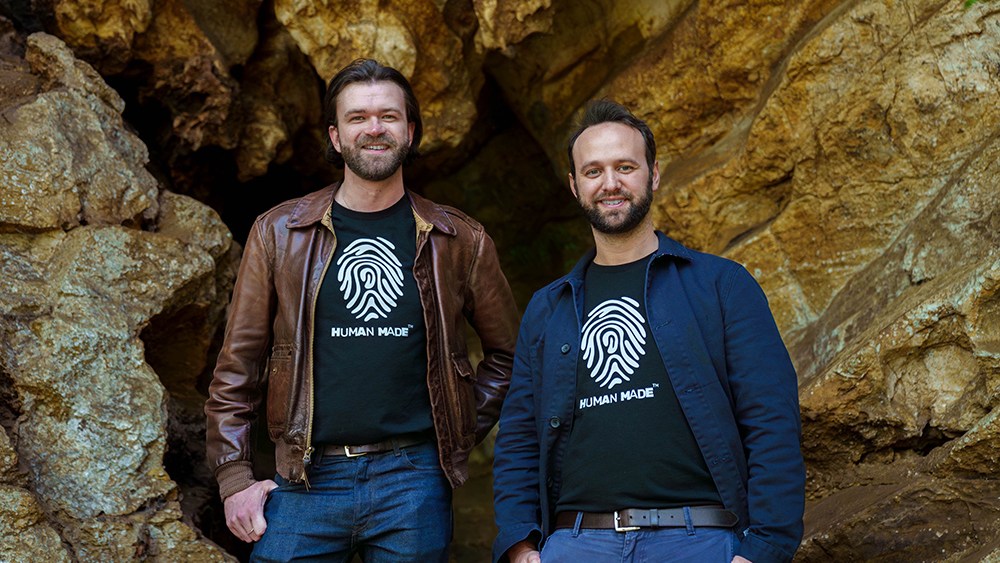
Following the rise of AI performers like Tilly Norwood and the recent news of Doug Limon’s upcoming AI-generated feature Bitcoin: Killing Satoshi, an effort has been launched aimed at giving filmmakers a way to celebrate human artistry behind and in front of the camera.
The Human Made Mark, first established last year, will appear as an identity in front of certified films and as a certified trust mark in the end credits, indicating that a project was not made with the help of AI. The idea behind this initiative is to give viewers the opportunity to dictate their viewing habits, similar to fair trade labels on food, and goes beyond studios adding their own disclaimers that have not been independently verified regarding the use of AI.
For the official launch, the initiative’s founders, William Grave and Eric Gruber, visited the site of one of the world’s oldest human-made remains, the 29,000-year-old Pech Merle cave paintings in France.
“It was a great experience to be with my co-founder Eric at Peck Merle in France to officially celebrate the launch of Trustmark here,” said Grave. “Going back to our ancient times reminds us how creativity and expression are inherently human.”
Even before Human Made Mark launched, it had garnered early support from the film’s creators, including Oscar-winning production designer Tamara Deverell, three-time Oscar-nominated cinematographer Dan Laustsen, and Oscar-winning costume designers Ruth E. Carter and Deborah L. Scott. Deverell said the initiative’s “mission to protect human villages on film sets is critical to the future of our industry.”
To obtain certification, a producer, director, or production company representative must provide evidence such as a call sheet, behind-the-scenes photos, credit list, private viewing link for the team to review, and sign a legal declaration. Human Made Mark claims to be the first initiative of its kind to introduce this level of verification. The current model supports both live-action and stop-motion animation production, with the goal of expanding certification to additional animation techniques in the future.
“We proudly set the bar high for certification. The Human Made Mark is the Michelin star of human craft,” Gruber said. In doing so, we can create a premium for human-made work while inspiring the next generation of artists. The future is not yet written. What we do now as filmmakers, industry players, and audiences could change everything. ”
Lawyer Aanchal Kapur, who set up the contractual framework behind Human Made Mark’s verification platform, described the project as a “pioneering use of law to protect the filmmaking industry” in the face of the threats posed by AI.
“With the increasing intrusion of AI into creative professions, the industry is asking: How can the law protect the arts ecosystem? As a lawyer and filmmaker, I believe that the legal structure of this verification scheme demarcates the entire creative industry against AI. AI can be a tool for human artists, but not at the cost of replacing human artists,” she added.
The Human Made Mark also recently collaborated with Kodak Film to create a visual love letter to filmmakers, which was released on social platforms on Valentine’s Day. The film, which was voiced by Bridgerton actor Ruby Barker, has gained momentum, racking up more than 200,000 views.
“When I was first approached by Human Made Mark, I researched their work, values and vision and was very excited to be a part of this project,” Barker said. “I feel it’s so important to stand up for myself as an artist and champion human-made art. Filmmaking has been such an important part of my life, and I wouldn’t be where I am today without the countless human artists I’ve met throughout my journey as an actor, and those who have become friends and valued colleagues.”
Watch the short film below.
