

SPOILER ALERT: This interview contains major spoilers from “The Bridge,” the finale of Apple TV’s “Imperfect Women.”
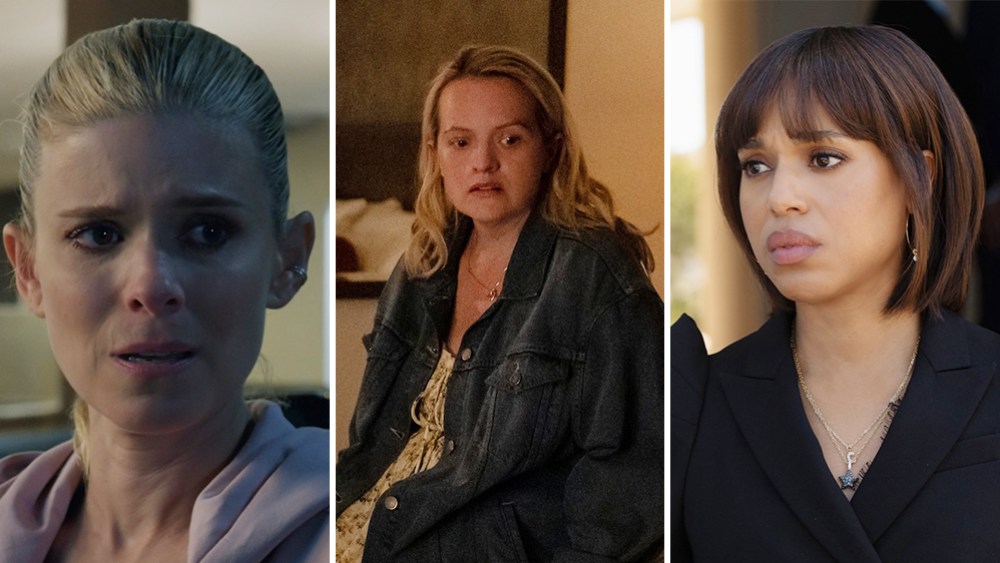
Were Mary (Elisabeth Moss), Eleanor (Kerry Washington) and Nancy (Kate Mara) — the trio at the heart of “Imperfect Women” — ever truly best friends, despite the many lies that they told each other?
“I think they were friends, but that friendship was mortally wounded,” says creator and showrunner Annie Weisman. “That’s why I think it’s painful. If you just revealed that (their friendship) was never really standing on firm ground, it wouldn’t be as painful a loss. I think they really did see each other and love each other. But once shame entered the chat, it got toxic and they broke. We land at the very end in a place of understanding and moving forward, but there’s been loss and pain.”
Over the course of eight episodes, the Apple TV limited series — which, much like Araminta Hall’s 2020 novel of the same name, is told from three alternating perspectives — gradually unravels the salacious secret that got Nancy killed, throwing her surviving best friends’ lives into disarray. In the months leading up to her tragic death, Nancy, who was married to Eleanor’s long-time crush Robert (Joel Kinnaman), had been having an affair with Mary’s husband, Howard (Corey Stoll), an underemployed academic.
As told in flashbacks, Nancy helped Howard secure a job at the experimental ballet that she was working on, initially acting purely out of a desire to help Mary and her family through another financial hardship. However, as she continued to work on a project where the director clearly valued her money more than her creative input, Nancy’s personal life began to fall apart. While her marriage to Robert appeared to be crumbling due to his excessive drinking and suspicious emails about dividing their assets, Nancy rashly reached back out to her ex-stepfather, Scott (Wilson Bethel), who had once sexually abused her.

Courtesy of Apple TV
Howard was able to give Nancy the emotional validation that she was looking for. When Nancy confessed to him late one evening at the theater about her past trauma, Howard kissed her, positioning himself as the only person who truly saw and appreciated her. The two then embarked on a torrid love affair, but the dynamic between them shifted violently when Nancy discovered that her husband was actually trying to protect her rather than divorce her. Wanting to recommit to her marriage, Nancy tried to end the affair by “ghosting” Howard. This rejection exposes Howard’s deep-seated resentment and entitlement. During the ballet’s opening night, after Nancy cruelly told him that no one would believe she’d ever sleep with someone like him, Howard retaliated by sending explicit photos to her phone while she was with her husband, effectively blowing up her life.
In the wake of Nancy’s murder, Mary discovers evidence of the affair, including a poem that Howard had previously written — with a particular phrase underlined — in the scrapbook that Nancy left behind and a ring belonging to Nancy hidden in Howard’s closet. Once he realizes that his wife is onto him, Howard uses his wit and intelligence to gaslight Mary, making her appear unstable to the police and even drugging their daughter to distract Mary from her investigation. As he threatens to sue his wife for sole custody of their children, Howard even frames Mary’s obsession with the truth as “jealousy” over Nancy’s beauty and status.

Courtesy of Apple TV
In the finale, after they both lose custody of their children at a court hearing, Howard kidnaps Mary from her motel room and forces her at knifepoint to return to the same place under a bridge where he previously killed Nancy. Mary convinces Howard to let her call Eleanor in order to call off their plan to go to the authorities with incriminating evidence about Howard, but Mary drops her phone and pretends that she does not have a cell connection because they are in a “dead zone.”
In the ensuing battle, Mary is unable to run away from Howard, who then pins her down and seemingly chokes her out. But when he walks away to retrieve the knife that he was going to use to finish the job, Eleanor — who was quickly able to deduce Mary and Howard’s whereabouts on that phone call — arrives on the scene and runs Howard over with her car. Eleanor then rushes to Mary’s side, attempting to wake her up. Despite his injuries, Howard sneaks up on Eleanor and pins her down, but Mary regains consciousness and uses the knife to stab her husband in the back and kill him.
In a conversation with Variety below, Weisman unpacks the major changes that she made from Hall’s novel for the ending of her adaptation.
In the finale, Eleanor tells Mary, “I think we are all scared of the same thing.” What exactly are they scared of? Are they afraid of finally facing the consequences of their worst decisions?
I think they’re all afraid of letting the people who love them most down, so the mistake they all made that turned out to be tragic was hiding things that they were ashamed of from each other. The downfall of the friendship — and, really, any relationship — is hiding what you’re ashamed of, and they all did it in a different way. And if they had just been able to share what they were ashamed of, they would’ve realized they all have things they’re ashamed of and they all would’ve been accepting of one another. But shame is kind of contagious. Once people are hiding what they’re afraid of revealing from you, then you feel that you have to do the same.

Courtesy of Apple TV
This limited series feels pretty faithful to the major plot points of the source material — Eleanor and Robert’s uncomfortably close relationship, Nancy and Howard’s affair, Mary finding enough evidence to connect Howard to Nancy’s murder — but you still had to deviate from the novel like with any adaptation, including who killed Nancy. In the book, the killer is Mary’s son, Marcus, who kills her accidentally when he’s confronting her about the affair with his dad. Did you ever toy with a different culprit for Nancy’s murder? Did you have any different endings in mind?
We did. Well, the book has a different ending, but we felt like (for) fans of the book, it’s fun to have a little bit more up our sleeve than they were expecting. Also, there were some shows in the interim (including Apple TV’s “Presumed Innocent) that had a similar culprit. Sometimes, you can get scooped by their shows, so you have to keep it fresh.
It’s funny, because in this show, it’s not really built like the biggest twist is at the end. I think sometimes that can get a little sweaty to keep being like, “You think it’s this, and it’s really that.” Honestly, the biggest twist comes in the middle of this show about who the identity of this person is. Like I said, we like the idea of having the ending feel more like a thriller so that even though you know you have all the information, we’re not hiding anything anymore, but what is still at stake is: Is he going to get away with it, and are they going to be safe? So that felt like a way to keep tension and stakes without cheating too many twists.
You could not give away Howard’s involvement early on, but in retrospect, you also had to craft the character in a way where he could have believably orchestrated the downfall of these female friendships. How did you and your writers’ room think about maintaining that tight-rope act with Howard?
In the book, he disappears from view a lot, and he’s sickly and that’s how you don’t suspect him, because he’s kind of weak in that way. For purposes of TV, that didn’t feel like it was going to be very interesting to look at. So we went a different way in terms of keeping Howard as hiding in plain sight as just a good guy, a good dad and a thoughtful teacher. It was this idea of: You don’t suspect the weak person; you suspect the visibly strong person — when, in fact, violence can really come from weakness. Violence can come from feelings of powerlessness and desperation. That felt true to a lot of our experience with people, so we kept him hiding in plain sight as a performatively good guy who was in fact very broken and weak and violent when pushed enough.
What exactly do you think Nancy and Howard saw in one another that attracted them to each other so intensely? Was it as simple as the fact that they were both in unhappy and rocky marriages at home, or was there a deeper underlying reason for their infidelity to their spouses?
It’s a good question, and one we talked about a lot, because, of course, the big shock that they’re together, we wanted it to feel both totally unexpected. And then as you dug under the surface, you understood why. Often, I think especially (with) somebody that’s predatory in the way Howard is, they can sense the need in someone else and play into it.
It’s the combination of his sensing and them coming together in a vulnerable moment in both of their lives, where there’s opportunity and there’s a forced intimacy in this working environment. He is able to see what she was lacking in her life, which was for someone to see past her beauty and to see her value as a thoughtful and creative person. By validating her in that place where she was seeking validation, he unlocked this attraction in her. It’s not the most romantic idea, but it’s a very true one. Often, sexual attraction is not just on the surface. It’s about opportunity and need coming together.
Do you think Howard feels any remorse for what he did to Nancy? He certainly seemed to put a lid on his feelings as he was trying to gaslight Mary into believing that he was not responsible for Nancy’s death.
We don’t see Howard as a sociopath. He wasn’t calculating in his actions. I think the way we saw it is that it was an act of rage and impulse that he was then trying his best to rationalize. And often, this is, I think, very true of a lot of people who commit violence. There is this mechanism by which people say, “She pushed me. She betrayed me. It wasn’t really my fault.” Even though the action happened, there’s just a lack of accountability. So I think he’s trying very, very hard — and frankly, very unsuccessfully — to convince himself and the world that something very, very terrible happened, and although it was his doing, it was not deeply his fault. So that’s why we wanted to build that pressure on him. Their relationship came out of their most wounded, vulnerable places, so her breakup and her dumping of him hits him in that very, very wounded, broken place, and that’s the place from which the violence comes too.
A theme in the show is that anger and love sometimes look a lot alike, and desire and passion and violence can be tragically linked. That’s the world we’re playing in, that kind of level of passion where it can be so dangerous. And, look, the most dangerous place a woman can be is in her home or in her relationship. There’s no question of the data on that. That is where the most violence happens to women. I get on my soapbox about it, because it’s true. That’s why I think friendship and bonding among women is so important — and always has been. We keep each other safe. We look out for each other. We can’t do it alone. The tragedy of the show is when the friendship is frayed and they’re not there for each other, then they’re vulnerable.
At the end of the book, feeling heartbroken about Marcus’ involvement in Nancy’s death, Mary kills Howard by giving him too many painkillers. On the show, she stabs him in the back in self-defense to save herself and Eleanor. How did you land on that ending?
It was really organic. When we get into this thriller, in a novel, there’s a power in that quietness. But in the build of a limited series, organically, it was action and momentum and release that we were craving in the finale. After everything that these women had been through, after everything Mary had been through, it felt like the right release that she took him out in a way that had the energy of release rather than that quiet, contained, private moment. Again, it’s beautiful in a book, but in this kind of storytelling, it didn’t feel quite right.

Courtesy of Apple TV
On a lighter note, whose idea was it for Sheryl Lee Ralph to come in and play Eleanor’s mother in the finale?
It was definitely a combination of Kerry Washington and Kay Oyegun, the co-writer of the episode and one of my really close collaborators on the show. I always think it’s fun to talk to actors about who they see as their parent, and someone who’s been working as long as Kerry has had different screen moms and screen dads, so it’s always really interesting to talk to them about who’s played your mom and who have you wanted to play your mom? Kerry reached out to Sheryl, and she said, “Sure.”
It’s funny — to different people, Sheryl means different things. To me, she is part of the original cast of “Dreamgirls” on Broadway and will forever be that. To Kay, she is Moesha’s mom. Therefore, she is part of her childhood, and there’s an emotional connection there from television from her childhood. She’s Nigerian and came to America, and like a lot of immigrant kids, TV families in America meant a lot. So it was just a special thing that they were excited about and I was really supportive of, and she was a delight to work with.
The introduction of Eleanor’s brother Donovan — a new character created for this adaptation, played by Leslie Odom Jr. — and her overbearing mother slightly reframes the audience’s initial understanding of Eleanor, who was brought up with the belief that you must “have more than you show, say less than you know.” Why do you think Eleanor has a tendency to, as Donovan puts it, “act unpredictable when tragedy strikes”?
In our conception of this character, she’s somebody who was always fighting for control — control of her image, control of how she’s perceived — and wanting to be independent. So she left her family behind, and has never been committed to a long-term romantic relationship. She’s really shaped by loss. The idea of someone getting really close and then hurting her or leaving her is everything she’s running from, so she builds a life to try to prevent that. And then, of course, life has other ideas, and you still form bonds and are vulnerable to loss and all of that. So we get to see her struggle with that and then really come through that.
The character of her brother was someone who sees her in the way only a sibling can, because they’ve had the same exact experience as you growing up, and he sees through her attempts to wall herself off and knows what she needs to do and just has the courage to say it to her directly. And she finally listens by the end.

Courtesy of Apple TV
There is one more character that I wanted to touch on: Robert. He insists early on that he is not a monster, but viewers are left to make their own judgments about him. He is certainly an integral part of Eleanor and Nancy’s arcs, but he fades a little bit into the background in Mary’s episodes. Do you think there is a world in which he would have been able to make a relationship with Eleanor work after Nancy died?
I do. You’re right that I wish I had more time. You always don’t have enough time to explore every character you want to, but I love his character. In his relationship to his father, we wanted to locate the source of his pain and insecurity. I always like playing with the idea of him seeming cold and villainous, but in fact, then getting to know him, (you realize) he was a sensitive, vulnerable person who had been shaped and hurt by his family of origin like most of us have. We got to work with Keith Carradine, which was very cool, as his dad. We didn’t get to work with him as much as I would’ve wanted to, but we did get to see the way that sometimes a really powerful father with money and who has control can infantilize and shape his son.
There’s a moment in the finale when Mary sees him and sort of reads him. She says, “I don’t buy this whole big, powerful guy act. You’re a branch; you’re not a tree. It’s like you never really grew up. You’re just a baby. You’re a kid.” And it’s like, “Whoa! She said the thing that he’s most afraid of people seeing in him.” And that’s how I see his character — someone who was never able to get out of his dad’s shadow. So he never made his own choices. He always made choices that he felt would be acceptable to his family, and that’s really damaging.
And the one choice he made for himself was sleeping with Eleanor, but he did not want to pursue a relationship with her until it was probably too late.
In a weird way, they had probably the most in common of anybody early on, and probably should have been together, but it was too late.

Courtesy of Getty Images
Mary gets the last monologue of the series: “I’d like to say all that pain we went through was a gift. That it taught us how strong we are. How capable of healing. But after everything we’ve been through, we could never lose the bond we share. Our friendship is too powerful. It should be able to survive just about anything. At least for now.” What is her final look to Robert and then into the camera meant to represent?
That’s one of those (shots) that I want to let people have their own interpretation of. It’s funny — the endings were such a collaboration, and everyone was so invested in their characters and where they wanted them to end up and what it meant. We collaborated and talked endlessly about every moment, every word, every shot of that. They were so close to these characters, and I think Lizzie very rightly is a little allergic to anything that felt too —I think my first drafts of it felt probably a little more cozy and pat, and she was encouraging a little edge, like, “Oh, they’re still imperfect, right? So the flaws are still there. Let’s let there still be the fly in the ointment there. So that’s what I’ll say about that.
Wait, Mary and Robert aren’t together romantically in that flash-forward, are they?
(Shrugs her shoulders.) They’re definitely friendly. You gotta ask Mary that question!
This interview has been edited and condensed.
