

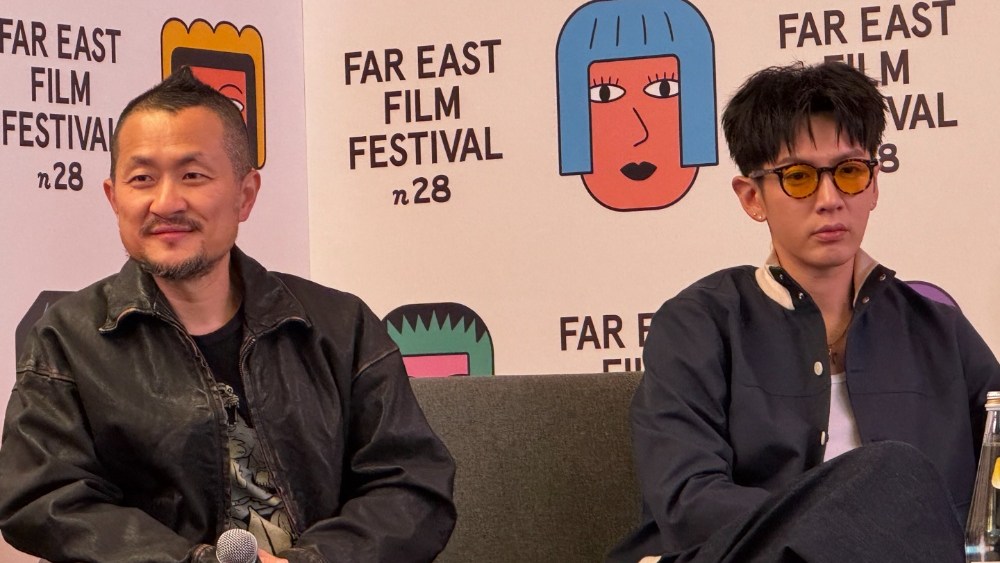
Taiwanese filmmaker Giddens Ko screened Kung Fu at the Far East Film Festival on Saturday, credited Stephen Chow with helping develop the film, and reflected on the more than 10-year journey it took to bring his most technically ambitious project to the screen.
In a panel moderated by Kevin Ma, Ko and his longtime collaborator Kai Ko (who stars in “Kung Fu” and wrote, produced and starred in “I Blow Out the Candle Before My Wish Comes True,” which has its world premiere at Sunday’s film festival) discussed their 15-year partnership, the demands of making a wuxia film, and their respective next projects.
Director Ko adapted “Kung Fu” from a novel he wrote about 25 years ago, and first attempted to film it as his second feature around 2013. Shortly after the commercial success of his debut film, You’re the Apple of My Eye, he withdrew from the project, citing setbacks caused by overconfidence.
“I was very happy that that story was a success,” Ko said. “As soon as I started reading this novel, I said, wow, this is martial arts, this is kung fu. I think everyone is going to love this.”
The abandoned project remained with him. Coe described the work as a creative wound that he ultimately resolved by returning to the work with collaborators who shared the same history. The finished film, which he described as Taiwan’s biggest budget production, incorporates footage from classic wuxia works. Koh pointed out that these clips are not simple homages, but rather narrative threads planted early on in the story.
“The classic clip at the beginning isn’t just there because it’s a classic clip,” Coe said. “Those were actually clues that laid the groundwork for seeing the character in the future.”
Ko’s concept of the wuxia genre centers around imagination as a martial art. “Wuxia is more than just action choreography,” he said. “Wuxia really speaks to expanding the viewer’s imagination.” To illustrate this spectrum, Ko contrasted the down-to-earth physicality of Jackie Chan with the more advanced combat of Jet Li’s Wong Fei-hong films. There, movement begins to push the limits of what the body is thought to be capable of achieving, and ‘kung fu’ is firmly placed in the latter tradition. He cited The Matrix as a structural touchstone, particularly the idea that a protagonist empowered by faith can transcend the rules of the constructed world. Ko also admitted that he showed the script to Stephen Chow, whose “Kung Fu Hustle” was a hot topic, and discussed the choreography and story.
Director Kai Ko, who is producing his fourth film with Giddens, said that despite the scale of the production, the dynamics of the collaboration have remained largely unchanged. Actors have become more prominent in Giddens’ post-production process, a development the director welcomes. “He gave me a lot of inspiration,” Giddens said. “He’s no longer just a presence. He was there and participated in a lot of the ideas that we discussed.”
Kai Ko, who directed his debut film Bad Education, which was written by Giddens, drew a clear line, but said the experience changed his approach to acting. “Remember that the coach is the real general,” Kai Ko said. “The true captain of this whole collaboration. And he has the power to cut.”
In “I Blow Out the Candle Before I Make a Wish,” Kai Ko plays a Taiwanese man who moves to Macau, is financially ruined, and meets a young girl. The role required him to speak many of his lines in Cantonese, a language he had to learn for the role. “The hardest part of playing this role was mastering Cantonese,” he said. “Cantonese has nine tones. If you use the wrong tone, it will have a completely different meaning.”
He traveled to Macau to research this character and interviewed people who went there during the country’s casino boom, but he noted that many returned empty-handed.
Looking ahead, Giddens confirmed that he is developing his next feature in Taiwan and is writing the role of Kai Ko. Separately, director Kai Ko said he is working on a second directorial project with a new writer, and if the script is finalized, the film will likely be completed in 2027. “We are in discussions back and forth about a new script,” Kai Ko said. “I hope it ends up being funnier and better.”
