

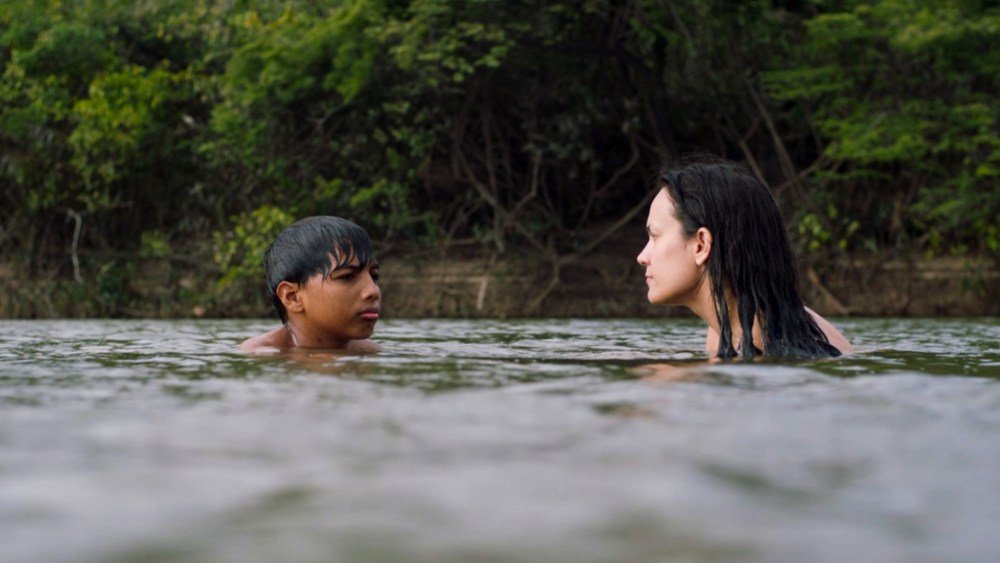
Brazilian training and development hub BrLab has announced its 15th award winners, with Miami-based FiGa Films acquiring distribution rights to Val Hidalgo and Alice Stamato’s award-winning drama Ninho Tinto (Red Nest).
The Brazilian duo’s film was one of 12 projects selected at the annual event, which brings together producers, directors and screenwriters from across Latin America, Spain and Portugal for a week of workshops, labs, mentorship and industry programming in São Paulo. A series of satellite events will also be held in Brasilia and Recife until early May.
Since its first edition in 2011, BrLab has grown from a small workshop for regional filmmakers to a central figure in the development of independent film in Brazil, Latin America, and across the Ibero-American region, with projects from more than 15 countries invited to participate this year.
“Celebrating our 15th anniversary is both a celebration and a statement of tenacity,” said Rafael Sampaio, founder, director and curator of BrLab. “It is also a time to assess and reaffirm our purpose and structure, taking into account all the changes and challenges we face in different countries and everywhere in Latin America.”
Sampaio said: “This is a region full of talent and creativity, where producers and filmmakers constantly navigate economic, political and institutional instability. In this international context, BrLab has become a regular and solid event where projects are challenged and supported, experiencing this early and fundamental moment when cinema is still only words and intentions.”
In addition to its carefully selected lineup and hands-on approach to the development and support of each project, BrLab serves as an important bridge connecting filmmakers to both the local and international industry.
“Filmmakers and producers don’t just develop their films alone; they connect not only with themselves and their instructors, but also with co-producers, festivals and decision-makers who participate as part of each edition of BrLab, helping to position their curated projects internationally from the earliest stages,” Sampaio said. “In situations where structural support can be inconsistent, the combination of rigor, continuity, and real access can move a project forward, not just as an idea, but as a film that can exist and circulate.”
This year, organizers have introduced a number of changes, including moving the event from its traditional October slot to early April, launching BrLab Kids, a new workshop dedicated to film and series projects for children and young people, and introducing a green initiative focused on sustainable industrial practices in Latin America, supported by Petrobas, the event’s new presenting partner and lead sponsor.
“It’s not about changing what’s already working, it’s about integrating it and expanding its scope,” Sampaio said. “Rather than a change in format, what we have done is to solidify the core of BrLab: the depth of the lab, close mentoring, and international dialogue, while at the same time creating a new layer around it. The idea is to strengthen not only the project itself, but the ecosystem surrounding the project.”
One of the key additions this year is a think tank developed by the institute in partnership with Petrobras and Cinema Verde. “This opens a space for broader and strategic thinking about the industry in Brazil and Latin America, bringing together different stakeholders to discuss structural challenges, sustainability and the future of audiovisual production in Brazil and Latin America,” Sampaio said. “Long-term positioning is more important than immediate results.”
As of 2025, 62 feature films have been produced and released in various BrLab categories, including Diego Cespedes’ film The Curious Gaze of the Flamingo (Chile), which won the Un Certain Regard section at the Cannes Film Festival last year. “Levante” (Brazil), directed by Lila Jara, will be screened at Cannes Critics Week in 2023. Légua, by Portuguese directors Filipa Reis and João Guerra, premiered at Directors’ Fortnight that same year.
This achievement is a tribute to the efforts of Sampaio and his organizing team to continue pursuing their vision despite what he calls “institutional weaknesses,” especially with funding cut to Brazil’s national film agency Ancine under right-wing former president Jair Bolsonaro. Mr. Incinet was not among the supporters of the 15th BrLab, which was held through a partnership with Programa Ibermedia, Spcine, Projeto Paradiso and Petrobras.
“Although Incine’s absence was an unexpected event that affected the Coproforum…our trajectory has taught us that we must be more solid than the organization,” Sampaio said. “The history of Latin American cinema and the BrLab reflects the struggle of professionals more than institutions. This is an effort by an international industry against the weaknesses of our country’s politics and government.”
Here is a summary of this year’s BrLab winners:
Vitrine Films Distribution Award: “Irma Mais Velha” (The Older Sister)
Director: Rafaela Camero
Producer: Andre Pereira, Mariana Muniz
Screenplay: Rafaela Camero, Andre Pereira

Provided by BrLab
After the tragic death of her older sister, 11-year-old Isabel is forced to live with her mother, Veronica, who hides a long-suppressed talent: the ability to communicate with the dead. “What I’m trying to say is that[my first film]shows that not every death has to be a tragedy,” said Camero, whose first feature, “The Nature of the Invisible,” premiered at last year’s Bernale. , the way we look at death fundamentally changes. Here, death is essentially the tragedy that drives the story. Isabel and Veronica must face this loss together, experience its grief to its fullest, and deal with the consequences it has for them.” It’s alive. ”
Pop-up Film Residency Award: “El Umbral” (The Threshold)
Director: Inti Jakanamijoy
Producer: Jorge Forero, Inti Jakanamijoy
Screenplay: Inti Jakanamijoy, Oscar Adan
Provided by BrLab
A coming-of-age story about grief, memory, and ancestral knowledge, “The Threshold” tells the story of a young boy who returns to his parents’ home after the death of his grandfather, a famous shaman. His grandmother also falls ill, and as her people prepare to cross the Zushi, a sacred place to die, an ancestral presence arrives at the home, blurring the line between the living and the dead. According to Forero, the film “combines a family story with the spiritual and metaphysical universe that inhabits our realm” and presents “a cinematic proposition that has the potential to be a standout film in today’s landscape.”
Cinéma en Développement + Projeto Paradiso Award: “Dentro do Rio” (Inside the River)
Director/Screenplay: Barbara Mathias Carilli
Producer: Mauricio Macedo
Provided by BrLab
When a dam threatens to submerge the indigenous community of Barro Vermelho, Lourdes, a teacher and single mother, is torn between accepting compensation and moving to the city or fighting back with her family and community. For them, ancestors are a force of resistance and rebirth. Matias Carili said the story is “rooted in Carili’s cosmology and brings a perspective from deep within Brazil with authenticity, imagination and strong authorship.” A unique combination of animation influenced by theater and poetry, it aims to “rethink trauma while opening up space for other ways of being and understanding the world.”
Cesnik, Quintino, Salinas, Valerio, Fittipaldi Award: “A Última Cachorra” (The Last Dog on Earth)
Director: Nina Kopko
Producer: Leticia Friederich
Screenplay: Taina Tokitaka, Nina Kopko
Provided by BrLab
Set in the near future of São Paulo, where a new pandemic has wiped out the planet’s dog population, a rideshare driver must decide whether to stick with his plan to end his own life or find a way to protect what may be the last dog on the planet. “Stories involving dogs create a direct connection with most audiences because dogs occupy an emotional place in our lives,” the filmmakers said. “Imagining a world where they disappear, especially since it’s something that will happen in the near future, is both strange and familiar, creating even more curiosity.”
BrLab Audience Design
Vitrine Lab Award: “Show da Xoxa”
Director/Screenplay: Lastricinha Dorneles
Producer: Hilda Pontes Lopez
Provided by BrLab
The dystopian parody “Xoxa’s Show” is set in a world where the stars of Brazil’s most popular TV show are subjected to humiliation and violent challenges disguised as entertainment. As members of the crew begin to die, the line between spectacle and annihilation begins to blur. Led by a transgender staff and cast, “Xoxa’s Show” is “a celebration of the creativity of transgender people,” Dorneles said. “Joining BrLab is so important because it recognizes our careers as cross-dressers and Hilda’s career as a non-binary person, and allows us to make this work so intimately relevant to the collective imagination of trans people.”
BrLab rough cut
Tanto Award: “Ninhotinto” (Red Nest)
Director: Val Hidalgo, Alice Stamato
Producer: Thiago Briguria
“Red Nest” (provided by BrLab)
Set in northern Brazil, Red Nest tells the story of Franguela, a Venezuelan immigrant whose stable life is upended by the unexpected arrival of her 11-year-old son. With Alejandro’s arrival, Frangela and her partner try to form an emotional bond with the boy in an attempt to start a new home. “What is home?” the directors asked. Although the word has many meanings, “there is something that always runs through it: the love we weave into it, the people we form bonds with, and the small acts we give and share parts of ourselves,” they said. “Red Nest” is “a sensitive depiction of how these bonds are rebuilt in the context of migration, which is shaped by vulnerability. But above all, it is also a gesture of resilience and life-affirmation.”
