

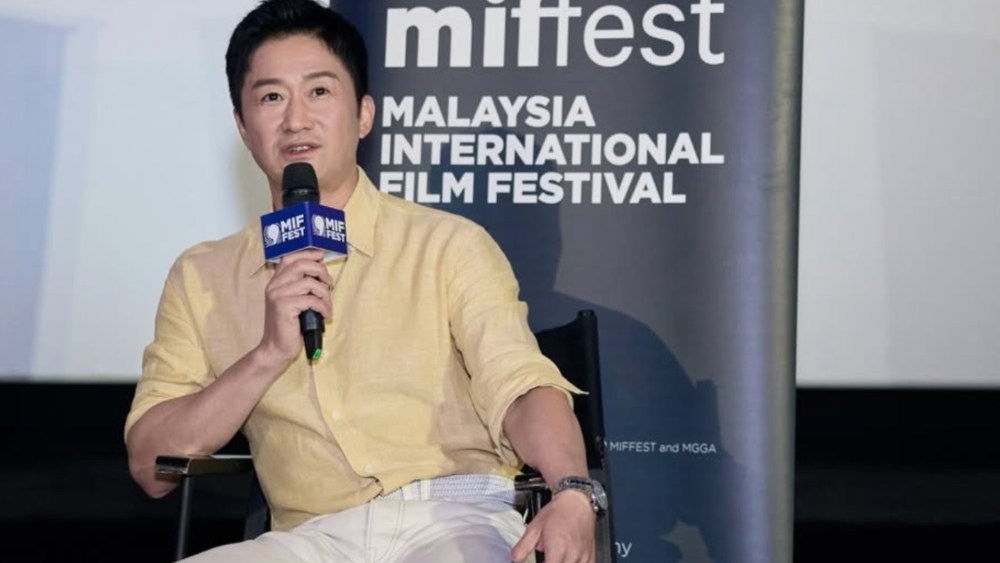
Wu Jing says that the traces of Hong Kong action cinema are still present in all Wu Xi films made today, including his own.
Speaking to Variety at the Malaysian International Film Festival (MIFFest), where he won the festival’s Best Film Award, the actor and producer reflected on the enduring influence of Hong Kong cinema while celebrating a special screening of Blades of the Guardians: The Desert Wind Rises.
Directed by legendary Hong Kong action choreographer Yuen Woo-ping and based on Xu Xian-che’s martial arts comic, the film was released during this year’s Lunar New Year holiday, grossing $215 million and receiving enthusiastic responses at MIFFest screenings.
“There are over 3,000 shots in exactly 125 minutes and 48 seconds,” Wu said in a post-screening Q&A. “I remember every moment, every sound.”
When asked if he was satisfied with the finished film, Wu said that his feelings changed throughout the production process. “From the day we finished shooting until the movie was released, the score in my mind kept going up and down,” he says. “At the end of the day, I don’t give it a score because once it’s released, it’s no longer mine.”
Wu, who has worked as an actor, director, producer and financier, says wearing multiple hats is nothing special, it’s just part of filmmaking. “Every role on a movie set is important,” he told Variety. “During breaks, I often try on other people’s costumes and play different roles. Everything I encounter is valuable. On a film set, there are teachers everywhere and you can learn.”
Wu says working across a variety of roles has made him a more humble actor. “This work teaches us to respect everyone who helps us create our characters.”
As technology advances and short-form videos increasingly dominate viewers’ attention, Wu says there is no definitive answer to how young viewers will understand the wuxia genre.
“Blades of the Guardians was created from our passion for wuxia,” he says. “As we love wuxia, we told ourselves that even though the wuxia genre is dying out, we want to make one last great wuxia show.” Wu also points out that the film’s cast has an unusually wide age range for nearly 100 years. “I have a mentor who introduced Jet Li and I to this industry, and he’s almost 100 years old,” Wu said. “Our youngest actor was born in 2020. His 100-year age reflects the history of wuxia itself.”
Visual effects can enhance on-screen martial arts, but serious filmmaking still relies on performance, Wu argues. “Wuxia action can be further enhanced with visual effects, but the real kung fu in filmmaking is expressing the character through the body and moving the audience sincerely.”
Wu, who has worked on productions from a variety of countries, says there is one observation that stands out above all others: the lasting influence of Hong Kong action films.
“The roots of action choreography around the world are in Hong Kong,” he says. “Many of today’s action sequences are built on techniques pioneered by Hong Kong cinema.”
Wu points to two lasting legacies that Hong Kong cinema has contributed to the global film industry: action choreography and production expertise. “In Hong Kong, a producer could direct three films at the same time,” he says. “This was the beginning of filmmaking as an industrialized process.”
Reflecting on the rise of short-form videos and streaming platforms, Wu argues that changes in technology have always reshaped cinema without eliminating older art forms. “Movie itself was once replaced by shadow puppetry. That doesn’t mean Peking Opera or theater has disappeared,” he points out. He believes the same ultimately applies to today’s films.
“Forms of entertainment will inevitably change,” Wu said. “Film as an art form will continue to thrive in new ways.”
