

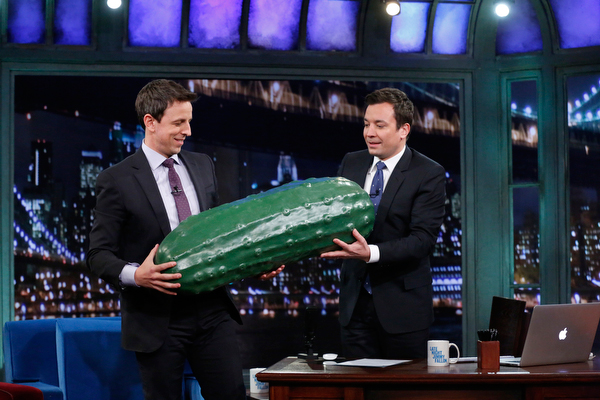
Jimmy Fallon and Seth Meyers will begin a multi-week late-night show Monday night aimed at reaching summer viewers, who watch TV at its lowest. Still, big opportunities await the two hosts.
Mr. Fallon will begin NBC’s “Tonight Show” on Monday without a regular competitor, a throwback to the days when Johnny Carson hosted the show before some media companies joined forces with Arsenio Hall and Joan Rivers to dethrone him from the early morning throne. Jimmy Kimmel is on summer break, and his ABC show will be relying on guest hosts for the next few weeks. Stephen Colbert is in exile and CBS no longer participates in late-night broadcasts, but it does lend a two-hour slot to entrepreneur Byron Allen. Similarly, Myers has no direct competition on “Late Night” at 12:30 a.m.
So it’s no wonder NBC announced impressive bookings for both shows in recent weeks. Before Fallon and Myers took their early summer break, both of their shows featured members of the New York Knicks following their team’s victory in the NBA Finals. Both late-night showcases, starting Monday, will feature guests starring in Christopher Nolan’s film “The Odyssey,” which opens later this week (distributed by NBCUniversal, which employs Fallon & Meyers).
It remains to be seen whether these efforts will strengthen NBC’s position as local news lags. After all, late-night TV is in trouble, and viewers are turning away from watching TV shows at certain times of the day. Ad spending on late-night TV programming fell from $519.7 million in 2017 to $209 million in 2025, a nearly 60% drop, according to data from the Guidelines, which tracks ad spending.
And since CBS canceled Colbert’s show in May, Kimmel’s show has taken a lion’s share of the audience. “About 15% of Colbert’s ad spend could go to Fallon,” says Sean Wright, Guideline’s chief insights and analysis officer, but even that is not guaranteed. “Previously, late night was its own budget item, and they just followed ratings to reallocate spending. But post-COVID, when late night dollars are lost, they go off the air. That money is more likely to be reinvested into YouTube, Facebook, Instagram, and TikTok.”
NBC may have bigger goals than winning this summer. Fallon and Meyers are currently under contract through 2028, while Kimmel recently signed a surprising one-year deal with Disney that will see him work after-hours through 2027. Additionally, NBC has become fond of celebrating big anniversaries in recent years with some of its most enduring shows, such as “Saturday Night Live.” “Tonight” will turn 75 in 2029, and if NBC wants to celebrate the occasion with its current host, it will likely need to extend Fallon’s employment agreement.
NBCUniversal declined to make executives or producers available for comment.
But NBC has proven adept at finding new ways to draw advertisers into its late-night orbit. NBC persuaded Allstate, T-Mobile and several other big-ticket advertisers to power the recently concluded 50th season of “Saturday Night Live.” This network has allowed Fallon to work in areas other than “Tonight.” He produces and hosts a portfolio of game shows led by Savannah Guthrie, including an upcoming competition series based on the popular New York Times game Wordle. Last season, NBC put Fallon at the center of a show called “On Brand,” where she helped market popular products. Meanwhile, some of Myers’ signature sketches are part of the social media realm, including “A Closer Look” and the online-only “Corrections.”
Perhaps NBC, like many other companies, is trying to find new ways to monetize late night. Fox Sports has agreed to the idea of a bespoke late-night show during the World Cup telecast, with a “pop-up” show led by former CBS host James Corden. In one corner, Corden challenged Norwegian soccer player Erling Haaland to a portrait paint-off.
Meanwhile, former social media series host Julian Shapiro-Burnham has launched Outside Tonight, an online-only emulation of linear late-night shows made for viewing on YouTube. During the six-and-a-half minute segment, the host had “honest and uncomfortable conversations” with three people he had dated and been rejected. None of his clips or full episodes seem to have more than 90,000 views.
Such experiments require scrutiny, said Stephanie Dolan, a principal at Deloitte who oversees the firm’s entertainment division’s advisory practice. “Late night shows aren’t going away. What’s really happening here is just the traditional network version of late night shows being replaced,” she says. “Audiences, economics, and cultural conversations have shifted from 11:35 p.m. scheduled viewings to an always-on, multiplatform content ecosystem.”
In fact, viewers still crave some of the things that late-night television has long offered. “Consumers are looking for formats that are culturally relevant, shareable, and timely conversations,” she says. “It creates a cultural discussion.” Capturing this feeling is one reason Netflix and others are testing subscriber appetite for video podcasts with celebrities including former NBC News and MSNBC anchor Brian Williams. If streamers can use video podcast and talk show formats to attract attention, they may be able to increase engagement and reduce churn as subscribers abandon one streaming service and consider the option of another.
The Keys provides late-night humor and commentary available to you at all hours of the day. “Younger consumers aren’t necessarily rejecting the fact that it’s great to see interesting people, hear commentary from hot people, and listen to interviews. Those are all still very interesting and culturally relevant forms of content,” Dolan says. But people will increasingly turn to programming that feels “more personal, personal, portable, and authentic.”
NBC is considering these new rules. And interestingly, the company is applying them to older late-night content. NBC and David Letterman’s production company, Worldwide Pants, recently signed a deal that will make clips from 6,000 episodes of CBS’s “The Late Show with David Letterman” and NBC’s “Late Night with David Letterman” from 1982 to 2015 available on YouTube, Facebook and other digital outlets. The companies are working with Melzigo, a technology company that operates digital distribution channels and also works with Hearst, Banijay, ITV and Fremantle, among others.
Of course, one thing many of these digital startups lack is a regular roost in broadcast television. Jimmy Fallon and Seth Meyers aren’t. The future of reaching fans of late-night humor may be digital, but it looks like there’s business to be done on TV as well. Success on television brings more help when hosts inevitably come online. Late-night TV may have less support for linear, but it’s still valuable. As this week shows, Fallon and Myers aren’t shy about grabbing whatever they can.
