

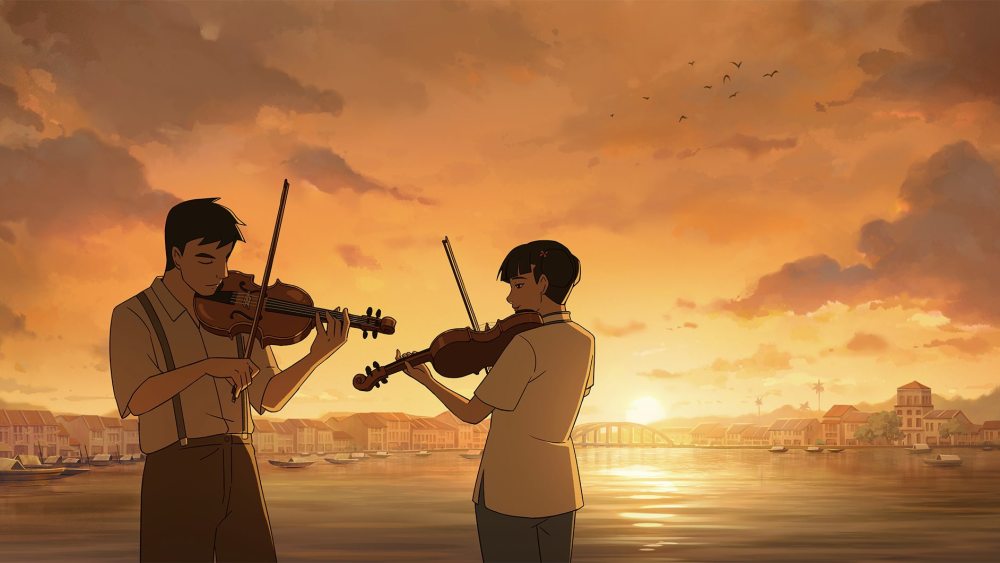
Ten years is a long time to carry a story. Ervin Han, co-founder of Singapore’s Robot Playground Media, had been living with “The Violinist” for most of that stretch before it finally screened in competition at the Annecy Animation Festival this year – and walked away with the Cristal for best feature and the SACEM Award for best original soundtrack. He is still finding the words for it.
“We’ve lived with this film for almost ten years, and along the way there were many moments when simply finishing it felt like the biggest challenge,” Han tells Variety. “To receive the Cristal is an extraordinary honor, but more than anything, I’m delighted for the hundreds of artists, animators, musicians and filmmakers who gave so much of themselves to this film. This recognition belongs to all of them.”
The film spans eight decades of Singapore’s history, following two childhood friends – gifted violinists Fei and Kai – whose lives are severed by the Japanese occupation of the 1940s. Framed by the investigation of a Spanish journalist who seeks to uncover the story behind an aging violin legend, the narrative moves across the decades as Fei rises to become a celebrated musician, though the instrument she plays and the music she performs carry a weight she cannot set down. Also woven into the story is Lim Bo Seng, the real-life resistance leader who serves as a mentor figure to Kai, and Takeshi Inoue, a Japanese officer drawn with deliberate moral complexity.
It is, on its surface, a love story. But “The Violinist” is also an attempt to bring a chapter of Southeast Asian history to an international audience that has largely never encountered it. For Han, who grew up with it, the impulse was personal and precise. “This project began over 10 years ago with a simple ambition: to tell a story from Singapore – and from Southeast Asia – that could resonate across borders, cultures and generations,” he says. “Not by explaining our history, but by exploring the emotions and experiences that connect us as human beings.”
He is careful not to pitch the film as a history lesson. “I don’t see ‘The Violinist’ primarily as a film about Singapore,” he says. “It’s a story that happens to be deeply rooted in Singapore. My hope is that audiences first connect with the people, and through them become curious about the history.”
Part of what kept these stories off international screens for so long, Han says, is structural. “Southeast Asia has historically had fewer opportunities to tell its own stories at this scale – certainly not in animation,” he says. “Many of these histories are incredibly rich, but they simply haven’t had the production ecosystems or international platforms that exist elsewhere.” The storytelling ambitions were always there, in other words; what was missing was the infrastructure to realize them.
His co-director came from a rather different starting point. Raúl García spent decades as a senior animator at Disney – his credits run from “Who Framed Roger Rabbit” through “Aladdin,” “The Lion King” and “Tarzan” – before a lecturing stint at LaSalle College of the Arts brought him to Singapore and introduced him to a city he found immediately compelling. “It was a love at first sight with this city, with this country,” García tells Variety. “My curiosity grew with every person I knew, every corner, all its nature growing from every crack of this both ancient and very modern city.”
For García, the film also offered something more personal: a corrective to his own blind spots. Growing up in Europe, his understanding of World War II had been filtered through a North American lens – Pearl Harbor, Hiroshima, the occasional exotic flourish like “The Bridge on the River Kwai.” “It was really interesting to delve into Singapore’s history and discover what went beyond the colonial period,” he says. “This film offered an opportunity to explore a chapter of Southeast Asian history that remains unfamiliar to many international audiences.”
The two men met when García was teaching at LaSalle College of the Arts and discovered Robot Playground Media, recognized something in each other’s approach to the medium, and eventually formalized their partnership into a co-directorship. The division of labor, as Han describes it, was less about separating tasks than about bringing complementary instincts to bear on the same material. “I had lived with this story for nearly a decade,” he says. “It comes from a place that is deeply personal to me, both culturally and emotionally, so I saw my role as being the custodian of its authenticity, its emotional truth and its overall tone.” García, he says, brought an instinct for cinematic economy – the ability to simplify and clarify emotion through staging and visual language. “Neither of us was trying to make our film – we were trying to make the best version of the film,” Han says.
Animation was Han’s medium from the outset, and not simply by default. A live-action version, he argues, would have pulled the story in directions that didn’t serve it. “Because the narrative is built around music and virtuoso violin performances, a live-action film would demand an extraordinary level of realism,” he says. “Audiences would naturally scrutinise every performance, every bow movement and every musical gesture. That burden can sometimes pull attention away from the emotional journey.” Animation sidesteps the problem. “It invites a degree of suspension of disbelief from the very beginning, allowing the music to function less as a technical performance and more as an emotional language.”
García, whose career has been built on hand-drawn studio animation, frames the medium’s case in broader terms, pointing to the influence Japanese anime has had in expanding audiences’ appetite for animated films that tackle adult subjects. “Animation is not a genre but a technique to narrate stories,” he says. “This is something Japanese animation understood better than the rest of the world, where animation is still associated with kid fare.”
García notes, however, that the American industry has been slower to follow: “The American hegemony in movie distribution has shaped the tastes of the audiences – even in techniques. It is widely accepted that CGI films are ‘theatrical’ and 2D animation is for TV.” Europe, he suggests, is more open. And Annecy, specifically, has been a consistent champion of animation as cinema rather than category. “We ended up making a film that happens to be animated,” García says, “not making an ‘animated film.’”
Music sits at the center of the project in a structural rather than decorative sense. The film’s central composition – an original violin sonata called the “Sunset Sonata” – recurs across the decades, shifting in texture and emotional register as the characters’ lives change around it. “I never wanted music to sit outside the story as emotional accompaniment,” Han says. “It had to exist within the story itself almost like another character.” The sonata, as he describes it, becomes its own kind of language – one the characters use to communicate when words are no longer adequate. “As the story unfolds, we hear the sonata evolve through different arrangements, performances and interpretations, almost growing alongside the characters themselves,” he says. “Generations pass, lives change and history moves on, but the sonata endures, binding the characters together across time in a way that words never could.”
The score was composed by Ricky Ho – a prolific Singaporean composer and Golden Horse Award winner whose previous credits include Tsui Hark’s “A Chinese Ghost Story” and “The Legend of Zu” and Chi Po-Lin’s “Beyond Beauty” – and Isabel Latorre, a Spanish composer from Valencia. The two divided the material between them: Ho took the sonata and the film’s character-driven leitmotifs, while Latorre composed the war sequences and action passages. Classical works by Mendelssohn, Paganini and Massenet round out the film’s sonic world. García describes three distinct musical registers that had to speak to each other coherently: “The musical fabric of the film has to be coherent,” he says. “The soundscapes have to fit the story and dialogue with each other.”
The multinational character of the production – a three-way co-production between Robot Playground Media in Singapore, TV ON Producciones in Spain and Altri Occhi in Italy, and the first animated co-production between Singapore and Spain – might have prompted softening of the story’s cultural specificity. García says it had the opposite effect. “We used the co-production as a tool to tell the story we wanted to tell,” he says. “No concessions, no sweetened sequences to please any specific market.” Han credits the international team with sharpening his instincts rather than diluting them. “My co-production partners would often question moments or assumptions that felt completely natural to me because they were part of my own culture,” he says. “Those conversations forced us to distinguish between what was culturally authentic and what was dramatically essential. The more specific we were about the world, the more universal we had to be about the emotions.”
One of the film’s more deliberate choices is its treatment of Takeshi Inoue, the Japanese officer whose story runs alongside those of Fei and Kai. Rather than positioning him as a simple antagonist, the film extends him a degree of interiority – he has a family he longs to return to, and a love of music that complicates his role in the occupation. García is direct about the reasoning. “I don’t think a soldier goes to war with a killer instinct to become a murderer of a fellow human being,” he says. “Soldiers are thrown into an armed combat decided by politicians or economic interests. Underneath the soldiers there is a human being, victim of the circumstances.” Han frames it more precisely: “The Japanese occupation was unquestionably brutal, and the film doesn’t shy away from that. But within any war, individual human beings remain more complicated than the uniforms they wear. The relationship in the film isn’t about forgiving history. It’s about recognising that compassion can sometimes survive even when history seems determined to erase it.”
Keeping the human story legible against the weight of eight decades of historical events required a discipline that both directors returned to repeatedly. “We constantly reminded ourselves that history isn’t experienced as history,” Han says. “People don’t wake up thinking they’re living through an important historical event. They’re thinking about their families, their friendships, the person they love, or simply getting through the day. That became our compass. Every historical event in the film had to be experienced through its emotional impact on the characters.” García puts the same principle differently, reaching for a comparison that reveals something of his own cinematic formation: “The best films are always grounded on the singularity of people or places to tell universal stories. ‘Amélie’ is a quintessential French film but speaks to a worldwide audience. The more the film is grounded in reality, the more universally accepted it is.”
Han is thoughtful about what the recognition might mean for the region. “Asia isn’t a single voice,” he says. “Southeast Asia alone is home to hundreds of cultures, languages and histories that remain largely unexplored in animation. I hope we’re entering a period where audiences become curious not simply about ‘Asian animation,’ but about the richness and diversity of storytelling across Asia itself.”
García, meanwhile, sees parallels between the moment Southeast Asian animation now finds itself in and the longer arc of how anime reshaped global tastes. “The worldwide phenomenon of Japanese anime and the musical breakout of K-pop in mainstream popular culture has opened the tastes of a new generation for different kinds of storytelling,” he says. “The same way that interest for manga shifted into manhwa, to other comic book artists from Indonesia or the Philippines – we are encountering now an openness about what kind of animation has been done in Southeast Asia.”
For Han, the ambition now is to make the path easier for whoever comes next. “I hope it gives people confidence that stories from Southeast Asia don’t have to imitate anyone else to find an international audience,” he says. “We have our own histories, artistic traditions and ways of telling stories, and those deserve to be seen.” The Cristal, he believes, may help. “Awards don’t change why you make a film, but they can change how far that film travels,” he says. “My hope is that the Cristal will help ‘The Violinist’ reach audiences around the world and, perhaps, create a few more opportunities for stories from Singapore and Southeast Asia. Every film industry begins with a handful of people willing to take that first leap of faith. I hope this film makes the next one a little easier.”
