

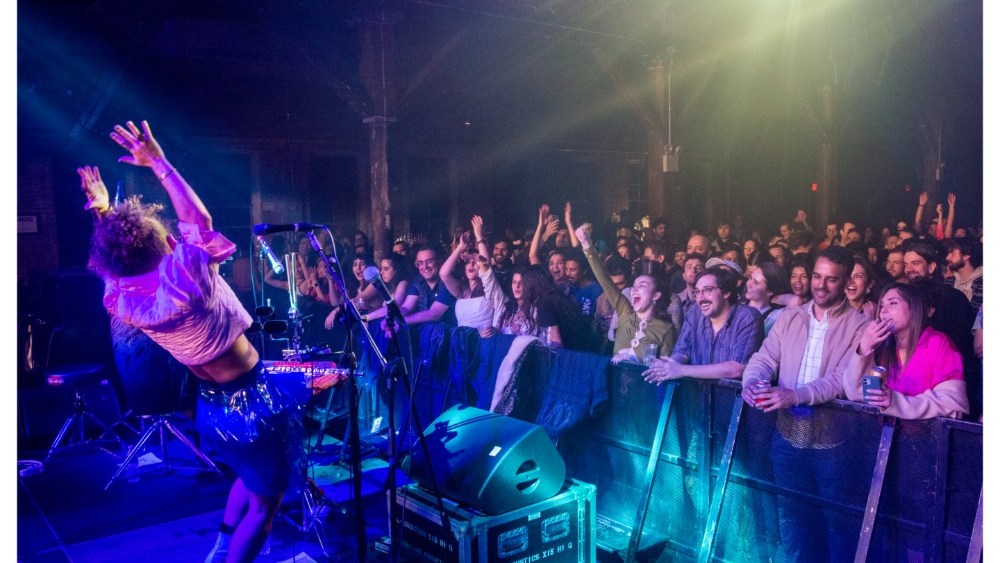
On the night of April 4, when Iran was under attack by U.S. and Israeli missiles, a large crowd in Rome celebrated the Persian New Year at the Eternal City’s Alcazar Club, dancing to Middle Eastern beats including vintage Iranian tracks by Gugosh, the iconic pop star who was imprisoned in Tehran in the early 1980s and now lives in Los Angeles.
The touring event, called Disco Tehran, which has also been held in New York, London and Berlin, is hosted by a filmmaker named Arya Ghabamian. He left Iran in 2008 and moved to New York, and in addition to Disco Tehran, he is also the co-founder of Cinema Tehran, which organizes Iranian film pop-ups around the world.
“The main driving force is just finding a community,” Gabamian says, sipping dry white wine at a sidewalk cafe in Rome’s hip Pigneto district. “What I see about these parties is that they are places of resistance where some healing can happen,” he added, noting that about 40 percent of the crowd in Rome was made up of Iranian diaspora.
But just as important to him is seeing non-Iranians dancing to Iranian music. “They don’t understand the language, but the music connects them.”
The same artistic philosophy applies to Tehran films. This includes rediscovering films that Gabamian never had the chance to see because they were banned in his home country and bringing them to theaters around the world.
Iranian film classics are a hot movie commodity in the indie market these days.
While Iran was in the headlines in New York in February after thousands of students were killed by Iranian security forces while calling for the overthrow of the Islamic regime, Ghabamian was busy introducing a screening of a retrospective entitled “Travelling Companions: Bahram Beyzai and Amir Naderi” at New York’s Metrograph movie theater.

Provided by: Tehran Cinema
The production includes a restored print of the recently deceased Beyzai’s 1984 masterpiece, “Bashu: The Little Stranger,” and Naderi’s autobiographical drama “The Runner,” about an 11-year-old boy scavenging through trash in Tehran during the escalating Iran-Iraq war.
Bashu, widely regarded as one of the best Iranian films of all time, also takes place during the Iran-Iraq War in the 1980s. This touching drama revolves around a young boy who is the title character of the film. A boy flees a bombing in a village in southern Iran that kills his family. He travels north, where Bashu is adopted by a mother of two whose husband is absent, ignoring the suspicions of the surrounding villagers.
“These films establish a history that puts many of the events we’re witnessing now into perspective,” says Metrograph programmer Ed Choi.
Frédéric Rouault, head of collections at MK2, a French company that sells fresh “Bashou” prints, said that after Mr. Beyzai’s death in December, “we received a large number of requests from festivals, cinemas and universities in the United States and Canada to organize memorial screenings. Then, with the acceleration of the Iranian conflict, we started adding more requests from all over the world.”
The newly restored “Bash” print won the Best Restoration Film Award in the Venice Classics category at the 2025 Venice Film Festival and is currently scheduled for theatrical release across North America through U.S. indie distributor Film Movement and Montreal, Canada-based Ritual. MK2 also sold a restored version of “Basai” to Trigon for theatrical release in Germany, and is planning a tribute screening of Bayzai in French cinemas.
ritual of courtesy
“Americans became interested in Iranian culture not because we dropped bombs on Iran,” said Michael Rosenberg, director of the Film Movement. “But there certainly is a large audience for ‘Bashu’ right now in North America,” he points out.
“The U.S.-Israel war against Iran kind of reminds us that ‘Bashu’ is a political movie,” said Ritual co-founder William Gagnon. “We believe that presenting this work theatrically is a way to talk about the present.”
At Cannes, MK2 will present buyers with a new Abbas Kiarostami tribute package to commemorate the 10th anniversary of the death of the esteemed Iranian writer, who won the Palme d’Or in 1997 for A Taste of Cherry.
Last September in Venice, exiled Iranian director Mohammad Rasoulof (The Sacred Fig Seed), who was also a member of the festival’s jury, accepted the award on Beyzaie’s behalf for the restored film Bashu. “Many of us have learned from him, directly or indirectly. We have learned how to cope with forgetting,” Palme d’Or-winning author Jafar Panahi (“It Was Just an Accident”) said following Beyzai’s death in December. Two-time Oscar-winning director Asghar Farhadi said it was “heartbreaking” that “this most Iranian of Iranians died thousands of miles away from Iran.”
Rasoulof, who fled to Germany in May 2024 after being imprisoned and flogged by Iranian authorities for making The Sacred Fig, which won the Special Jury Prize at the Cannes Film Festival, became the first major Iranian director to publicly speak out about the US and Israeli attacks on Iran. In March, Rasoulof commented on the killing of Iran’s supreme leader Ayatollah Khamenei in an impassioned social media post, calling him “the most hated figure in modern Iranian history.”
Meanwhile, Panahi reportedly returned to his beloved Iran in April after completing the US Oscar campaign for It Was an Accident, despite being sentenced to a year in prison in his home country.
Farhadi, who has lived outside Iran since 2023, left just before protests broke out in his home country following the death of Mahsa Amini and did not return, but he is expected to appear on the Cannes red carpet soon with his new film Parallel Tales, set in Paris and starring a top-notch French cast including Isabelle Huppert, Vincent Cassel and Catherine Deneuve vying for Palhador.
Shortly before the April 8 cease-fire, at a time when airstrikes against Iran were at their peak, with US President Donald Trump threatening that “an entire civilization will perish tonight and we will never get it back” if a deal was not reached, Farhadi began appealing to the United States and Israel to stop bombing “infrastructure that belongs to the Iranian people and is related to the basic needs of daily life.”
Besides “Parallel Tales,” another Iranian film, “Rehearsal for the Revolution,” by London-based Iranian director Pega Ahangarani, will soon be screened at Cannes. Drawing on her personal archives, home videos, footage of street protests, and newspapers, it traces more than 40 years of Iran’s history, from the early days of the current Islamic theocracy to the war in 2026. As the document’s synopsis states, these materials offer a portrait of a nation shaped by political repression and “sustaining the constant hope of a new revolution.”
“Our country’s recent history is made up of failed revolutions,” Ahangarani told Variety. “But I believe that we need to process what we have been through in order to stand up and remove the dictatorship.”
The Iranian film industry, as well as the rest of the world, certainly has a lot to process. Iran’s outlook now appears even more uncertain than it was before the country came under attack by the United States and Israel.
But one thing is clear to this country’s arts community.
“The war never solved the problem,” Babak Karimi, the versatile Iranian who played a judge in Farhadi’s “The Separation,” told Variety in Rome shortly after fleeing the wartime bombing of Tehran across the Iran-Armenia border.
“They just pass it on to the next generation.”
