

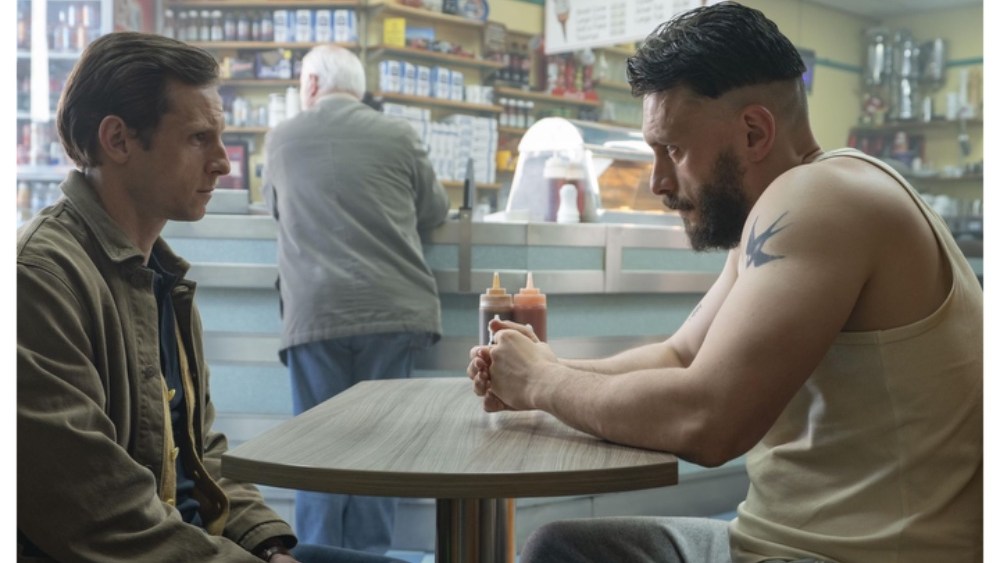
Baby Reindeer creator and star Richard Gadd talks about his new Cannes series opener Half Man.
The film depicts the complicated relationship between two brothers, Niall and Ruben, and Gadd co-stars with Jamie Bell. Stuart Campbell and Mitchell Robertson play younger versions of the characters.
“Sometimes I get the urge to write about something. I wrote the first episode in 2019 and I really wanted to go back to that episode to honor the story and the characters. I think there was a lot of conversation about male anger and violence at the time, and some of that seeped into my subconscious.”
Refusing to explain the title, he admitted that he wasn’t always supposed to play Reuben, saying, “I don’t want to say why it’s called ‘Half Man,’ because it’s important that different people have different interpretations. I don’t want to take that away.”
“Initially, I had no intention of appearing in it at all. I thought I’d just be behind the camera. It was Jamie who first brought it up. He said, ‘I’d love to play opposite you as Ruben.’ No one had suggested that before. I was going to have a cameo as a police officer or a bartender. That was the only meaningful character left at that point. It scared me, and it scared all of us, because you don’t think of this masculine identity when you look at me.”
“When I got home, I was upset thinking about it. But all my ‘what if’ thoughts were about what people would think. That’s a dangerous headspace. You don’t get the chance to play a role like this very often, so why would you take it away because you’re afraid of what people will think? That wasn’t enough, and we’ll see.”
He decided to undergo radical physical changes for this role.
“This was an exploration of male masculinity and violence, and he needed to feel free in his later life. I wanted him to be… strong. That’s what I kept telling my personal trainers. I didn’t want that Hollywood six-pack body. He wasn’t a gym goer. He was heavy with life. It was almost animalistic, and it had to be real.”
Gadd wants people to enjoy his work, he said.
“I never thought about these expectations and pressures until I finished editing. I just want people to like it and react in the way I see fit. If it provokes a reaction, that’s great.”
He certainly provoked people with “Baby Reindeer,” which became a huge worldwide hit. But the Scottish actor, who was also in Cannes to receive the Convenience Commitment Award, has taken up stand-up work.
“I was in awe when I saw all the comedians trying it. It looked like so much fun. It wasn’t until I started doing it myself that I realized it wasn’t. The first gig was actually okay, but the second gig and the other 100 gigs were not.”
So how were they?
“Terrible. That’s how I describe it. It took me a while to get off the ground. None of it seemed very authentic. Then I realized that it was all the gaps between jokes that I found funny. I liked it when something didn’t land. I felt human weakness there. So I wrote a lot of jokes that were intentionally terrible.”
‘Baby Reindeer’ was his final show at the Edinburgh Festival Fringe.
“Someone said to me, and it was good advice, ‘You should go to Edinburgh until you don’t need it anymore,'” he laughed.
“I think it was the talk of the town. It exploded. All the channels were interested, it was a bidding war. We felt like Netflix was the perfect place for it.”
He considered it an “indie film” as it explores the difficult subject of sexual violence against men.
“It was never supposed to be achieved that way with this subject matter (and it was). It’s too unique for that commercial, but that’s what made it stand out,” he said, also praising his co-star Jessica Gunning.
“There’s a hesitancy to tackle a lot of topics on TV, not just sexual violence, but anything that’s emotionally challenging to people. But people want to be challenged. When you look at two shows that exploded into the public consciousness and the zeitgeist, you think of ‘Baby Reindeer’ and ‘Youth.'” One was about a comedian having a psycho-sexual relationship with a stalker, and the other was about a 15-year-old boy murdering his classmate. No one was crying out for it to be a commercial hit. All you need is authenticity with the trappings of a hit. ”
Still, it’s the show’s tangible social impact and raising awareness that he’s most proud of. Gad is an ambassador for We Are Survivors, a sexual abuse charity for men.
“Their statement was ‘Let’s break the silence’ and it got me out of the pit of hell. I never talked about these things. I thought people would criticize me and make me feel powerless. They’re doing a great job.”
“Baby Reindeer” brought him awards and recognition beyond his wildest dreams.
“I asked Steve Martin for a photo and he asked me to give one back. I’m a big wrestling fan, I’m a big John Cena fan, and he sent me a video saying how much he loved the show. I got a call from Elton John, but the biggest one was the Pogues,” he recalled. Gad will also be revisiting his Emmy speech, where he said, “The one constant in television success is great storytelling of our time.”
“I think that’s true. If you look at all these success stories, they’re original ideas told through the prism of a unique voice. What really captivates the public are the stories you didn’t know you needed to hear. That’s the secret formula: a mob boss with depression, a chemistry teacher who cooks meth, a priest who falls in love with a sex addict.”
He thinks it’s not easy to let go, as the saying goes, “All artistic endeavors are abandoned and never end,” but you just have to start.
“All I know in life is to keep going. The show came out on a Thursday, but nothing big happened. My manager took me to a restaurant, and it was a ‘good luck next time’ meal. Then came the weekend when people ate big. I couldn’t go anywhere on Sunday.”
He has “a lot of plans beyond just TV,” but will he ever return to comedy?
“I’m not saying never, but probably never.”
“What drives me is what happens next. I need something to become my next obsession.”
