

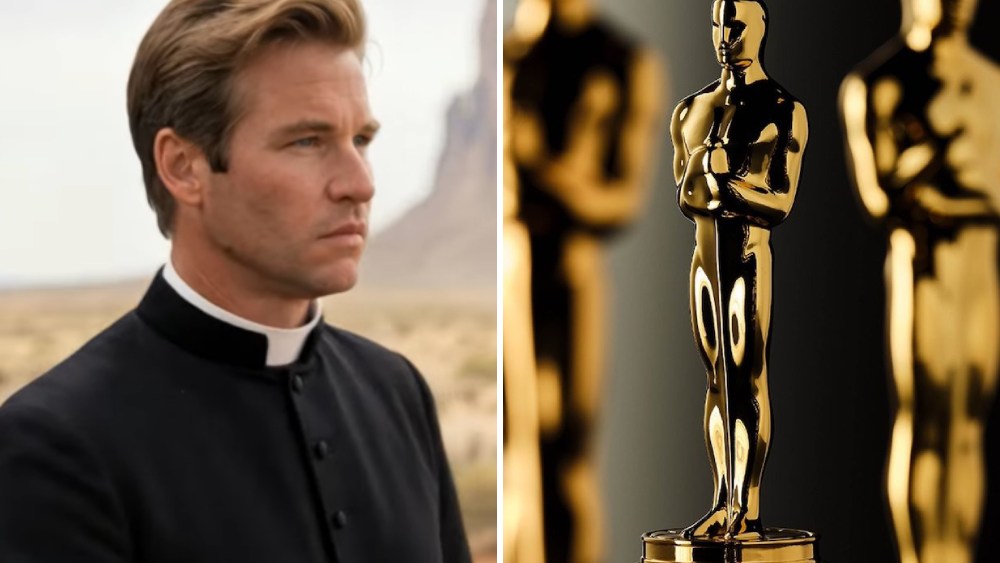
Whether AI performers can actually “act” is still an open question, but awards bodies will soon be faced with whether such performances can be considered for major awards.
It’s like a story ripped from a Hollywood dystopian satire. Still, with concepts such as AI “actress” Tilly Norwood being cast in an upcoming movie a year after Val Kilmer’s death, questions persist among organizations that recognize filmmaking achievements whether AI-generated caricatures can be considered for awards.
Before his death in April 2025, Kilmer appeared in As Deep as the Grave, in which he was scheduled to play Father Fintan, a Catholic priest and Native American spiritualist. Complications from throat cancer ultimately prevented him from appearing on set. Writer and director Corte Voorhees, who had built the role around him, refused to recast him. Instead, with the help of Kilmer’s estate and his daughter Mercedes Kilmer, Voorhees used generative artificial intelligence to reconstruct the performance, assembling the role from archival materials and digital tools.
“He was the actor I wanted to play this role,” Voorhees told Variety when the film’s trailer was released. “It was really designed around him.”
The film, which has not yet been distributed in the United States, comes at a time when the industry is still considering the implications of trying to recreate an actor’s performance using AI.
And while it remains to be seen whether “As Deep as the Grave” will be a strong awards contender or whether its Kilmer-ness will be considered a success, awards organizations are still being forced to confront questions they weren’t written in the rulebook to answer. The question is: Can a performance never performed by a human be able to compete for the industry’s highest honor?
The answer, depending on who you ask, can range from “probably” to “probably not” to even “we’re still working on it.”
The Academy of Motion Picture Arts and Sciences took the most public position on the issue after the 2024 awards cycle. This season saw controversy surrounding Brady Corbet’s historical drama The Brutalist, which used generative AI to enhance Hungarian dialogue and create architectural imagery in Adrien Brody’s performance. This caused enough anxiety within the academy that they felt they had no choice but to respond, but no formal ruling was reached. The academy said the AI tools “will neither help nor hurt the chances of winning the nomination.” Instead, voters were instructed to consider “the extent to which humans are central to creation.”
Yes, it is a principle, but it is not yet a policy. Kilmer’s case raises more questions than it solves. The organization plans to announce this year’s updated rules in the coming weeks.
The acting awards, led by SAG-AFTRA, draw a tougher line. Under current rules, performances that are “completely generated by artificial intelligence” are excluded from consideration for best actor awards. AI-enhanced productions can also qualify, but only if the performers consent in accordance with union agreements. The consent portion is a standard met by Kilmer’s estate, but it seems likely that the performance would be considered “fully produced” and therefore exempt.
Previous precedents, including the digital revival of Peter Cushing and Carrie Fisher in Rogue One: A Star Wars Story, have included characters previously played by the cast and have drawn some criticism.
However, this is not a problem that only affects actors. The use of AI in creative work is impacting all crafts. Other major award bodies have reached positions of varying degrees of clarity. In response to its own review of AI-generated music, the Recording Academy decided in June 2023 that only human creators would be eligible for Grammy Awards. Works that include AI elements may also qualify, but the human contribution must be meaningful and not incidental.
Recording Academy CEO Harvey Mason Jr. told Variety at the time, “We’re not going to give nominations or awards to AI computers or to people who just inspired AI.” “This is a human award that highlights excellence driven by human creativity.”
The Television Academy, which organizes the Emmy Awards, requires disclosure of AI-generated material if it exceeds minimum standards and is tied to a code of ethics. BAFTA prohibits the use of AI in certain categories, particularly in the gaming sector. Notably, none of these positions were written with Kilmer’s scenario in mind, nor are they fully equipped for it.
One of the deep discomforts lies in the question of what AI performance really is and who or what deserves the credit. Kilmer has been performing for over 40 years and remains a staple of his legacy. I often think back to his career-defining roles as rock icon Jim Morrison in The Doors (1991), Doc Holliday in Tombstone (1993), and his role as a wisecracking gay private investigator in Kiss Kiss Bang Bang (2005).
The prospect of posthumous recognition through the role constructed after his death raises its own kind of anxiety. Does the recognition honor Kilmer himself, or simply the technology introduced in his name? Does this deserve to be considered for best visual effects, up there with “Avengers: Doomsday” and “Dune Part 3”?I think many members of the visual effects department will disagree on the answer.
But what’s clear is that the studio isn’t waiting for the controversy to be resolved.
Tencent senior executive Sun Zhonghuai predicted in late 2025 that AI-driven productions could account for 10% to 30% of film, TV and animation output within two years. Tools are accelerating faster than ethics are evolving, and AI adoption is accelerating faster than rules are being written.
Organizations like the Golden Globes and Critics’ Choice Awards have yet to formally develop AI guidelines, but they are expected to do so within the next few years (maybe sooner?).
This version of the conversation began long before Kilmer’s film hit the market. Andy Serkis played the fearsome hobbit Gollum in The Lord of the Rings and the warrior ape Caesar in the modern-day Planet of the Apes trilogy.Andy Serkis’ living work has inspired audiences and award bodies to rethink what acting is. Serkis was nominated for the Critics’ Choice Award for Best Supporting Actor for Rise of the Planet of the Apes (2011) and won a special award from the same organization for Best Digital Performance Performance for The Lord of the Rings: The Two Towers (2002).
This debate continued with the arrival of James Cameron’s Avatar (2009) and voice work such as Scarlett Johansson’s role as the AI Samantha in Spike Jonze’s Her (2013), which the CCA nominated for Best Supporting Actress in each year. And this awards season, puppeteer and voice actor James Ortiz may raise questions about whether his performance as Ryan Gosling’s astronaut’s lovable sidekick Rocky in Project Hail Mary is worthy of recognition.
If audiences react positively to Kilmer’s performance in “Deep as the Grave,” awards voters could be faced with a verdict not anticipated by existing guidelines. Are people seeing a tribute to a beloved actor, or just another example of AI gone awry?
The answer is important. But whatever it is, it won’t be the last of its kind.
