

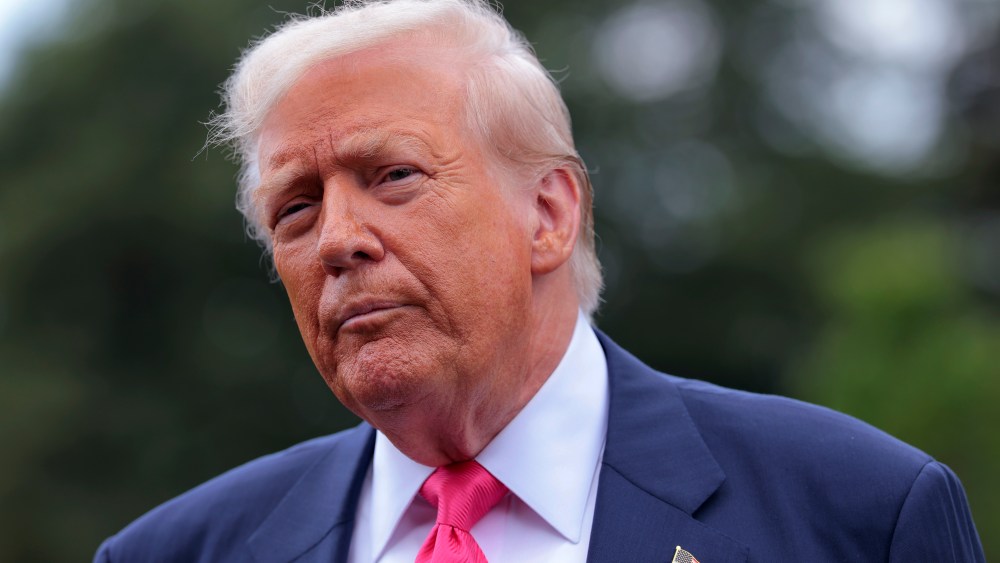
President Donald Trump addressed the FCC’s potential move to raise or eliminate the current 39% cap on local TV station owners, saying he opposes it if it results in “an expansion of fake news networks,” citing ABC News and NBC News in particular. But the proposal to the FCC to eliminate the cap would have no effect on the reach of national broadcast news networks, which today are available in virtually every television home in the United States.
President Trump’s comments contrast with the position of FCC Chairman Brendan Carr, who was appointed by President Trump. Mr. Kerr has been a strong advocate of repealing the FCC’s decades-old rule that restricts television groups from owning stations that reach more than 39% of U.S. households. The National Association of Broadcasters also supports lifting the cap.
President Trump indicated he would oppose the move if it had broader implications for “radical left” news networks.
“I wouldn’t be happy if[removing the FCC’s 39% ownership cap]also allowed radical left networks to ‘expand’. ABC and NBC are especially pathetic. Virtual wings of the Democratic Party,” Trump wrote on his Truth Social account on Sunday. “These should be considered illegal campaigns against the radical left. Expansion of fake news networks is prohibited. If anything, make them smaller! President DJT.”
President Trump included a link to an article quoting Christopher Ruddy, CEO of pro-Trump media outlet Newsmax, who claimed that raising the FCC’s holding limits would be a “disaster” for conservatives. According to the article, “President Reagan understood that Republicans would have little chance of winning state or federal elections if left-wing networks like ABC, NBC, and CBS, or groups like today’s Nexstar, controlled every local station and its local news.”
However, eliminating or increasing the 39% cap would not expand the reach of ABC News and NBC News, which are already available in every television home in the United States. Instead, it would give more powers to group owners of TV stations. And supporters of the move say it will strengthen local television journalism amid the growing influence of big tech in the news media landscape.
Nexstar Media Group, seeking to clear a $6.2 billion contract with rival television broadcast group Tegna, formally filed an application with the FCC last week that includes a request for an exemption from the station’s 39% ownership cap on local TV stations. Nexstar is the largest owner of local television stations in the United States, with 201 owned or affiliated stations in 116 markets. The partnership with Tegna, which has 64 stations in 51 markets, will give the combined company 265 stations and expand Nexstar’s reach to 54.5% of U.S. TV homes, exceeding the FCC’s ownership limit of 39%.
In a statement released Monday in response to President Trump’s comments, Nexstar said: “We continue to believe that the situation is ripe for regulatory reform and we are on track to closing the deal. The status quo is no longer acceptable and will strengthen legacy media and Big Tech’s stranglehold on the marketplace of ideas. I agree with President Trump that the government should do nothing to stop these platforms from entering every pocket, wallet, and backpack of America, and the best way to disrupt their monopoly power is to give local broadcasters a chance to compete on a level playing field.”
Nexstar’s statement goes on to say, “Americans want more access to local news and diverse voices that are not filtered through the filters of coastal elites. By modernizing the FCC’s rules, regulators will ensure that communities have access to fact-based, diverse local “This is a historic opportunity to change the status quo and win for Americans across the country who are tired of legacy media’s influence over their local broadcasters.”
FCC’s Kerr also supports updating the 39% ownership cap rule. Speaking at the Milken Institute World Congress in May, he renewed his call for the agency to reform what he called “arcane artificial restrictions” on TV station ownership. In June, the FCC began a process seeking public comment on whether to “modify, maintain, or eliminate” the 39% national audience cap on local television ownership. Ownership caps have been in place since the 1980s and were raised to the current 39% level in 2003.
In August, NAB asked the FCC to lift the 39% ownership limit on television stations. The trade group highlighted that “decades-old rules prevent local stations from achieving the scale needed to compete with global technology and streaming giants such as Google/YouTube, Amazon, Meta and Netflix, all of which face similar restrictions.” NAB argued that there is “no credible justification for maintaining analog-era rules that are no longer consistent with the way Americans consume media or the functioning of advertising markets.”
In announcing its application to the FCC for approval of the Tegna acquisition, Nexstar said, “This application addresses why a waiver of some of the FCC’s rules governing television ownership, if they remain in effect, is in the public interest, particularly in the communities served by Nexstar’s stations.”
Nexstar’s acquisition of Tegna is “critically important to the future of local television and local journalism,” Nexstar Chairman and CEO Perry Sook said in a Nov. 18 statement. “We are grateful that the Trump Administration and the FCC recognize that current television ownership regulations are outdated and do not reflect the competitive media landscape that has evolved over the past 25-plus years. Like the Trump Administration, we are committed to achieving deregulation and continue to advocate for the removal of outdated restrictions on local television ownership as the best solution to level the playing field for all media.”
