

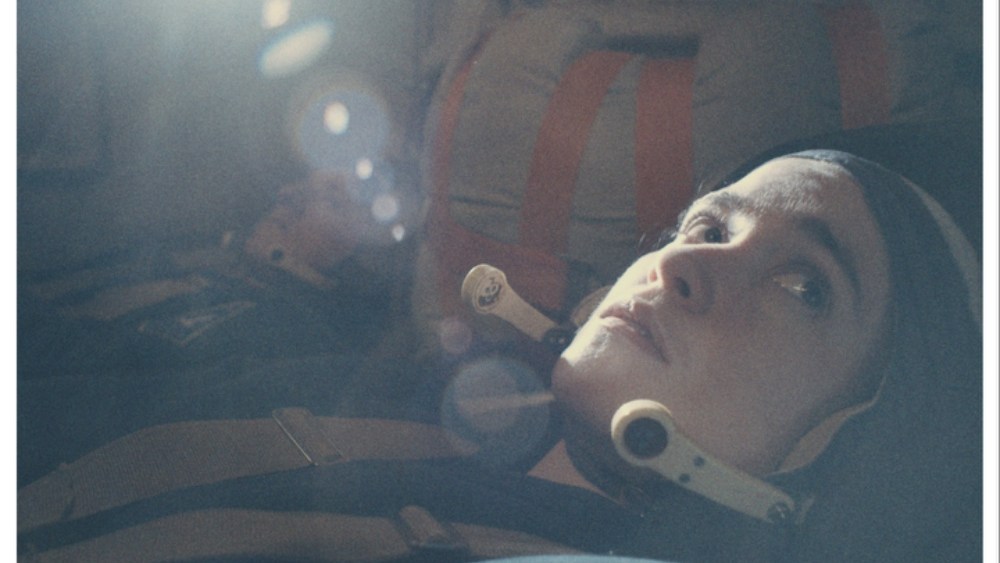
Ben Nedivy and Matt Wolpert, who co-created “For All Mankind” and its spinoff “Star City” with Ronald D. Moore, are adamant that people are dreaming of space exploration again.
“With the launch of Artemis II that just happened, I felt that excitement again. It wasn’t about space travel, it wasn’t about rich people. It was about being inspired,” Wolpert told Variety at the Cannes Series, where Star City had its world premiere on April 26.
Apple TV’s Star City (produced by Sony Pictures Television) depicts the space race between the United States and the Soviet Union. Starring Rhys Ifans, Anna Maxwell Martin, Agnes O’Casey, Alice Englert, and Solly McLeod.
“There was a moment in the late ’60s and early ’70s when we were pushing each other forward. It was a competition, but it certainly led to great things. We have the exploration gene in our DNA, and space is the final frontier.”
They acknowledge that it’s a “complicated time” to tell a story set in the Soviet Union, as Russia’s invasion of Ukraine continues.
“Our perspective is that humans are humans, and their institutions and governments are clearly negative, but many people living under those governments either don’t agree with it or are just trying to live a normal life,” Wolpert points out.
Nedivi added: “We are students of history and, sadly, history repeats itself. This period speaks volumes about what is happening now. It is a reminder and a warning of what can happen if we are not careful. We can easily return to that horror.”
As he points out, the characters soon realize that “there’s more danger on Earth than in space.” These refer to real space pioneers such as Yuri Gagarin and the first female cosmonaut Valentina Tereshkova, while others are fictionalized.
“Everyone knows everything about America’s plans. There were movies, TV shows, books, magazines. But the Soviets wanted to keep their plans secret. The stories we heard were unbelievable and insane. We couldn’t believe they were true.”
Wolpert cites the landing of Soviet cosmonaut Alexei Leonov as an example.
“They went off course and landed in the middle of a snowbound forest in Siberia, surrounded by wild animals. They had to survive there. These astronauts and engineers became superstars, but because of that they were under intense surveillance. The idea of being so scared of something you’re so proud of is fascinating.”
In this series, astronauts are controlled by a system. It tracks their every move, writes speeches and decides who to marry.
“Again, this is based on what actually happened. Tereshkova had an arranged marriage with another cosmonaut. They didn’t feel safe,” Wolpert says.
Despite these struggles, they wanted to show that the human spirit can overcome almost anything.
“This is the story we wanted to tell. We live in very dark times. Every time I read a newspaper I want to cry. These characters really spoke to us,” Nedivi says.
“Honestly, we were surprised that Apple would pull it off. To their credit, they never looked at things through the lens of politics or what would sell or not. It’s a testament to Apple’s confidence that we were able to tell a story like this, which is very rare on television.”
Although “Star City” is in English, they set out to create an international show.
“‘Chernobyl’ was definitely one of our inspirations. Like them, we also filmed in Lithuania. This show is the epitome of an international production. Here we are, with two American writers and a British cast, a show filmed in Lithuania is premiering in France,” says Nedivy.
“Many of our Lithuanian crew members grew up in the shadow of the Soviet Union. Their parents would come and look at the costumes and buildings in horror. It’s important to explore cultures outside of our own, now more than ever as the world shrinks. What unites us is this wonder of venturing further into space. This is for all of us. This is for all of humanity.”
Wolpert argues that going there changes people’s perspectives.
“So many of them have started working across borders against conflict. Science and facts can actually break down barriers between different societies.”
His co-creator added, “They say, ‘Write what you know,’ which is the biggest lie. But I can’t help but write what I feel. Seeing how our society has evolved and changed over the last five years has definitely affected my psyche. But our hope is that this show will be a lesson in embracing exploration again. The world can be better. I believe in that.”
