

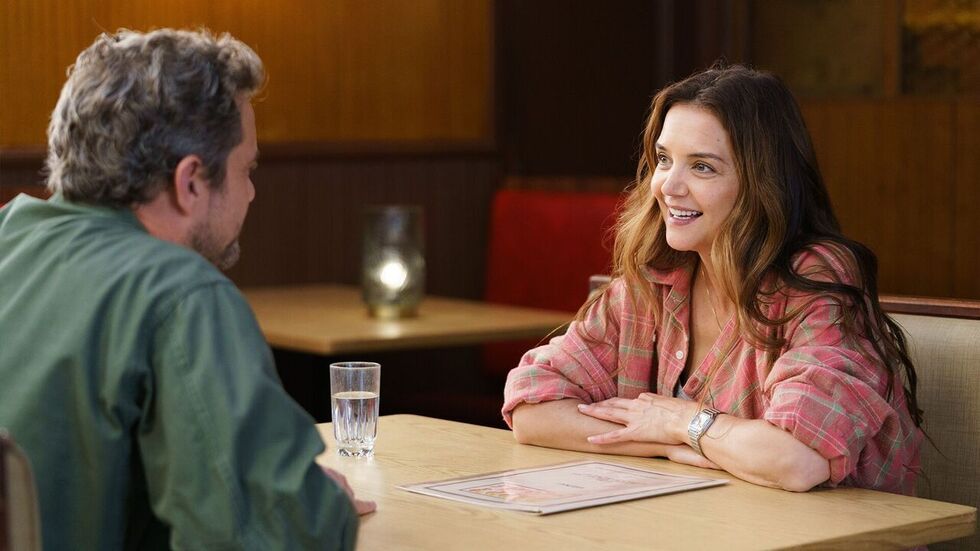
The star duo of “Happy Hour” is not just a selling point, but also a viewer filter. If your heart softens a little when you hear the words “Katie Holmes and Joshua Jackson working together again,” then congratulations! This equally heartwarming romantic comedy was made directly for you. But if you’re not thrilled by the prospect of a “Dawson’s Creek” reunion, or are too young to know what that means, feel free to move on. While completely innocuous, Holmes’ latest work as a writer and director doesn’t offer anything particularly new to viewers who aren’t all that attached to the protagonists they’ve previously engaged with.
The good news is that Holmes and Jackson, once teenage lovers, met by chance in middle age. Holmes and Jackson are as personable now as they were then. Holmes’ screenplay, on the other hand, is a light affair of a plot that relies heavily on the metatextual nature of the casting, and doesn’t ask for much more. With its tidy commercial rom-com tropes and shaggy walk-and-talk like Richard Linklater’s Before, “Happy Hour” lacks the depth and breadth of dialogue needed to sustain the latter approach. It’s being discussed as the first in a trilogy revolving around these characters, but we don’t really want to know all that much about them.
Still, while Holmes’ previous three feature films (including two that premiered at Tribeca) had to settle for online releases, the star’s appeal (both on paper and in reality) might be enough to get Happy Hour a theatrical release. While the supporting cast of Constance Wu and Mary-Louise Parker (who adds a welcome touch of sweetness each time she appears as a free-living, freedom-loving elder) further enhances the film’s mainstream indie status, the other characters here only exist to support the reunited lovers.
Liz (Holmes) is a professional photographer who has just gotten divorced and takes a job cleaning out her ex-husband’s remains from his Manhattan apartment. Coinciding with her divorce, she began taking a new, uncompromising approach to her work life. She prioritizes passion projects over paychecks. “I only want to photograph real people,” she says, refusing to take portraits of famous people. At least, until one such request becomes too intriguing to ignore: acclaimed travel writer Andrew MacLeod (Jackson), who happens to be the first man she ever loved nearly 30 years earlier. Recurring flashbacks outline a blissful young romance (Jack Martin and Jonna Diaz-Watson as Starr’s younger partners), and the soundtrack is not 90s classics but the new wave pulse of Blondie, the two old souls’ mutual favorite band. Decades later, with Norah Jones’s original score offering a more serene midlife mood score, the two still don’t know what went wrong between them.
“Happy Hour” is a movie with an unwavering belief in soulmates, even if it’s not entirely true that two attractive, successful New Yorkers with everything going well are still clinging to unrequited love from decades ago. Liz may display some passive-aggressive signs when meeting up with Andrew for a lively photo shoot, but they only have a few minutes of screen time before those old feelings resurface. A harrowing group date with Joe Tippett and an eclectic motley crew of friends, including John McGinty, a deaf actor who plays Andrew’s straight-talking best friend, is pleasantly portrayed with ASL conversations without any additional narrative context, but the pair never strays from their clearly destined course, nor are some contrived narrative obstacles thrown in late. True love doesn’t break, and the established rules of romantic comedy don’t break either.
“Happy Hour” begins with Alan Watts’ famous quote. “Present experience cannot be compared to past experience; it can only be compared to past memories that are part of present experience.” The most ambitious Holmes scripts apply that idea to a relationship that unfolds in two time frames, but the observation is not particularly essential. Events happen in life, time is long but short, and people change except when they don’t. Fortunately, Holmes and Jackson have enough natural chemistry to maintain this simple structure. Even if neither Liz nor Andrew are fully dimensional characters, they are compensated by the personalities and backstories of the actors playing them.
