

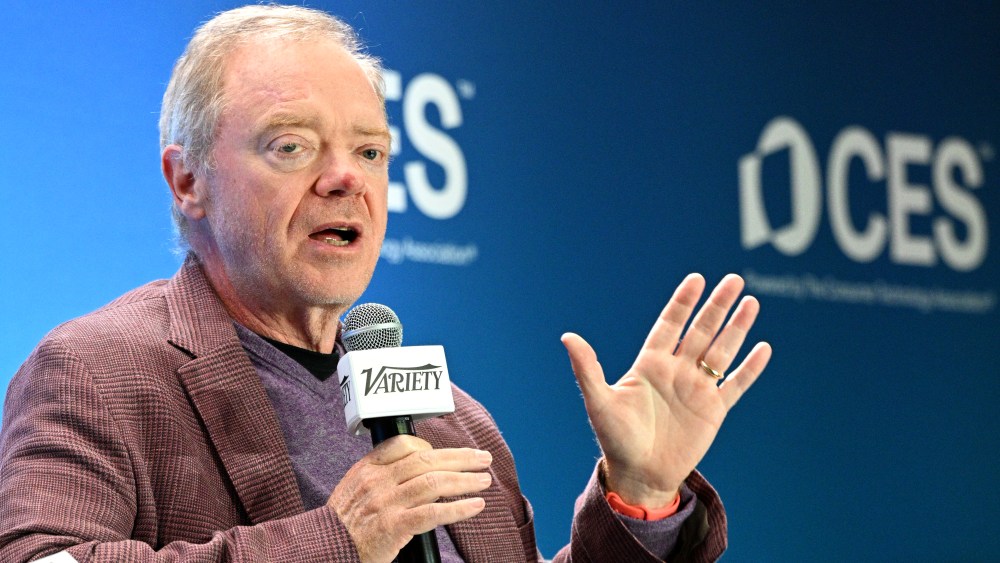
Roku founder, chairman and CEO Anthony Wood has some big predictions about the undetermined impact generative AI will have on Hollywood. Among them: the first 100% AI-generated “hit movie” to be released within the next three years.
“I don’t know if there’s going to be an investment bubble, but I do know that AI is going to be huge, and it already is,” Wood said Wednesday in a headline conversation with Variety co-editor-in-chief Cynthia Littleton at the Variety Entertainment Summit at CES. “This will impact a variety of industries, but in our industry it will reduce the cost of content production. For example, we predict that within the next three years we will see the first 100% AI-generated hit movie.”
Wood founded Roku in 2008 and has since grown the technology company into the world’s largest streaming platform, with more than 50% of broadband households using its service. According to Wood, Roku handles 40% of all streaming flows in the U.S., Canada, Mexico, Latin America, and the United Kingdom.
With such a big business at stake, Wood is leveraging the potential of AI to streamline streaming.
“My thinking falls into three buckets,” Wood said at Variety’s CES Summit at Aria in Las Vegas. “One is just business operations: How can we make our business more efficient with AI? We’re actively doing that. I think companies that don’t do that are going to be at a significant competitive disadvantage. Our operating expenses are going to be higher than other competitors. So our focus is just on being more efficient. We’re using AI across our products. Targeted advertising, recommendations, all of these are AI-based technologies. This is traditionally machine learning-based AI, but we’re moving all of that to generative AI.” AI is like the next generation. ”
Check out Roku’s full conversation with Anthony Wood.
Wood agrees with the widely held opinion in the industry that the biggest impact generative AI will have on the media industry, outside of the potential benefits to business operations, is in reducing content creation costs.
“I think people underestimate how dramatic it will be,” Wood said. “So obviously I don’t think people will be replaced. Humans will still have the creative power to produce content and hit shows, but costs will drop dramatically and business models for many companies will change. So I’m looking at how we can leverage that. This is a huge opportunity for us.”
Roku’s main focus now is its platform business, which includes advertising and subscriptions, and Wood said it had more than $4 billion in revenue in 2025. However, the company recently acquired two new businesses that expand its portfolio and revenue potential. They are low-cost ad-free streamer Howdy (which includes a broader content library than Roku’s originals) and bundled channel service Frndly TV.
About Howdy Wood describes the $3-per-month Howdy service as “designed as an add-on service, not a replacement for major streaming services like Netflix or Disney.”
“The opportunity for Howdy is that if you look at what’s going on in the streaming world, streaming services are getting more and more expensive,” Wood said. “They keep raising prices and adding more and more ads. So the low-cost, ad-free part where the market really started is now gone. There’s no streaming service that caters to that part of the market. That’s Howdy’s opportunity. $3 a month. There are no ads and it’s doing very well. Just like we used the advertising power of the platform to build the Roku channel, that’s what we’re doing with Howdy.”But we’re using it to grow.” has such a broad appeal that there are a lot of people who want a $3/month streaming service with no ads. So we’ll start with Roku, and I think that’s going to be a very big business. ”
