

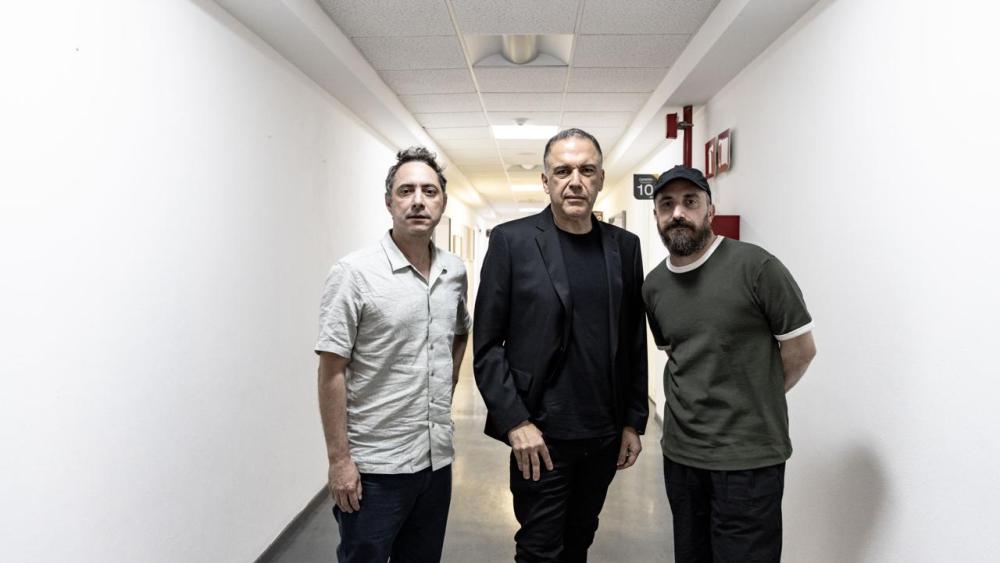
This was one of the most anticipated events of the 41st Guadalajara Film Festival (FICG), where Chile was the guest of honor.
On April 19, director Pablo Larraín, founder of Chile’s most successful production company Fabra, and his producing partner, brother Juan de Dios Larraín, sat down with Francisco Ramos, vice president of Latin American content at Netflix, to discuss how the company has grown into the international company it is today, with offices in Santiago, Mexico City, Los Angeles, Madrid, and possibly Bogota, Colombia in the not-too-distant future.
Throughout their conversation, they reflected on how Chilean and Latin American cinema has grown from a small industry with limited resources to a globally recognized creative force.
Mr. Ramos left many people wondering how a country so remote and relatively small could generate such a powerful creative force. “Here we have Maite Alberdi, Sebastian Lelio, but beyond that, there are many other filmmakers who have come up in the last 30 years. And it’s really interesting to ask why. Why are there so many compelling voices coming out of Chile?
He added: “You wonder what the environment is like to foster talent at that level, because it’s not just the director. There’s the producer, the cinematographer, the designer, the screenwriter. All of these roles branch out and feed off each other, forming the ecosystem that the industry needs to really grow and thrive.”
This question puzzled them, but only to a certain extent. Pointing out Chile’s rich culture of painters, poets, and writers, as well as its recent rise in cinematic sensibilities, Juan de Dios said: “I think the visual aspect, the graphic sensibility, plays a big role. Chile is almost like an island. You have the Andes on one side, the Pacific Ocean on the other, and a desert to the north. It’s a pretty isolated place. When you grow up there, whenever you want to do something or go somewhere, you can do it.” For us, that always meant getting on a plane. We grew up in a more remote environment, so I think that creates an urge to go out into the world and be recognized overseas, and that shapes you and creates more drive. ”
“But to be honest, it’s just a theory. I’m not sure I fully believe it myself,” he added, drawing laughter from the audience.
Pablo, whose work has ranged from local stories of resistance like No to an English-language trilogy about three iconic women: Diana Spencer, Jackie Kennedy and Maria Callas, agreed: “I think it’s great that we’re such a small country, so diverse, and yet so hard to define at the same time. I don’t know if there’s a clear explanation. We’re very close to it, because we’ve been immersed in this world for years.” And we ourselves are part of it. ”
He quoted Chile’s esteemed documentarian Raul Ruiz, who described Chile as a country that “resists categorization, and categories have not yet fully established themselves.” “There’s also a lot of internal tension in that. We’re challenging each other, and there’s a kind of constant self-scrutiny, restlessness.”
Juan de Dios Larraín also pointed out that it was the size of Chile’s market that forced them and their colleagues to look outside for film production.
“Co-production is not only helpful, it’s essential for Chilean cinema. There’s no other way. You can’t finance a film purely through the Chilean market. The numbers don’t add up. So from early on, going out and looking for funding became a fundamental part of the process. It’s built into the system.”
“In a way, that limitation forces you to grow. It forces you to adapt, collaborate and think outside your box from the beginning,” he said.
Pablo Larraín further added, “We have made a lot of films, almost 50, with different directors. And looking at both the most successful and the least successful ones, I always come back to the same idea: The key is to support the director.” Mr. Fabra has supported Mr. Lelio, who won Chile’s first international feature Oscar for his transgender drama “Fantastic Woman,” and Mr. Alberdi, who has been nominated twice for documentary work.
Juan de Dios also pointed to television as another key factor contributing to the company’s growth, noting that advertising remains a strong pillar.
“For the first 10 to 15 years, we were a very independent production company, with a strong editorial identity, working with directors from all over the world, and driven by very writer-driven ideas. Then we gradually moved into something more collective, sort of treating filmmaking as a shared sport, so to speak. At the same time, there was a push to get bigger budgets, which led to our first production with Lelio.”
“Around the same time, television also emerged as a major force, and that combination created something of a perfect storm for us as a production company. It helped us evolve and expand from a relatively small organization operating in just a few countries to something more structured and, for lack of a better word, more ‘corporate.’ Without television, the company probably wouldn’t have grown as much as it did. And in a way, the Oscars gave us a kind of legitimacy and identity. This allowed me to take the next step at the exact moment the opportunity presented itself. ”
The Film Festival of Guadalajara (FICG) runs from April 17th to 25th.
