

As the story goes, Tesuque Pueblo’s Camel Rock may or may not have influenced the look of Steven Spielberg’s ET character. But the mushroom-shaped rock formations in the Sangre de Cristo Mountains just north of Santa Fe, New Mexico, are attracting attention for another reason. It is named after the world’s only indigenously owned and operated film studio.
For four years, the studio, a former casino owned by Tesuque Pueblo, has been home to “Dark Winds,” an AMC and AMC+ mystery show set on the 1970s Navajo Nation near Monument Valley. Based on the novel by Tony Hillerman, the series stars Zahn McClarnon as tribal police lieutenant Joe Leaphorn, who solves crimes with the help of police officers Jim Chi (Kiowa Gordon) and Bernadette Manuelito (Jessica Matten). Season 4, which premieres on February 15, centers on the search for a missing Navajo girl.
During a set visit during the production of Season 4, Variety was able to tour the backlot and stage with Dark Winds executive producer and director Chris Eyre. Eyre explains that not only will having the series based in one scenic location just 10 miles from Santa Fe streamline production, but the studio will also provide training for Indigenous staff and ultimately become home to more Indigenous productions.

Jim Chi’s “Dark Winds” trailer set at Camel Rock Studios
Michael Morias/AMC
Your backyard is your studio’s secret weapon. The 100 acres of varied desert land adjacent to the studio building houses most of the show’s permanent outdoor sets, from a Navajo village to Bernadette’s trailer. But as long as the tribe’s historical advisor agrees, the production will also have access to more than 17,000 acres of surrounding Tesuque Pueblo land.
“Every look is character. They’re authentic Southwest, on tribal lands, and a show made in part by Native Americans. And that’s the way it should be,” Eyre says.
The more than 30,000-square-foot studio building, housed in the former Camel Rock Casino, houses the show’s interior sets, as well as a wealth of 1970s-style costumes, police uniforms, and vintage props.
“Dark Winds” has made a significant contribution to Native entertainment, with a diverse cast and crew, and with great care for authenticity and respect for Navajo traditions.
Once a new filming location in Pueblo is chosen, “cultural preservationists go back to the office and look at the records, and then they tell us yes or no,” Eyre says. “There are ruins of villages there, pottery shards and all sorts of things that keep us away, and that’s not surprising.”
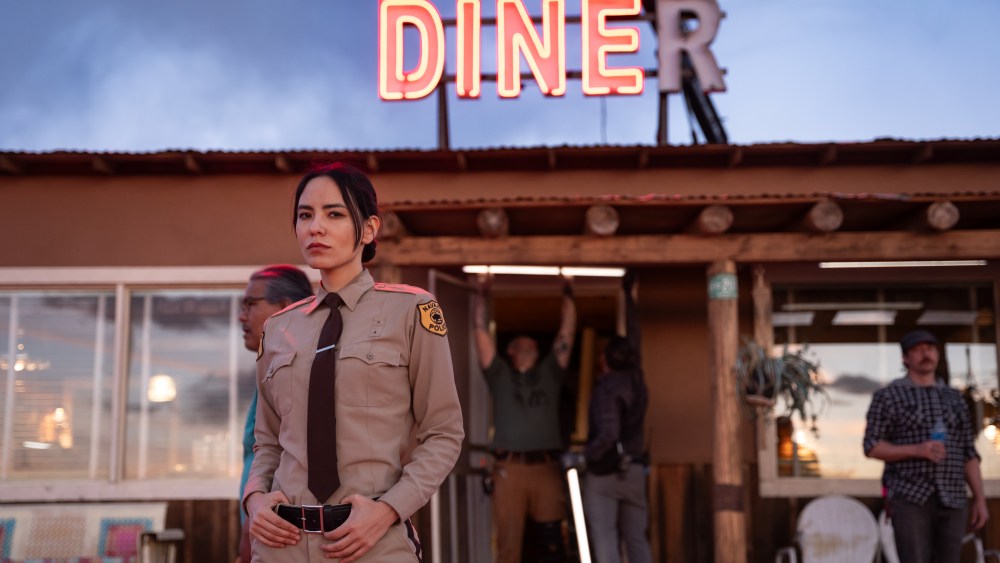
A short path past the exterior of the studio building and tribal police station reveals the exterior set of “Dark Winds” among the impressive desert spiers and sandstone outcrops. Leaphorn’s Cabin, Bernadette and Chee’s Trailer, Hogan Indian Home and Diner are among the frequently used locations, with the interior built upon the stage.
“When we look at the exterior of the Hogan in a beautiful landscape, we usually have something to complement the interior on stage. These are commonly referred to as cover sets. When we’re shooting in the backyard and it’s too windy or too rainy, we use the interior of the Hogan as a cover set,” Eyre explains.
The next season of “Dark Winds” will also feature scenes shot in Albuquerque, which is twice as big as downtown Los Angeles in the 1970s. But filming on the backlot is especially meaningful for Eyre, who has shown Indigenous stories in film and television.
“My favorite places to shoot shows are the outdoor landscapes of the Southwest: mesas, sunsets, cliffs, rocks, sand, and pinions because it’s always so eclectic,” he says.
Jessica Matten plays Bernadette Manuelito in Camel Rock Studio’s Navajo Police Department shooting “Dark Winds.”
Michael Morias/AMC
The production and set designers underwent significant training on the Season 4 sets.
“Not to give anything away, but we have some big set pieces that we’ve built on stage that we’ve never seen before, and it’s pretty cool,” Eyre teases.
New Mexico has seen a significant increase in production thanks to major investments from Netflix and NBCUniversal. However, because Pueblo is considered its own country, content filmed at Camel Rock is not currently eligible for the state’s generous incentives, although officials say there are ongoing discussions about whether that could change.
Once “Dark Winds” is finally finished, the tribe hopes other films and shows with Native content can be filmed at Camel Rock.
“It benefits the Tesque Pueblo development company’s business and gives them an opportunity to think about other types of film and television production and what they can do to tell their stories. So it’s kind of a great plan,” Eyre said.
