

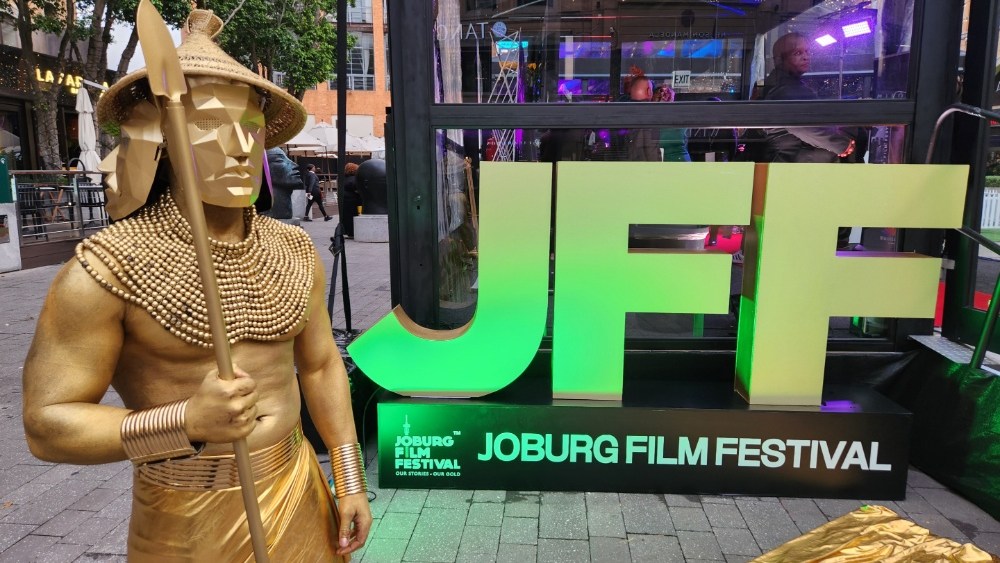
Following the uproar over whether art and politics should be separated at the Berlinale, organizers of the 8th Joburg Film Festival at its opening on Tuesday night pointed out that African filmmaking is inherently political and were adamant that all opinions and perspectives are welcome.
Hundreds of filmmakers, TV and film executives, distributors, actors and the media gathered at Theater on the Square to watch the sold-out festival opener, The Laundry, a poignant apartheid-era drama written and directed by Zamo Mkhwanazi.
The audience included the ambassadors of Nigeria, Japan and France to South Africa, as well as executives including Laurent Scicouri, head of films and series at Canal + International, which recently acquired MultiChoice.
Some 138 films will be released this week, many of them with political themes and provocative titles, such as the documentary “The Little Black Man from the Congo” (Negrito del Congo), directed by Chirillo Waha Mjira.
“Of course, this festival takes place at a moment when the world is feeling nothing but nuance, a moment when artists are being asked: should they speak or should they remain silent?” festival curator Nhlanhla Ndaba said in her opening remarks on stage before the screening of “The Laundry.”
“At the Berlinale, we witnessed a heated debate about whether filmmakers should get involved in politics. It was suggested that artists should distance themselves from politics because cinema is antithetical to politics.”
“The Joburg Film Festival has always been a place where politics and art meet, where the African continent and the world are connected, and where politics is just another story. We don’t pretend that storytelling happens in a vacuum there.”
“The moment we stop reflecting the world in all its beauty and fragility, that is the moment we cease to have meaning.”
“Over the past year, South Africa’s film industry has faced a crisis that has tested its very foundations. As of January 2026, the Department of Trade, Industry and Competition (DTIC) owes our industry more than R600 million in unpaid rebates.”
“The last adjudication committee meeting was held in March 2024, so that was two years ago. For two years, cameramen, grips, sound engineers, producers and make-up artists were staring at approved projects and payments that had yet to arrive.”
“Just a few weeks ago, hundreds of film workers marched to Parliament carrying banners reading ‘Save SA Film Jobs’ and the creative sector received little recognition in the State of the Union address. President Cyril Ramaphosa made no mention of the film rebate crisis. There is no plan to restore investor confidence and no timetable for intervention,” Ndaba said.
“While rebate payments have been delayed, our spirits have not. While international film production companies have abandoned South Africa for Malta and Portugal, where incentive programs are working effectively, our filmmakers have not abandoned their craft.”
“We will continue to tell our stories while we wait for a system that seems to have forgotten us,” Ndaba said.
“This is an industry and who is standing here and refusing to die when they are told they don’t matter? No matter how dysfunctional the bureaucracy is, they can never take that away.”
JFF Manager Taryn Joffe said the festival “recognizes the courage of filmmakers to stick to their stories, create their work, and reach audiences despite uncertainty.”
MultiChoice’s head of programming, Nicolas Ore, caused a shock when, after brushing away a flying insect from his hair, he squealed on stage and said: “The world is restless and changing its shape in real time.”
“Globally, the entertainment industry is under tremendous pressure. Markets are changing, traditional business models are being rewritten, and the rise of AI is changing everything we do. It will change the way we tell stories and the way people see and discover our stories.”
“We can’t control these pressures, but I believe that African filmmakers know how to find rhythm in the chaos. We know how to create despite, and sometimes because of, and that’s what matters right now. Africans are creative. We are resilient and there is a sense of community around us that allows us to do things that are impossible elsewhere.”
“For me, movies are inherently political,” producer and JFF judge Kate Pansegrow told Variety on the sidelines of Tuesday’s red carpet.
“People don’t think enough about the fact that freedom of expression is in real danger with the rise of fascism and that we need to say absolutely everything we want to say and ask the toughest questions.”
