

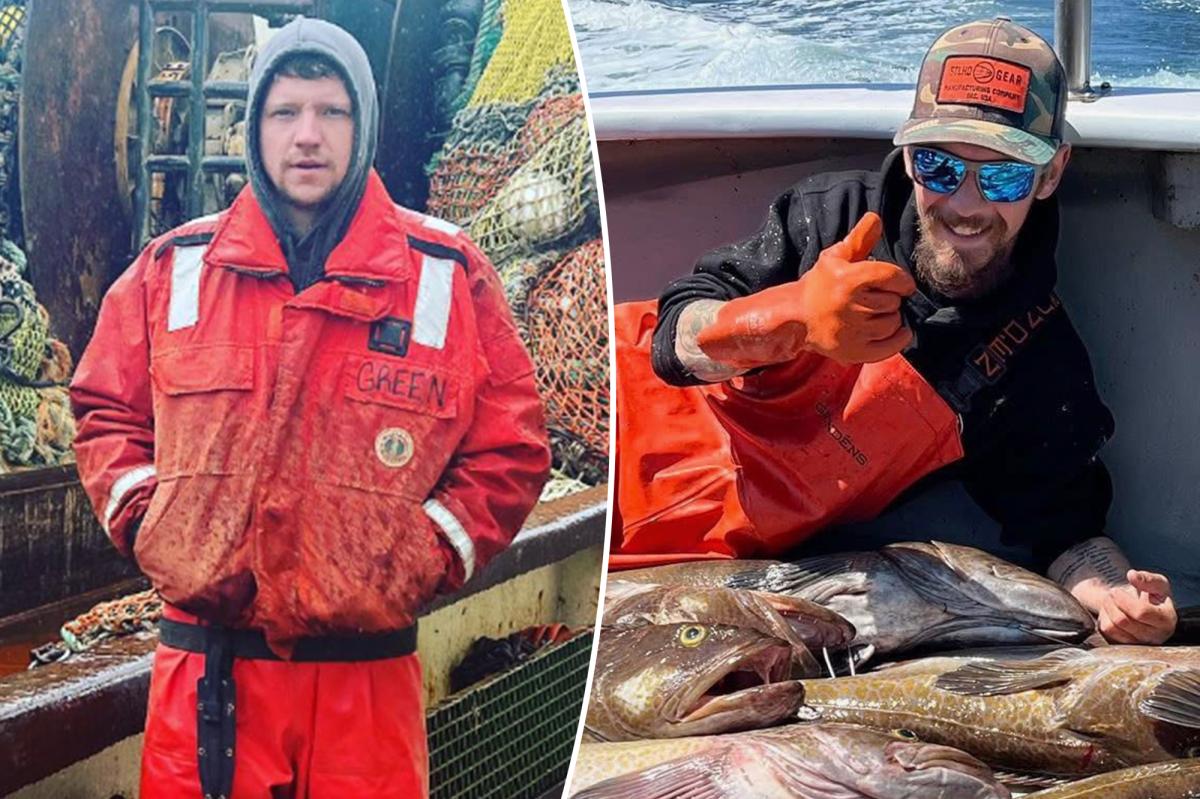
The crew of Captain Rick Shelford’s Aleutian Lady fishing boat “did everything they could” to save “Deadliest Catch” star Todd Meadows before he tragically passed away on February 25 at the age of 25.
Deckhand Trey John Green III told Page Six in an exclusive interview that the notoriously dangerous Bering Sea was “flat” and “calm” that day, and the weather was “really nice.” He noted that the incident occurred in the late afternoon when the sun was still out, so visibility was high.
However, he said the water was “only a degree or two above freezing” and that “the outside temperature was below freezing”.
Mr. Green claimed that his fellow deckhand, Mr. Meadows, had an accident with one of the pots (rigid, baited traps used to catch shellfish) on the 127-foot boat and fell overboard.
However, the U.S. Coast Guard investigation is ongoing, and authorities have not officially released the exact circumstances surrounding Meadows’ death.
Green, 30, said as soon as Meadows went overboard, he ran to the back of the boat and climbed onto a pot to look for Meadows.
“I see Todd. He’s floating, he’s swimming. He’s got big baby blue eyes. And from maybe 100 yards away, you could see his eyes looking around,” Green recalled.
He said Mr. Shelford kept giving Mr. Meadows his finger while he turned the boat to get within a few feet of Mr. Meadows.
“Todd is still alive, still swimming, still trying to hang on. We went next to him and Steve (Porter) — Steve — every boat has a designated rescue swimmer for just this type of scenario. Steve was already set up, already in his diving suit,” Green said. He added: “When Steve jumped into the water, the harness that was attached to the crane actually broke.”
Mr Green said other crew members were then able to submerge a life sling attached to the crane into the water.
At this point, Green explained that Meadows was able to work with Porter to get into the sling. Mr Green said Mr Meadows was “half way up” and “almost back in the boat” when he “fell into the water”.
“The second time we went to pick him up, Todd just wasn’t alive,” Green lamented. “There was nothing left for him. The first time, like I said, he was fighting and trying to get into the sling. And the second time, he was just dying.”
Porter did not respond to Page Six’s request for comment.
Green said Meadows was only in the water for “three or four minutes” before being pulled back into the boat, by which point he was already “turning blue” with foam coming out of his mouth and nose.
Still, Green said he and others began CPR “immediately.”
“We ended up getting him inside and continuing CPR. We have an AED (machine) on the boat, which is basically a defibrillator, and we tried to use that as well, but it just wasn’t working. And finally, after 30 to 45 minutes of trying to get him out, the captain came down and said, ‘Guys, that’s not working,'” Green recalled.
The official cause of death has not yet been announced. Notably, Meadows’ mother, Angela Meadows, told TMZ that her son suffered a blow to the head while working on the Aleutian Lady about a month before his death. He suffered a concussion and spent a week recuperating at his home in Washington before returning to work. It is unclear whether that head injury played any role in his death.
As for Mr. Green, he explained to us that the Aleutian Islands Lady was about “12 hours away” from Dutch Harbor, Alaska, at the time of the rescue effort. Crews then made the difficult decision to wrap Todd’s body in a tarp, put it in a freezer and return to town, he said.
“When someone’s life is at stake, training and everything is tough. You try to do the best you can. And everyone did. I want to reiterate, everyone did everything they could,” Green insisted before admitting that Todd was not wearing a life jacket.
“On this boat, we don’t wear life jackets. We don’t really know why. I know it sounds stupid, but to people who aren’t[in this field]it just seems kind of crazy. It’s like, ‘Why wouldn’t someone wear a life jacket?'” he elaborated. But when you’re working 18 or 20 hours a day, it’s just a piece of equipment, and it’s just a nuisance. To be honest, I really don’t know why we don’t wear it. ”
Mr Green said the experience was an “eye-opener” that put his work “in perspective”.
“I remember thinking, ‘Oh, if you go overboard in the middle of the night, you’re going to die.'” So at night, you die. But during the day, it’s like, ‘If I overdo it, they’ll kick me out and I’ll be fine,”’ he told us. “But this wasn’t a long rescue. This was like everyone did exactly what they were supposed to do. We got him on the boat as quickly as we could, but it wasn’t enough.”
Green went on to claim that “everything” that happened on the boat that day was caught on camera by the Discovery Channel, which was in the final stages of filming Season 22 of the popular reality series “Deadliest Catch.”
“Discovery has deck cameras that are like fixed-mount deck cameras that record 24/7,” Green claimed. “So that camera itself was capturing everything. Captain Rick, he also had his own camera for the boat, and they were capturing everything as well. And also, during the rescue operation, the producer and the cameraman were also on deck filming the whole rescue. So there’s multiple angles. So they were capturing everything.”
When asked for comment, a Discovery Channel representative told Page Six: “This remains an ongoing investigation by the U.S. Coast Guard. We are supporting their efforts and cannot comment at this time.”
Meanwhile, a USCG representative said the USCG is “investigating the incident to determine the cause and provide the necessary feedback to prevent a similar incident from happening again.”
“Coast Guard investigators are currently working with a team of qualified marine accident investigators to compile evidence. Investigators will then prepare an official report and timeline of the incident to determine (1) causative or contributing factors, (2) evidence of foul play or negligence, (3) whether there was defective material, and (4) whether Coast Guard or other government agency personnel caused or participated in the cause of the incident.”
“This process is essential to drawing accurate conclusions and initiating the necessary corrective actions to prevent similar accidents and casualties from occurring in the future.”
“The results of the investigation will not be disclosed while the case is ongoing,” the official said, adding that the USCG “has not assigned a timeline for completing the investigation.”
Mr. Shelford did not respond to Page Six’s request for comment. Todd’s family has also been contacted.
Todd leaves behind three young sons and completely devastated loved ones, many of whom have posted heartbreaking condolences on social media.
In a Facebook post announcing the shocking news, Shelford said Todd’s “love of fishing and his strong work ethic quickly earned him the respect of everyone.”
Green agreed, saying, “We’re all out there making money and making a living, and we love it to some extent. But Todd was more excited to do this, almost to the point of doing it for free. He was just one of those guys who was ecstatic to be up there.”
He described the enthusiasm that Todd brought to the spacecraft as “refreshing,” adding, “He was one of those guys who was just happy to be there. And it kind of ignited that, reminding everyone why we’re there and why we’re doing what we’re doing.”
