

The 28th Shanghai International Film Festival closed on June 21 with the industry’s clearest statement yet about what it values most: new voices, deep pipelines, and an embrace of artificial intelligence that it says complements, rather than replaces, the humans who make movies. Whether the industry believes that last part is another matter.
Debut directors had a night in both directions.
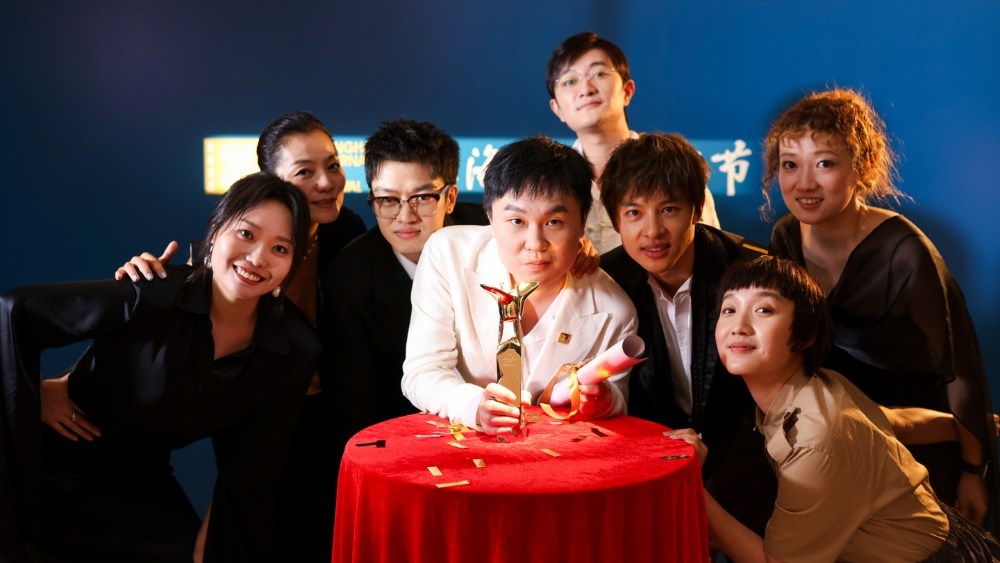
When Zhong Kaifeng’s Atlantic Rhapsody won Best Feature Film at the Golden Cup Awards, it achieved a smash hit that no one had planned ahead of time, but that in hindsight felt inevitable. The film is a leisurely, time-jumping portrait of a young man searching for his father in the chaos of freewheeling capitalism in Northeast China in the late 1990s, and it also won an award for best cinematography for director Hao Jiayue, whose previous films included “A Song Sung Blue.” This is Zhong’s debut full-length work. ”
The same story was told in Asia’s new talent section. Her First Taste, directed by Kong Yi-wen, is a campus-set identity film developed over the past three years with support from the SIFF project, and won both Best Picture and Best Actress for its star Ma Fufu. The Thai director’s Cannes Director’s Fortnight title, Sompot Chidogasongponse’s Nine Temples to Heaven, was a double winner in this category. With the exception of Best Original Screenplay, which went to Hunter’s Moon, all of Asia’s Newcomer Awards went to debut films.
That the two competitive sections independently reached the same conclusion is more a signal than a coincidence. The judges, led by Tony Leung Chiu-wai, who was serving as a judge for the Golden Goblet Competition for the first time, clearly read the atmosphere in the venue. It’s an industry hungry for fresh creative energy in a market traditionally dominated by established names.
Pipeline is the key
Shanghai’s investment in new talent goes far beyond the competitive program, and its infrastructure became more visible at the 28th edition than in previous years. The festival’s three-pronged system – SIFF Projects for project incubation, SIFF ING for emerging filmmakers, and SIFF YOUNG for talent development for the industry – currently serves as a structured ladder from idea to international exposure.
Schiff Young announced the Class of 2026, nine filmmakers selected from 59 applicants to direct, produce, and write. Celebrities such as Jia Zhangke and Jojo Hui were nominated. The chief judge for the final judging was Mr. Wen Muye, himself a 2023 SIFF YOUNG graduate. “The young creators we selected boast outstanding talent and diverse styles,” Wen said. “They combine solid professionalism with independent thinking.”
Meanwhile, SIFF ING’s new mobile filmmaking camp concluded with 10 short films shot entirely on iPhone by emerging Chinese directors, and screened both on-site in Shanghai and online. The camp provided each participant with professional iPhone filmmaking equipment, production funding, and technical guidance throughout the production cycle. This kind of small-scale, well-designed approach is what sets SIFF apart from festivals that treat talent development as a press release rather than a program.
AI will be everywhere, but employment issues will not go away
Shanghai has integrated AI deeper into the main program than any previous SIFF edition, running dedicated workshops spanning image creation, audio adjustment, AI writing, and legal guidance, and partnering with generative AI company MiniMax as an institutional collaborator. AI film showcases and AI-welcoming studio launches were held throughout the 10 days of the festival.
At SIFForum’s panel discussion on “Smart Tech, Immersive Worlds, and the Next Cinema Revolution,” speakers identified three key challenges: computing power, distribution, and the ability to precisely direct the video AI it generates. Yan Yijun, vice president of AI basic model building company MiniMax, said computing is “the absolute core” of the problem. “For generated video models to achieve higher fidelity, what they really need is more computing power to iterate on refinement and experimentation,” Yang says. “The more you experiment, the more effectively you can train certain aspects.”
The speed of change in the field is already astonishing. One AI-first company that spoke to Variety at the festival revealed that it completed filming a 120-minute live-action period drama in seven days using AI background replacement, relighting, and VFX work, with an acting crew that was later replaced by AI-generated actors. Throughout the festival, AI Forum panelists reiterated that generative AI complements human creativity, rather than replacing it. The anxiety in the room suggested the industry was still not convinced.
China wants the world – but bureaucracy is a reality
Unlike many festivals in China, which tend to be inward-looking in their programming and industry focus, SIFF emphasizes its international standing. For the 2026 edition, more than 420 films were selected from around 4,100 entries from 125 countries, and managing director Chen Guo said the selection was based on “the values reflected in each film and its premier status,” while taking into account geographic representation and diversity of filmmakers by gender and generation.
The Belt and Road Film Festival Alliance, established by the film festival in 2018, currently has 55 members from 48 countries. Chen described the initiative as “transforming a cultural showcase into an in-depth, long-term industrial cooperation.” A dedicated Egyptian Film Week was held to commemorate the 70th anniversary of the establishment of diplomatic relations between China and Egypt.
However, SIFForum’s co-production committee issued a more candid assessment of the barriers to that collaboration. Yang Peng, deputy general manager of state-run Huaxia Film Distribution, pointed out serious discrepancies in regulations and copyrights affecting Chinese producers operating overseas, including differences in regional approval qualifications, actor ratios, investment ratios, and content censorship. “From copyright to derivative intellectual property rights, there are often issues of inconsistency,” Yang says. “Distribution cycles and currency settlements at the theatrical, streaming, and television ends are also different, leading to cross-border accounting complications.” Ambition and friction, after all, go hand in hand.
The festival knows what it is and does it
The opening ceremony at the Grand Theater attracted Chinese stars, creating an unmistakable atmosphere. The standout moment was not Leung’s appearance as president of the jury, but the Lifetime Achievement Award awarded to “Crazy Rich Asians” actor Lisa Lu, who has already celebrated her 100th birthday according to the Chinese calendar. “Shanghai is my hometown and the place where my artistic journey began,” Lu said from the stage. “Look at the many great filmmakers here today and please contact me if you have any future opportunities. I am not retiring. I will continue to be an actor.”
The ceremony opened with performers hoisted on robotic arms interacting with AI-generated projections, but it was no coincidence that the emotional focus centered on the 100-year-old actor declaring he could still work. That was the theme statement of SIFF, a festival that threads the needle between technology and the irreducible human. It’s small things like having interpreters at almost every press conference, photo ops for reporters accessible without a Chinese phone number, and quick recording of events, but they reflect a festival that understands what it takes for international credibility. SIFF is China’s only FIAPF-certified competitive A-list feature film festival and produces a major televised awards ceremony-level opening gala. That execution was no accident.
