

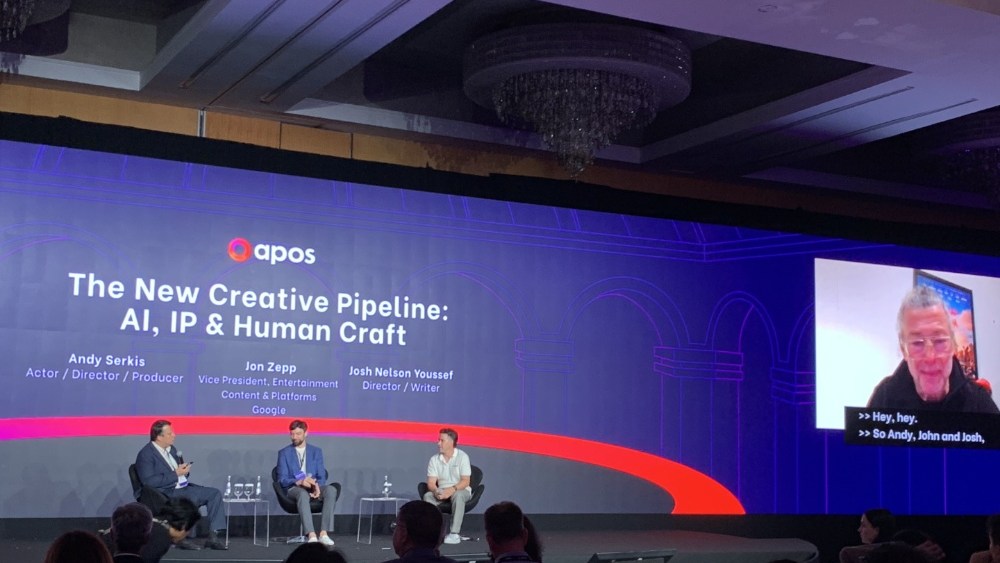
The opportunities and risks of artificial intelligence took center stage at the APOS Conference’s New Creative Pipeline: AI, IP, and Human Craft session on Wednesday, as actor, director, and producer Andy Serkis joined Google executive John Zepp and filmmaker Josh Nelson Youssef to discuss the future of storytelling in an increasingly AI-driven landscape.
Serkis, whose pioneering performance capture work helped redefine modern visual effects, said he’s excited to see how the next generation of creators will combine new technologies with new forms of storytelling. He joined via video call from New Zealand.
While he said he’s “looking forward to seeing how new creators utilize these tools in imaginative ways,” he acknowledged that the rapid expansion of creative possibilities has also raised serious concerns about misinformation, blurred lines, and accountability.
“As the creative environment expands, so do our responsibilities,” Serkis added.
Zepp, Google’s vice president of entertainment content and platforms, described AI as a “major new dimension of storytelling” and argued that the technological innovation is creating new opportunities for both creators and viewers. He pointed to Google’s growing investment in different forms of content, including emerging formats such as microdramas, as part of a broader effort to better understand audience behavior and preferences. At the same time, he emphasized the importance of transparency as AI-generated content becomes increasingly common.
“In most cases, viewers will want to understand the source,” Sepp said, adding that creators, technology companies and industry players must work together to establish new frameworks for trust and attribution in what he describes as an era of democratized content creation.
Filmmaker Youssef also reiterated the benefits of AI-assisted workflows, saying that digital tools can help creators achieve greater efficiency and higher levels of execution. But he insisted the industry must remain focused on the purpose behind the technology.
“The question is not just what can we do with these tools, but why do we use them?” Youssef says.
Looking ahead, all three speakers expressed optimism that advances in technology will continue to expand the possibilities for world-building and storytelling. However, they agreed that human imagination, creative freedom and trusted sources of information will continue to be essential as the industry moves into the next phase of digital transformation.
“The world is changing rapidly,” Serkis said. “But human creativity evolves with it.”
