

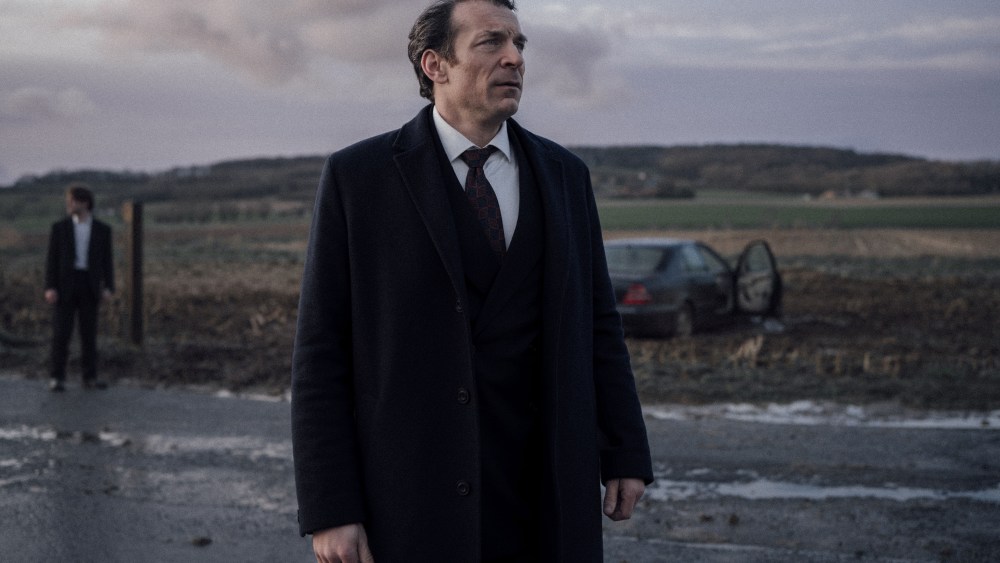
In Anke Blonde’s latest film, two middle-aged male friends in expensive suits walk in lockstep through an office and a banquet hall for much of the first act. You might expect their breakthrough to be scored by power ballads and upbeat hip-hop tracks, but since “Dust” is a film that exposes financial fraud, it’s scored by moody, heavy strings, and the two men in question are scheduled to be arrested in just a few hours. There’s an absurdity and abstraction to the whole affair, a glimpse into the minds and egos of the people who run the modern world, not to mention the ironic disdain amidst the surprising empathy. However, this prosperity does not last long, and the film ends without saying much.
It begins with a dusty substance floating through the frame, out of focus. It could be snow, or ash, or even pieces of gold. It’s a good introduction to a film with countless possibilities, including a voiceover about quickly switching gears to a blank computer screen and filling in your own story. The year is 1999. Handsome Belgian executive Geert (Arie Walterter) dazzles an enthusiastic crowd with his yarn, while his grumpy technical director Luc (Jan Hamenecker) demonstrates what is believed to be the world’s first speech-to-text technology. It may seem rudimentary now, but at the time it was a huge advance, no different from the way technology companies are pushing various forms of AI today.
The film wastes no time in hinting that something is amiss, as it cuts back and forth between Geert and Luc being summoned by angry executives at the weekend, being accosted by brash journalist Aaron (Anthony Welsh) in a public restroom, and dancing around the subject of their investigation. Before they realize it, their fate is decided. Come Monday morning at 9am, they will be arrested for setting up empty shell companies and defrauding thousands of public investors. But where the story climaxes with this revelation, here it is the catalyst for the characters’ strange, introspective final 24 hours of freedom, and is initially portrayed with intriguing flourishes.
The story, written by Angelo Tijssens, is loosely based on the Belgian tech company Lernout & Hauspie, but it has little in common with real-life events and often plays like a half-remembered fable. Its dim, gaslight palette and breathy musical hum give it a ghostly feel, like the Harvard hallways turned haunted house in David Fincher’s similarly amber technological cautionary tale, The Social Network. This eerie feeling is further enhanced by the elliptical editing, which seamlessly skips back and forth in time over just a few days, creating a sense of fluidity in parts that should feel discontinuous. With a mesmerizing and extremely cheerful face, the bespectacled Luc (his thinning hair tipped upwards like the devil’s horns) spits, curses, and even does both at the same time.
The two are separated for much of the running time, but when forced to consider whether to flee or blow the whistle, they circle each other. But the hours leading up to the arraignment (a wall clock is etched in the background of most scenes) are also moments of remorse, as the men catch up with acquaintances and loved ones who will no doubt be affected by future events. Luc consults his wife about how to proceed, but Geert wants to spend her last few hours free with her driver/boyfriend Kenneth (Thibaud Dooms). After all, he’s a man with a lot of secrets, but Luc seems to have a tendency to spill the beans.
This simmering tension over what choices they make as they wander the rural landscape is at the heart of the film’s narrative, and feels important in many cross-cutting scenes. However, as the story progresses, the editing becomes more perfunctory and mechanical than poetic, with the blonde presenting her scenes in an increasingly drawn-out and simplistic manner, which unfortunately detracts from the game. Strip away its style and there’s little substance to “Dust,” despite plenty of scenes of men panicking or quietly reflecting on their regrets. Its characters are vessels for stories of broken friendships, but they rarely feel bound by their immediate circumstances.
The film is incredible, even nice and stylish, but beyond the initial presentation there’s little that guides the story in new or exciting ways. Perhaps more than an echo of the theme of how today’s less naive and inept tech brethren make fast things. Both of the leads command the camera’s attention, but the long, dim scenes in the second half would quickly die in the hands of bad actors, and there’s only so much dimension each of them can conjure up in a story that hardly seems to be heading toward anything meaningful. The film reaches its climax without any catharsis or irony, but instead treads an uncompromising middle ground of gonzo sentimentality that leaves you looking back and wishing things had been different.
