

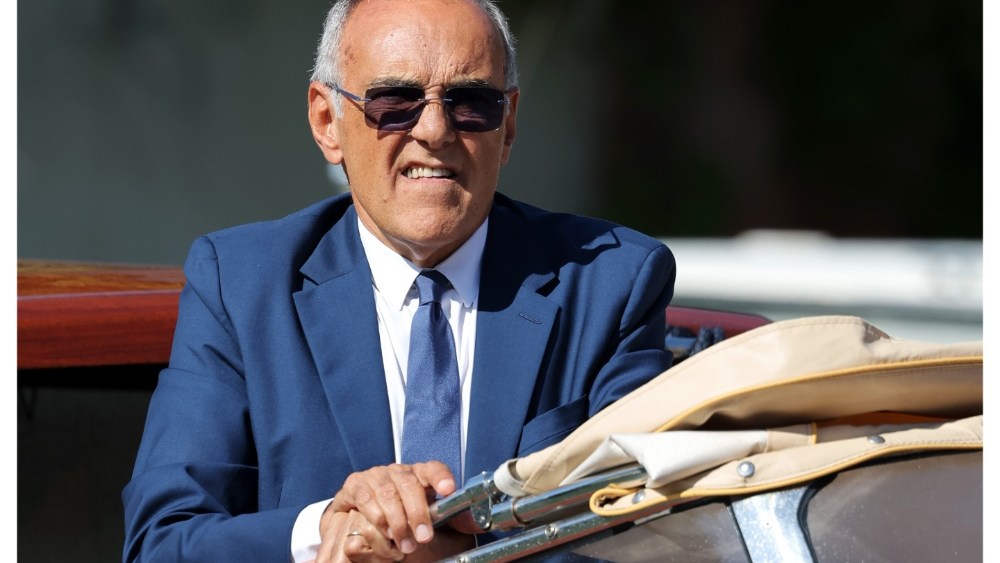
Venice Film Festival chief Alberto Barbera has pulled off a pretty remarkable feat this year, putting together a buzzing lineup of stars set to disembark at the Lido, despite having fewer films at his disposal from American studios and streamers.
This includes new projects from world-class directors including Martin McDonagh, Florian Zeller, Danny Boyle, Werner Herzog, Lance Oppenheim, Nanni Moretti, Hirokazu Kore-eda and Chang-Dong Lee, as well as the world premiere of the Oasis reunion documentary Don’t Look Back in Anger, starring British brothers Liam and Noel Gallagher.
After announcing the tantalizing selection, Barbera spoke to Variety about the changing studio ecosystem and how festivals won’t necessarily be considered in the future.
How do you explain the lack of films from US studios and streamers? Have they grown cold towards Venice and festivals in general?
You should not jump to hasty conclusions that may lead to misunderstandings. Let’s stick to the facts. Take a look at the predictions that have been attempted in recent months regarding movies that might land in Venice. In fact, there were very few Hollywood movies listed in the predictions, because there are no Hollywood movies at all. The problem is they aren’t there. Studios are in this limbo, struggling and trying to redefine themselves through mergers. Either way, when you’re going through an identity crisis, the auteur films that would normally make it to film festivals aren’t there. It’s not because they don’t want to come to our festival.
The only movie that made it happen — and this is a marketing choice by Warner Bros. over which we have no control — is Digger, directed by Alejandro González Iñárritu and starring Tom Cruise. They announced a few months ago that they would bypass all fall festivals and release it directly in theaters. I believe it is a marketing choice and has less to do with concerns about the negative impact the festival may have. However, I believe that movies are very powerful and beautiful, so no one should have to worry about this. But it’s a marketing choice.
So what’s the problem?
The real problem for everyone today, especially studios, is finding ways to promote their films. The real problem is that the set of tools that were used until yesterday no longer exists. They don’t work anymore. They have been proven ineffective. But you still don’t know what new tools to use to promote your film. So, in some cases, people say, “I want to just throw that movie straight into theaters and have this surprise effect make it a big hit.” right? Or, if you’re Christopher Nolan, create expectations that last for months and the outcome will take care of itself. But in our case, some other movies that were announced in advance weren’t ready.
I read recently that (Aaron) Sorkin’s movie Social Reckoning was filming some scenes in early August, so they didn’t actually have time to finish the movie. David Fincher’s film (The Adventures of Cliff Booth) seemed certain to happen at one point, but family and personal issues forced production to be halted, and the film has yet to be completed. Maybe it will be completed within a month. But it’s precisely those unforeseen, unforeseen, unwanted delays that mean the film won’t be ready in time. Do you know any other Hollywood movies?
What about Dune 3?
It’s scheduled for release at Christmas, but it’s not ready yet. I spoke with Denis (Villeneuve) several times, and he told me, “We are in full-scale production using a huge amount of special effects.It will be ready around the release date.” So the problem is, the film isn’t here. It would be a mistake to conclude that the studio’s attitude towards festivals has fundamentally changed. Because that’s not necessarily the case. It is a contingency and the future cannot be predicted. It remains to be seen whether next year (which, on paper, seems to be much richer in interesting and promising (studio) films) will lead to a refusal to participate in the festival. Or what if, instead, there was a return to using festivals as a platform to promote films. It’s impossible to know at this point. However, I am very cautious about jumping to conclusions. That’s not true. Because when the movie is there, it comes. right?
Well, that turns out to be the case with the A24 as well. A24 is sending “Primetime” starring Robert Pattinson to Venice, even after “Smashing Machines” was a huge flop when released there last year.
Well, in the case of Smashing Machines, there were quite a few problems, but that’s because it was a movie with so much potential. Why didn’t it work? Do you know? Perhaps the film’s positioning and marketing strategy was flawed. There were a lot of reasons why the movie didn’t work, even though it actually had all the elements it needed to work. But you just need to understand that if a movie doesn’t do as well as you expected at the box office, it’s not the film festival’s fault. And for “Prime Time” they only do Venice, so they have to believe us.
“Prime Time” didn’t catch our eye. How did you intercept it?
We were in contact with (director) Lance Oppenheim from the beginning. At first, we didn’t think it would be difficult to do it at our own festival until the last minute. And there was actually some uncertainty as to whether Pattinson would be available because he was filming a movie in London, and there was a risk that he might not be available. And without Pattinson, promoting the ambitious film will be even more difficult. So I actually think this is the last movie confirmed. We watched it very, very late. It was one of the last movies we saw. After we saw it, Pattinson confirmed that he could come to Venice. He didn’t think twice. He immediately said, “Of course, we’ll come to Venice and give this film all the promotion it deserves.”
The studio is actually in Venice, as Disney is working on the Oasis reunion documentary Don’t Look Back in Anger, which was expected to feature Liam and Noel Gallagher. How did you land that?
This is another movie that frankly didn’t catch anyone’s attention. Nor is it ours. They told us about it at the beginning of June. It’s a great musical movie, so of course I immediately invited them. We were all speechless. And the Gallagher brothers were very happy to be there and made it clear that they wanted to screen the film. But there’s one more movie from the studio, and that’s Searchlight Pictures’ Martin McDonagh-directed “Wild Horses Nine.” I have to say they are very loyal to Venice and always have been. And this movie was supposed to come to Venice from the beginning. So, on the one hand, it’s not true that studios don’t exist. On the other hand, the fact that some of us are absent this year, I don’t think it’s a choice that will hurt future relationships in the years to come.
Is May El Tukey the only woman participating in this year’s competition? why? Isn’t Venice aiming for gender equality?
She is the only player we found who has enough quality to compete internationally. Since 2000, Venice has awarded more top prizes to female directors than Cannes, Berlin or any other festival, so I don’t think it can be accused of bias against female directors. This year’s three main judges are women. We expected to find more films directed by women in the competition, but there were fewer entries. Fiction films directed by women accounted for 24% of submissions this year, compared to 30% last year. Unfortunately, they also turned out to be of poor quality, so we could not bring any more products into the competition. This is very unfortunate, but no one should suspect any bias on our part.
The only strict standard we follow is the quality of the film. We are absolutely against selecting movies based on gender. Because I don’t think it’s beneficial. It’s humiliating for a woman to feel like she was chosen because she’s a woman and not because she made a good movie.
We don’t decide production or budgets or control women’s access to the profession. We only review submissions. That judgment will necessarily be subjective, but it will be based on the film itself. If we made a mistake by not choosing a film directed by a woman, people will be able to tell when they see the film. ”
This interview has been edited and condensed for clarity.
