

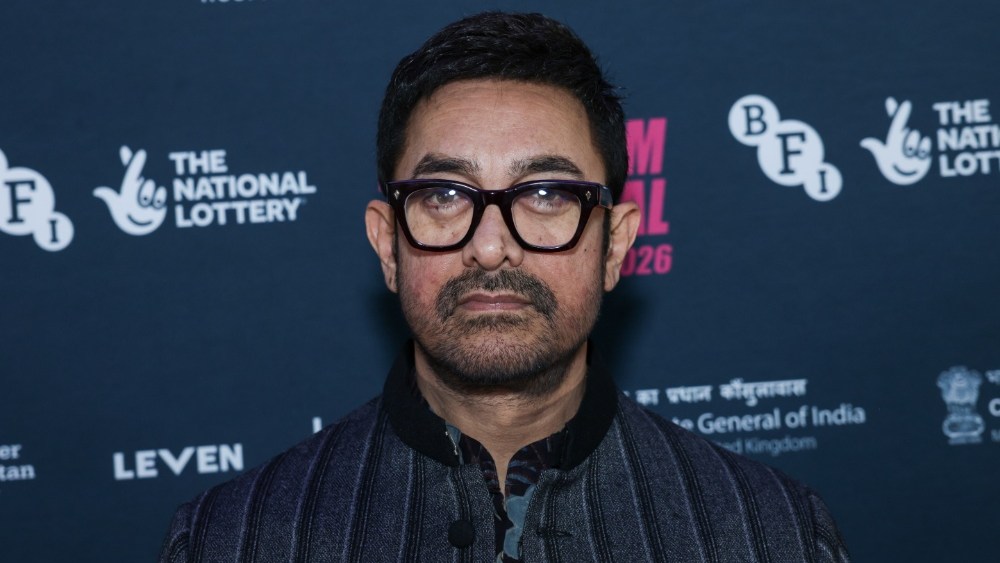
Bollywood superstar Aamir Khan has denied that his role in “3 Idiots” is based on educator and climate change activist Sonam Wangchuk, addressing the long-running rumors at the BFI In Conversation event at BFI Southbank, held as part of the London Indian Film Festival (apart from “Lagaan” to celebrate 25 years of “Lagaan”).
“No, actually that’s not the case. No, no, that’s a misunderstanding,” Khan said.
The question arose after 3 Idiots co-star Omi Vaidya, who played Chatur in the film, shared a video on social media linking Wangchuk with Poonsukh Wangdu, played by Khan, drawing attention to Wangchuk’s deteriorating health during a hunger strike to protest the resignation of India’s education minister.
“I know I saw Chatur’s video not too long ago. He said yes. No, he is wrong,” Khan said. “Maybe Chatur thought so, but I would like to tell you that neither Raju (director Rajkumar Hirani) nor Abhijat (writer Joshi) are the scriptwriters of these two, nor am I. We didn’t know Mr. Sonam. But what he is doing is a good job. In any case, he doesn’t have to be based on the character of ‘The Three Idiots’ for us to respect him and his work.”
Asked about Mr Wangchuck’s hunger strike, Mr Khan said: “I think we are all very concerned about his health and we hope it ends well. We all hope that Mr Wangchuk ends his fast.”
‘Lagaan’ was released in 2001 and was nominated for an Oscar. Asked if he expected to be discussing “Lagaan” on a London stage a quarter of a century later, Khan said no. “We were just scared. We were just scared trying to get it right,” he said of the production. Later in the conversation, he described the film as “a movie about the triumph of the human spirit.”
Khan grew up in a film-making family. His father and uncle were both film directors. When asked about his early interest in acting, he replied: “My parents and my whole family were very against the actor.”
Khan reached state championship level in tennis as a junior player, but then quit the sport. He said, recalling the exhibition match between Roger Federer and Novak Djokovic. “I have the privilege of having Federer and Djokovic sit on either side of the net and trying to bring the net down…I’m the only one with that privilege.”
Khan’s first experience on a film set was when he was seven or eight years old for ‘Yadon Ki Bharat’. He recalled that the pancake makeup on his face “smelled awful.” Of the set itself, he said, “It was very scary. The whole thing was very dark, very noisy, people were screaming.”
Khan cited Ketan Mehta’s 1984 film Holi as a turning point. “I wanted to be in the film just to see what a Steadicam is and how it works,” he said, noting that the equipment never arrived and was instead shot handheld.
Asked about his perception of the golden age of Hindi cinema in the 1980s and ’90s, Khan pointed out that it goes back even further. “For me, the golden age of Indian cinema is the 50s and 60s,” he says, naming the writers, composers and filmmakers of that time, noting that the 1980s, by contrast, were the lowest point for commercial cinema before a wave of younger directors began to revive it.
“I was always swimming against the current,” Khan said of his choice of lead roles, such as Deepa Mehta’s 1947 Earth.
Khan said he was in the middle of a string of box office failures when director Mahesh Bhatt offered him the film. He turned it down because he didn’t like the script. “If I had compromised that day, I think my entire career would have been a series of compromises,” he said. “When I was able to stick to what I believed in during the worst of times, it gave me a lot of strength.” He said the experience taught him that before signing on to future projects, he needs to weigh three factors: the strength of the script, complete trust in the director, and a producer willing to provide the creative team with the right resources.
Asked about the years after 2001 releases ‘Lagaan’ and ‘Dil Chahta Hai’, Khan said, “Actually, I was going through a personal crisis myself. I was going through a divorce with Reena, so mentally I was not in the frame of mind to work.”
He made a comeback with Mehta’s ‘Mangal Pandey’. Talking about the research process for ‘Mangal Panday’, Khan said, “Very little has been written about Mangal Panday.” He pointed out that the India House Museum in London only has a few pages about 19th century soldiers and revolutionaries.
When asked about directing child actors in his feature directorial debut Taare Zameen Par, director Khan said, “I have to say that directing children was the easiest. I didn’t have to teach them anything. They were very natural and understood immediately.”
Asked about the string of hits that followed, including “Ghajini”, “3 Idiots”, “Dhoom 3”, “PK” and “Dangal”, Khan said, “I’ve been really lucky to have such great stories,” adding that there was no way to predict which films would win the hearts of audiences before their release.
Khan pointed to smartphones as a dividing line for moviegoers and contrasted today’s audiences with what he called the “captive audience” decades ago. “I’m competing with a thousand other things,” he said, adding that regardless of format, it’s the storytelling that determines whether a film connects or not.
Asked about his process, Khan said, “My first step is to get into the character’s head. Once that’s clear, everything else comes from there. The way I look, the way I act, the way I speak, everything comes from there.”
Khan’s next film is an Indian-Australian project. Aamir Khan Productions, Mind Blowing Films and Kabir Khan Films have announced the feature film ‘Shirkhara 41’, inspired by the 2023 rescue operation at the Silk Yala Tunnel in Uttarakhand, India. The film, written by Australian screenwriter Andrew Anastasios (The Water Diviner) and directed by Kabir Khan (Bajrangi Bhaijaan, ’83), focuses on the role of tunnel-boring expert Arnold Dix in the operation. Preparations will begin on August 1st, and filming will begin in November.
