

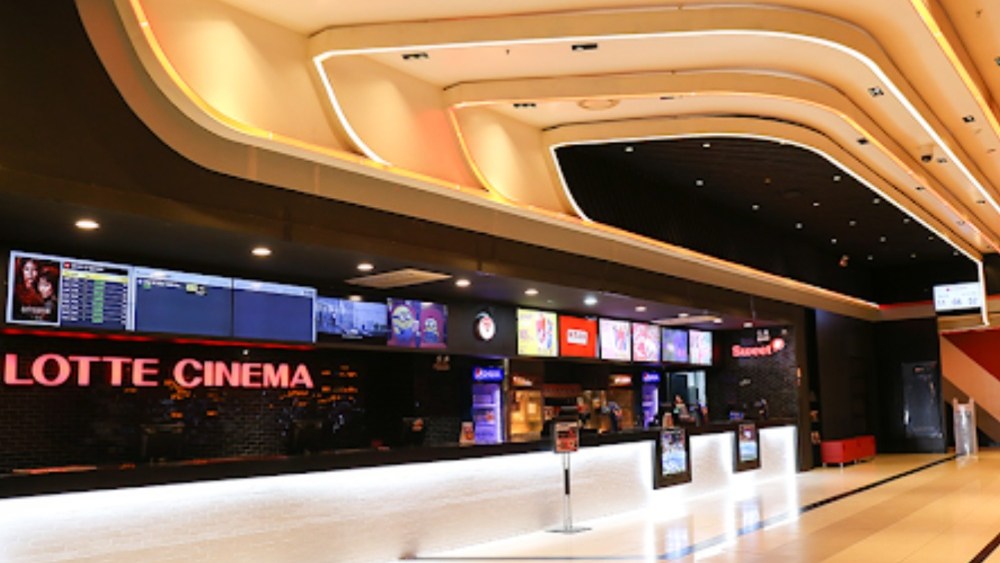
The proposed merger between Lotte Cinema and Megabox, which was supposed to create South Korea’s largest theatrical performance company, officially collapsed after about 14 months of negotiations, and the deal was ultimately scrapped by the financial crisis that engulfed Megabox’s parent company, the JoongAng Group.
Lotte Shopping and Contently Jun’an announced on Wednesday that the memorandum stipulating the merger between Lotte Culture Works and Megabox Jun’an expired on June 30, officially ending the process. The two sides signed an initial memorandum of understanding in May 2025 and extended it three times while adjusting the terms of the agreement, most recently extending the deadline to June 30th.
Had it been closed, the merger would have boosted the combined company’s domestic screen share to nearly 50%, making it Korea’s top exhibitor, overtaking long-time market leader CJ CGV. Instead, the local theater market remains in the existing three-way competition between CGV, Lotte Cinema, and Megabox.
According to the Korea Film Council, total theater revenue in South Korea in 2025 will decrease by 12.4% to 1.047 trillion won ($673.1 million), and attendance will decrease by 13.8% to 106.09 million won, marking the second consecutive year of decline. However, the market has shown a remarkable recovery this year, and according to KOBIS ticketing data, box office revenue for the first half of 2026 reached an estimated 539.7 billion won ($347 million) with an estimated attendance of 53.19 million won, up from 407.9 billion won ($262.3 million) and an attendance of 42.5 million in the same period last year.
Negotiators were unable to resolve differences over how the combined company would be financed, including credit enhancement terms and collateral structures. Because Megabox leases most of its theater properties, it has little of its own collateral to offer investors, while the parent company credit backing required by outside investors has been unable to be provided by Contently Jun’an or holding company Jun’an Holdings amid its own liquidity problems. Both sides had sought external investment of up to 400 billion won ($257.2 million) to support the agreement.
The final blow was when Contentree JoongAng and Megabox JoongAng filed for court-supervised reorganization on June 14, a move that forced a complete reassessment of Megabox’s assets and rendered the equal partnership structure of the original merger unsustainable.
The rehabilitation application was part of a broader liquidity crisis that has hit the Central Group since June 12, when broadcaster JTBC declared default after failing to repay 20.6 billion won ($13.2 million) in securitized loans on maturity. Subsequently, credit rating agency NICE Investors Service downgraded JTBC’s unsecured bond rating from BBB negative to CCC, while Korea Ratings downgraded JTBC from BBB negative to BB due to negative reviews.
Two days later, on June 14, Chuo Holdings, Contently Junan, Megabox Junan, and Chuang P&I all applied for court rehabilitation at the Seoul Bankruptcy Court. On June 15, JTBC itself submitted an application for a voluntary restructuring support program that allows it to negotiate directly with creditors before starting formal procedures. Central Group Vice Chairman Hong Jeong-do apologized at a press conference. He argued that the filing was due to the prolonged contraction in the capital markets, which further exacerbated the company’s accumulated financial burden.
Part of the crisis is due to JTBC’s failure to make a high-stakes bet on high ratings for the Milan Winter Olympics earlier this year, compounded by a slump in its advertising business. The network broke away from South Korea’s traditional joint rights system with KBS, SBS, and MBC and independently acquired broadcast rights for the 2026-2032 Olympic Games and 2026-2030 FIFA Soccer World Cup. World Cup later resold some of its rights to KBS for 14 billion won ($9 million), but was unable to reach similar deals with the other two networks.
On June 30, the Seoul Bankruptcy Court approved JTBC’s request to put the rehabilitation decision on hold for one month until July 30, pending negotiations with creditors. For the other four affiliates, the court proceeded with formal restructuring, retaining the existing management as court-appointed administrators rather than installing an external receiver. The final restructuring plans are expected to be submitted by Megabox Jun’an by December 1st, Contently Jun’an by December 15th, and Jun’an P&I and Jun’an Holdings by December 22nd.
The group’s flagship newspaper, JoongAng Ilbo, which operates independently of the affected affiliates and has posted an operating profit for 13 consecutive years, said it is pursuing a separate creditor-led training program rather than court rehabilitation. Content production affiliate SLL JoongAng also avoided restructuring, recently repaying its 5 billion won ($3.2 million) short-term bond in full, increasing market speculation that the JoongAng Group may be considering selling the unit as part of a broader restructuring.
With the merger falling through, Lotte Culture Works plans to lean into its own momentum. The company recorded consolidated sales of 124.6 billion won ($80.1 million) and operating profit of 7.9 billion won ($5.1 million) in the first quarter, making it the only one among South Korea’s three major multiplex operators to make domestic operations profitable this year. The company plans to expand its reclining seats, upgrade its projection technology, add specialized audio auditoriums and grow its proprietary IP content business.
Meanwhile, Megabox is prioritizing cost efficiency and financial stability as it looks to rebuild. Lotte could ultimately emerge as the sole acquirer of Megabox through a pre-approval M&A process, allowing the buyer to take over Megabox’s valuable assets while forgiving most of its debt under court supervision, but the combined company’s viewership of around 55% is likely to come under antitrust scrutiny from the Korea Fair Trade Commission.
The disruption comes just ahead of Megabox’s PlusM Entertainment’s high-stakes release, director Na Hong-jin’s “Hope,” which premiered in this year’s Cannes main competition. The film stars Hwang Jung-min, Cho In-sung, Jung Ho-young, Michael Fassbender, and Alicia Vikander. PlusM is distributing the film in South Korea, while Neon is handling distribution in North America. “Hope” will be released in Korea on July 15th.
As revealed by Variety, Na is set to receive the Daniel A. Craft Action Film Award at the New York Asian Film Festival, which runs from July 10th to 26th, and on July 20th, “Hope” will be screened as the festival’s centerpiece, along with a complete retrospective of the director’s work.
