

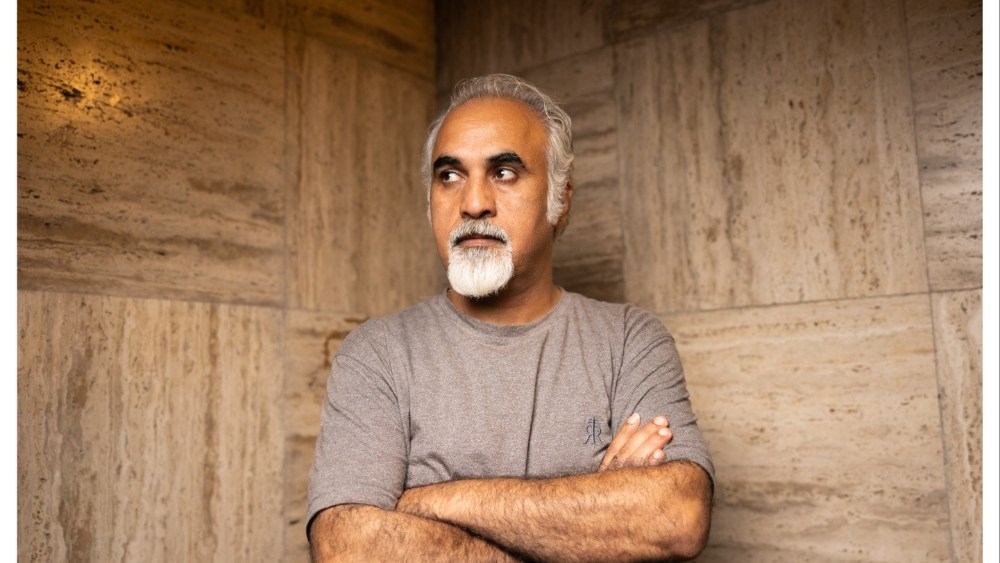
Iranian writer Nader Saiwar, who has been collaborating with Jafar Panahi since 2017, will soon appear in the Berlin-set drama Hijamat at the Karlovy Vary Film Festival. The drama features a man named Kalam as the main character. A secret love affair with a man shocks a devout Muslim family.
Director Saeivar, who won the Cannes Film Festival screenplay award for Panahi’s “3 Faces” in 2018, is best known for his work as a director in Iran’s underground film industry. In 2020, he made his directorial debut with “Namo,” which premiered in Berlin. His second full-length novel, No End, premiered in Busan. Director Saivar’s latest film, The Witness (2024), won the Audience Award at the Venice Film Festival.
Saavar spoke about his fourth film, the first to be shot outside Iran, which also stars German stars Kida Khodor Ramadan, Moritz Bleibtreu, and Nastassja Kinski, and why he chose to tackle the hot topic of homosexuality in the Islamic world.
I believe this is the first movie to be shot outside of Iran. How did that happen?
A production company in Berlin invited me to make a film. This was happening even before I shot my third film in Iran. So I decided that I didn’t want to make any more films about Iran or the Iranian issue. I said to myself, “Next time, I want to make a more personal film.” Because the films that we (Iranian directors) make in Iran are considered interesting because they are mainly related to Iranian society. So I decided to make a film that is a little removed from Iran’s social and political issues.
The title of your film, Hijamat, refers to the so-called wet cupping therapy. This treatment, which originates from traditional Iranian medicine, applies suction to the skin to draw out stagnant blood and toxins. Please talk about its significance in this story.
I wanted to show how people’s perspectives change and that that can be a good thing. This is also done by the practice (wet cupping), where it is necessary to remove the “dirty” blood under the skin on the back of the body. To free yourself from old and outdated perspectives and opinions, you need to do a kind of spiritual hijamat. Even in political struggles with the regime, I believe that the real solution is not just political change. First we have to change the dirty blood behind these people.
You are living in Berlin these days. Are you planning to return to Iran?
I didn’t choose Berlin, Berlin chose me. I came here about a year and a half ago and fell in love with this city. It influenced my outlook on life. Part of the sense of freedom felt in Hijamat may be related to living in this city.
Are you currently living in exile in Berlin?
I am not an exile, I came here to work. I can go back to Iran. But I know that if I go back, my passport will probably be confiscated and it won’t be easy to leave Iran again. Unfortunately, it is true that many Iranian filmmakers currently have to struggle with issues such as getting a passport, leaving the country, and having the freedom to make something. And only about 20% of their energy and time can be used to make a good movie. I spoke with Jafar Panahi yesterday. He said that since returning to Iran, he has been spending all his time going to court every day, meeting his lawyer and trying to get his passport back. He has no time left to do anything else.
Tell us about your collaboration with Jafar Panahi on this film.
Whenever I come up with a new idea, Jafar Panahi is the first person to talk about it. I talked to him about this idea and started writing the script right around the time the script for It Was Just an Accident was completed. I had to leave Iran in the middle of shooting that movie. But even when I was here in Berlin, we were rewriting parts of the script together from afar. When I was filming, Panahi left Iran for the Cannes Film Festival. After that, he was busy traveling for the Oscar campaign. But in between trips, I would come to Berlin whenever I could and we would work on editing together.
Please tell us about working with German-Lebanese actor Kida Khodor Ramadan.
He lives in Berlin and has always been very open and cooperative towards minorities living here, especially immigrants. There is a saying in Persian that if you want to conquer a village, you must first visit the village chief. If Kida wants the Arab or Turkish community (in Germany) to understand the issue, he will definitely be able to succeed more than any other actor. In addition to that, I was always impressed by his acting skills, depth of expression, and understanding of his role.
In the film, Hodur Ramadan plays Murad, who struggles with the fact that his younger brother is gay. This is the central conflict of the film in the context of Berlin’s Islamic world. Why did you feel it was important to address this issue in this particular context?
This film is about breaking down the walls that people have built around themselves, not only in the Muslim community but also in the Western world. In modern Islamic societies, these walls are associated with God, or religious beliefs. I wanted to address the heart of these walls, and homosexuality seemed the perfect issue to do so.
Did you make this film with the possibility that Iranian audiences could view it through the internet?
of course. I know they will see it. Having lived briefly in Germany, I can tell you that Iran is probably the most secular country in the world. In Iran, we see a kind of aversion to religion among the younger generation that we don’t see here (Berlin) yet. For many young people here in Europe, the church, or religion, is still very attractive.
No one has a crystal ball, but what are your hopes for Iran’s future?
There is a Persian proverb that more or less says, “When water flows, it finds its own way.” Iran’s young generation is like water. can’t stop them. What we are seeing is older generations seizing power by force. I wish America hadn’t attacked Iran. It is for the Iranian people themselves to reach the necessary and desired results. The results would definitely have come much sooner than they are now.

Provided by: German Film
